- Trending
- Comments
- Latest

WASHINGTON – The cease-fire between Washington and the crypto industry just ended.
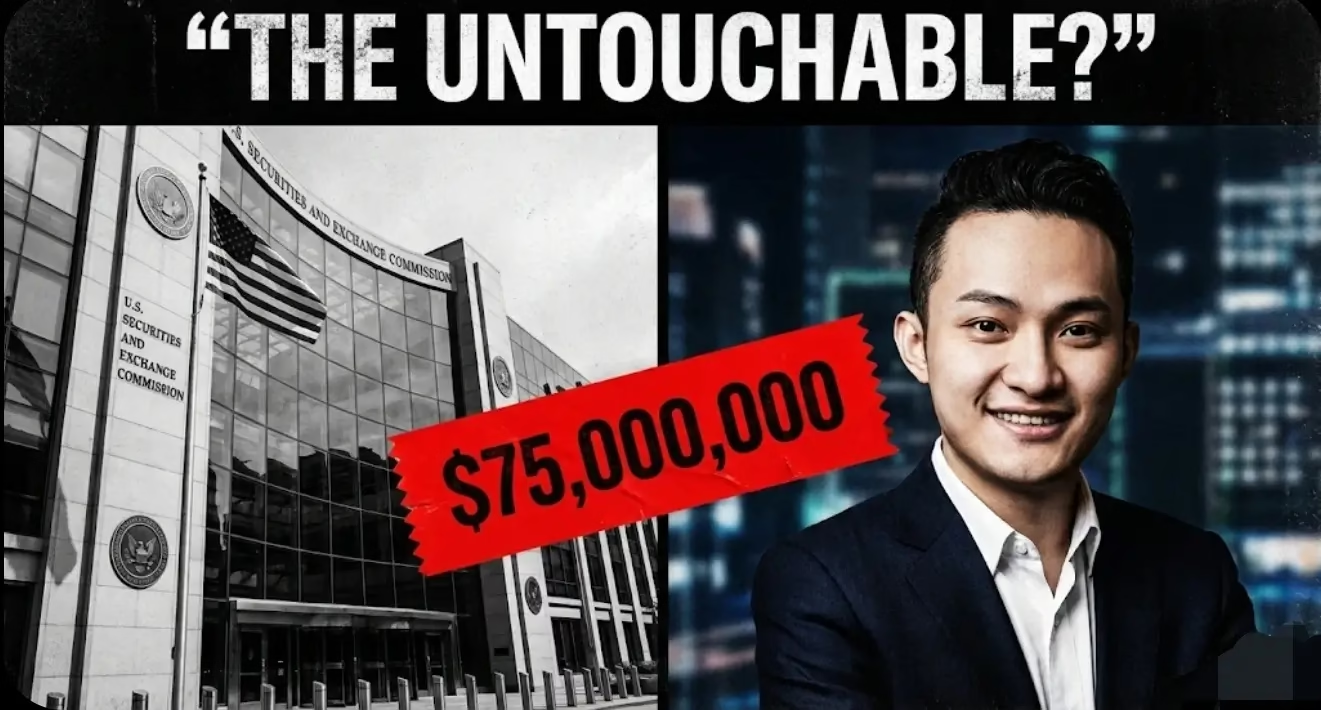
In a blistering letter released late Thursday, House Democrats formally accused the Securities and Exchange Commission (SEC) of operating a “pay-to-play” scheme, alleging that the agency deliberately paused its fraud case against crypto billionaire Justin Sun because of his financial ties to the President’s family.
The letter, signed by Ranking Member Maxine Waters (D-CA), Sean Casten (D-IL), and Brad Sherman (D-CA), demands an immediate explanation from SEC Chair Paul Atkins regarding why the agency’s litigation against Sun has been “frozen” for 11 months—a timeline that Democrats say aligns perfectly with Sun’s massive investment in World Liberty Financial (WLFI).
The allegation is explosive: Did one of crypto’s most controversial figures buy his way out of federal prosecution?
The core of the allegation is devastatingly simple: Did Justin Sun buy his way out of a lawsuit?
According to the letter, Justin Sun became the largest investor in World Liberty Financial, a decentralized finance project launched in 2024 that lists Donald Trump Jr., Eric Trump, and Barron Trump among its leadership team, with the President himself holding a promotional role—in late 2024 and early 2025, purchasing over $75 million worth of tokens.
Shortly after that investment was finalized (and following the change in administration in early 2025), the SEC’s enforcement division requested a “stay” (pause) in its active fraud and securities violations case against Sun and the Tron Foundation. That stay was granted in February 2025 and has remained in effect for 11 months, spanning nearly the entire duration of the new administration.
“The SEC’s request to stay the Sun case… signals to the market that securities laws are enforced selectively, and that those with sufficient political influence can evade accountability.” Rep. Maxine Waters, House Financial Services Committee
The lawmakers didn’t mince words. They explicitly described the sequence of events as creating an “unmistakable inference of a pay-to-play scheme.”
The sequence of events is what has Democrats crying foul:
As Rep. Sean Casten noted in the letter: “The appearance of impropriety is overwhelming.”
While the SEC occasionally pauses enforcement actions during settlement negotiations or administrative transitions, an 11-month freeze without public explanation is highly unusual for a case of this magnitude—particularly one involving allegations of securities fraud and market manipulation affecting retail investors.
Why this matters
If the allegations are true, this would represent the first documented case of a crypto executive using investments in a presidential family business to influence federal enforcement. It could establish a precedent that fundamentally changes how digital assets are regulated—or not regulated—in the United States.
If the corruption allegations weren’t enough to rattle the markets, the letter also opened a new front: National Security.
The lawmakers slammed the SEC for ignoring Sun’s alleged ties to the People’s Republic of China (PRC). The letter references Sun’s previously reported involvement with research programs affiliated with China’s Central Party School—the training ground for Chinese Communist Party officials—and raises questions about whether his continued control over the Tron network presents a national security risk.
This isn’t an academic concern. Tron currently processes the majority of global USDT (Tether) transaction volume, making it critical infrastructure for dollar-pegged stablecoin flows worldwide. Democrats argue that by pausing the case, the SEC isn’t just failing investors; it is potentially exposing the U.S. financial system to what they describe as a “plausible vector” for foreign influence.
Translation: If Justin Sun has ties to Beijing, and Tron controls the pipes for billions in daily stablecoin transfers, who is really in control?
The impact was immediate—and predictable.
For institutional investors, the message was clear: regulatory immunity might not be permanent.
Justin Sun has not publicly commented on the Congressional letter as of publication.
In previous statements regarding the SEC case, Sun has maintained that Tron operates in full compliance with applicable regulations and that the agency’s allegations are “without merit and politically motivated.” He has characterized the enforcement action as part of a broader “witch hunt” against innovative blockchain projects.
World Liberty Financial similarly declined to comment on the investment timing or the lawmakers’ allegations when contacted by The Bit Gazette.
The silence is notable. Sun, normally prolific on social media and quick to defend his projects, has offered no response to what may be the most serious allegation leveled against him to date.
The letter is not just a press release; it is a procedural weapon.
The lawmakers have issued a formal document preservation request, ordering the SEC to retain all communications related to the decision to pause the Sun litigation—including any emails, text messages, or calls from “third parties” such as lobbyists, administration officials, or representatives of World Liberty Financial attempting to influence the outcome.
Chair Paul Atkins has until January 30 to respond.
If Atkins fails to provide a satisfactory explanation, Democrats have signaled they are prepared to escalate. Potential next steps include:
The January 30 deadline also creates a ticking clock for crypto markets. If the SEC is forced to restart the Sun case under Congressional pressure, TRX could face further downside, and the broader narrative around “Trump-era crypto favoritism” could dominate headlines through Q1 2026.
This scandal may be about more than Justin Sun.
If the “pay-to-play” allegations stick, they could fundamentally reshape how crypto companies approach Washington. The implicit message: Access to power now has a price tag—and that price tag might include strategic investments in family businesses.
Already, analysts are speculating about which other crypto executives may have made similar calculations:
The Waters letter pulls back the curtain on a question the crypto industry has whispered about for months but never dared to ask out loud: Is the fix in?
For 11 months, Justin Sun has operated in a regulatory gray zone—investing in presidential ventures while his fraud case gathered dust at the SEC.
Now, with three members of Congress formally alleging corruption, a document preservation order in effect, and markets pricing in the possibility of renewed enforcement, the question is no longer whether the SEC will restart its case.
It’s whether anyone will face consequences for stopping it in the first place.
The January 30 deadline is coming. The documents are being preserved. And the crypto industry is about to find out whether the rules apply equally—or only to those who can’t afford a $75 million insurance policy.
This is a developing story. Updates to follow as the SEC responds to Congressional demands.



Copyright © 2025 - The Bit Gazette.