



- Trending
- Comments
- Latest

Australia’s corporate regulator has scored a major enforcement victory after the Federal Court ordered financial services firm BPS Financial Pty Ltd to pay 14 million Australian dollars ($9.3 million) in penalties over its promotion and operation of the Qoin Wallet.
The ruling concludes a multi-year legal battle between BPS Financial and the Australian Securities and Investments Commission (ASIC), which accused the company of running an unlicensed financial services business while making misleading claims about a crypto-linked payment product marketed to consumers and merchants.
According to the court, the Qoin Wallet was promoted as a non-cash payment facility connected to the company’s proprietary Qoin digital token, but was issued and operated without the appropriate regulatory approvals.
In a decision handed down this week, the Federal Court found that between January 2020 and mid-2023, BPS Financial issued the Qoin Wallet and provided financial product advice without holding an Australian Financial Services Licence, in breach of the Corporations Act.
ASIC said the company also made false and misleading representations about the product’s regulatory status, functionality, and market acceptance, creating a distorted picture of the risks involved.

“Given the nature of these products, providers must have the appropriate licenses and authorisations, and investors must be able to make decisions based on clear and correct statements,” ASIC Chair Joe Longo said in a statement. “This is especially important where crypto products are volatile, complex and inherently risky.”
The penalty imposed on BPS Financial includes $1.3 million for unlicensed conduct and $8 million for misleading and deceptive representations connected to the Qoin Wallet.
In her judgment, Justice Downes described the conduct as “serious and unlawful,” pointing to the involvement of senior management and a lack of adequate compliance systems within the business.
Beyond the financial sanctions, the court barred BPS Financial from operating a financial services business without a license for the next 10 years. The company was also ordered to display court-mandated notices on its app and website warning users about the findings related to the Qoin Wallet, and to cover the bulk of ASIC’s legal costs.
ASIC first launched civil penalty proceedings against BPS Financial in 2022, alleging that claims made about the Qoin Wallet were inaccurate and deceptive.
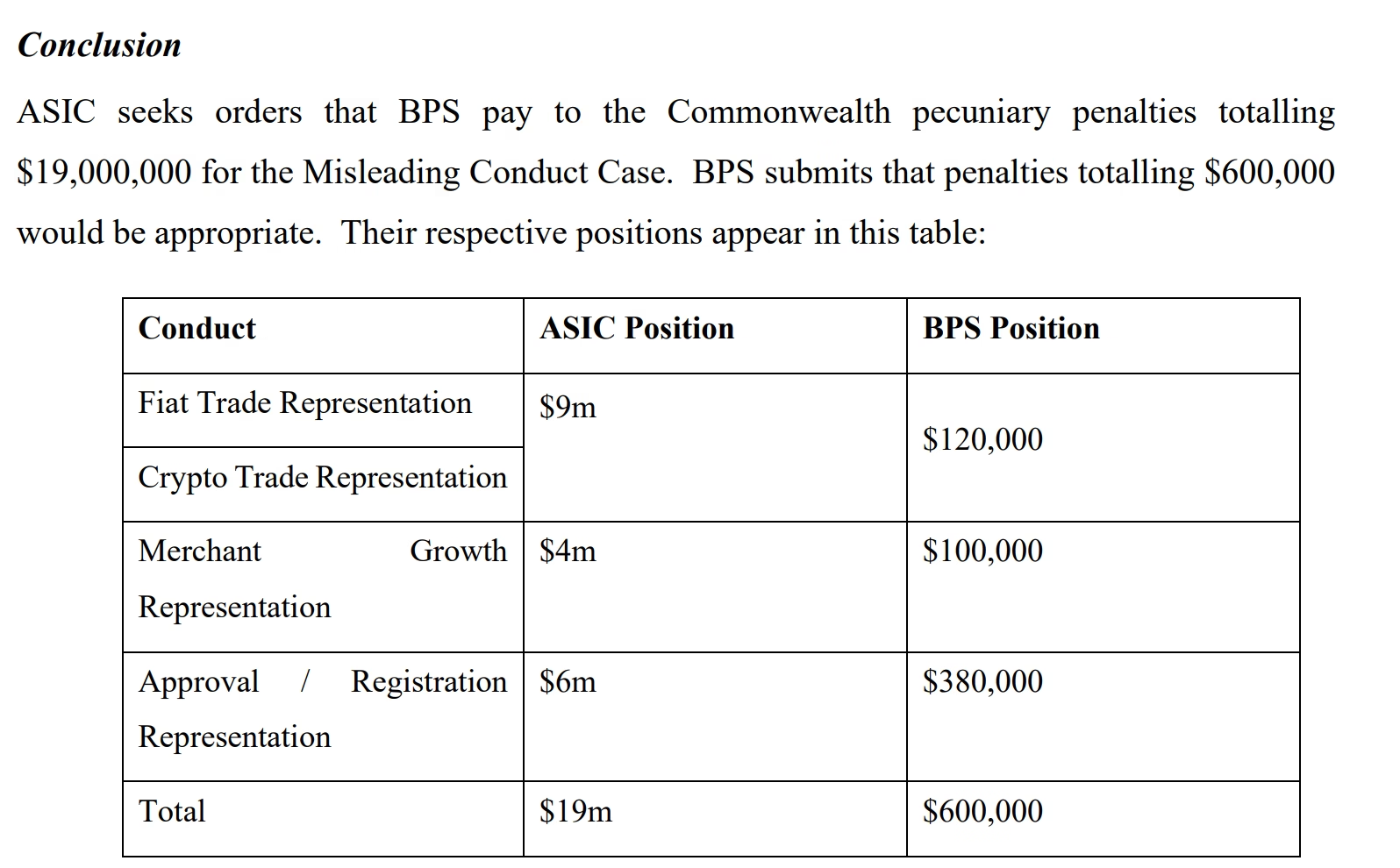
In earlier judgments delivered in 2024 — later upheld on appeal in 2025 — the court ruled that BPS misled users by suggesting the product was officially approved or registered, that Qoin tokens could be easily exchanged for fiat currency or other crypto-assets, and that the token enjoyed widespread merchant adoption.
Those findings laid the groundwork for the substantial penalties confirmed in the latest ruling.
The case sends a clear message to crypto and fintech companies operating in Australia that regulatory obligations apply regardless of how products are branded or marketed.
ASIC said the Qoin Wallet proceedings demonstrate its willingness to pursue enforcement action where firms blur the line between technology platforms and regulated financial services.
“This outcome reflects our commitment to protecting consumers and maintaining market integrity,” Longo said, adding that businesses dealing in digital assets must not misrepresent regulatory status or functionality.
While ASIC has taken a firm stance in the Qoin Wallet case, the regulator has also moved to modernise aspects of Australia’s digital asset framework.
In December, ASIC finalised targeted exemptions designed to simplify the distribution of stablecoins and wrapped tokens. The changes allow intermediaries to use omnibus accounts with strict record-keeping requirements, reducing the need for multiple Australian Financial Services Licences in certain circumstances.
The relief aims to lower compliance costs for legitimate operators while maintaining safeguards for consumers.
In a separate report titled Key Issues Outlook 2026, Longo identified regulatory gaps in digital assets and fintech as one of the major challenges facing the financial system.
He also highlighted growing retail exposure to opaque private credit markets, operational failures in superannuation, high-risk investment sales, and potential consumer harm linked to artificial intelligence.

Cases like the Qoin Wallet enforcement action, ASIC says, underline the importance of clear rules and firm supervision as innovation accelerates.
For industry observers, the outcome reinforces that crypto-linked payment products will be treated as financial services where they meet the legal definition — regardless of whether they are marketed as alternatives to traditional money.
The Qoin Wallet ruling is likely to influence how other token-based payment platforms structure their offerings and disclosures in Australia.
As regulators globally increase scrutiny of digital asset products, the message from the Federal Court is clear: innovation does not excuse non-compliance.
With $9.3 million in penalties, decade-long restrictions, and mandatory public warnings now in place, the Qoin Wallet case stands as one of Australia’s most significant crypto enforcement actions to date, and a cautionary tale for the wider industry.



Copyright © 2025 - The Bit Gazette.