


- Trending
- Comments
- Latest

Ethereum’s stablecoin market recorded its first major contraction of the current cycle, with approximately $7 billion exiting ERC-20 stablecoin supply during the week ending January 26, 2026—a decline analysts interpret as investors leaving crypto markets entirely rather than rotating into other assets.
According to Darkfrost, the market capitalization of ERC-20 stablecoins issued on Ethereum fell by approximately $7 billion over the past week, ending a prolonged period of stability and gradual growth.
“During the latter half of 2025, stablecoin supply consistently increased, reflecting sustained inflows into the crypto ecosystem,” the analyst wrote in a post on X. “This recent move breaks that structure.”
Stablecoins are digital assets typically pegged to fiat currencies, most commonly the U.S. dollar. They are widely used by traders and institutions as a volatility buffer and as dry powder for deploying capital into Bitcoin, Ether, and other cryptocurrencies.
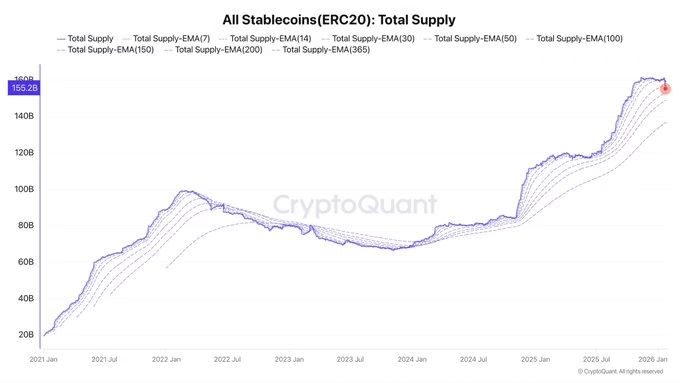
Historically, rising ERC-20 stablecoins supply has coincided with bullish conditions, as capital enters the ecosystem and waits for risk-on opportunities. Conversely, stagnation or decline has often preceded broader market slowdowns.
Darkfrost’s data shows that when Bitcoin and other major cryptocurrencies turned bearish earlier this year, ERC-20 stablecoins did not immediately decline. Instead, supply flattened — signaling that capital was pausing rather than exiting.
The recent drop represents the first decisive move lower in stablecoin market capitalization in years, ending what analysts described as a prolonged sideways consolidation phase.
“This is the first rapid contraction of ERC-20 stablecoins during the current cycle,” Darkfrost noted, calling it a “negative signal” for near-term crypto market momentum.
Bitcoin prices declined alongside the drop in stablecoin supply, reinforcing concerns that liquidity is thinning across the market. Although Bitcoin has staged a partial recovery from Sunday’s lows, analysts caution that price action alone may not tell the full story.
“When stablecoin supply falls alongside price, it suggests capital is leaving the system rather than rotating,” said Ki Young Ju, CEO of CryptoQuant, in previous commentary on stablecoin flows. “That’s generally more bearish than consolidation.”

The contraction in ERC-20 stablecoins also coincides with renewed strength in traditional markets. U.S. equities have remained resilient, while gold and other precious metals have posted gains — signaling renewed appetite for perceived safe-haven assets outside crypto.
Darkfrost suggested that the decline in ERC-20 stablecoins points to a shift in investor behavior. Rather than moving funds from volatile tokens into stablecoins — a common defensive strategy — some market participants may be cashing out entirely.
“This suggests capital is not just rotating within crypto,” the analyst wrote. “It’s leaving the market.”
That interpretation aligns with broader macro trends. Expectations for interest rate cuts have softened, while real yields remain attractive in traditional markets, reducing the relative appeal of holding idle capital in stablecoins.
Ethereum remains the dominant settlement layer for ERC-20 stablecoins, hosting the majority of supply from major issuers such as USDT, USDC, and DAI. As a result, changes in Ethereum-based stablecoin metrics are closely watched as a barometer of overall crypto liquidity.
“A contraction in ERC-20 stablecoins is effectively a contraction in on-chain dollar liquidity,” said Noelle Acheson, former head of market insights at Genesis. “That has implications for leverage, trading volumes, and risk appetite.”

While stablecoins also circulate on other blockchains, Ethereum’s role as the primary hub means declines there often ripple across the broader ecosystem.
Despite the sharp weekly drop, analysts caution against interpreting the move as a market capitulation. Total stablecoin supply remains historically elevated, and Bitcoin has recovered some recent losses.
Still, the shift in ERC-20 stablecoins supply marks a notable change in market structure.
“This isn’t panic,” Acheson said. “But it is a warning that liquidity conditions are tightening.”
Whether the decline continues will likely depend on macroeconomic signals, Bitcoin’s ability to hold support levels, and whether capital finds renewed reasons to re-enter digital asset markets.
For now, the first major drawdown in ERC-20 stablecoins supply of this cycle serves as a reminder that crypto liquidity can reverse quickly — and when it does, markets tend to feel it.



Copyright © 2025 - The Bit Gazette.