

- Trending
- Comments
- Latest

US Commodity Futures Trading Commission Chairman Michael Selig has ordered the agency to draft formal regulations for prediction markets, withdrawing proposed bans on political and sports betting contracts in his first major policy move since taking office.
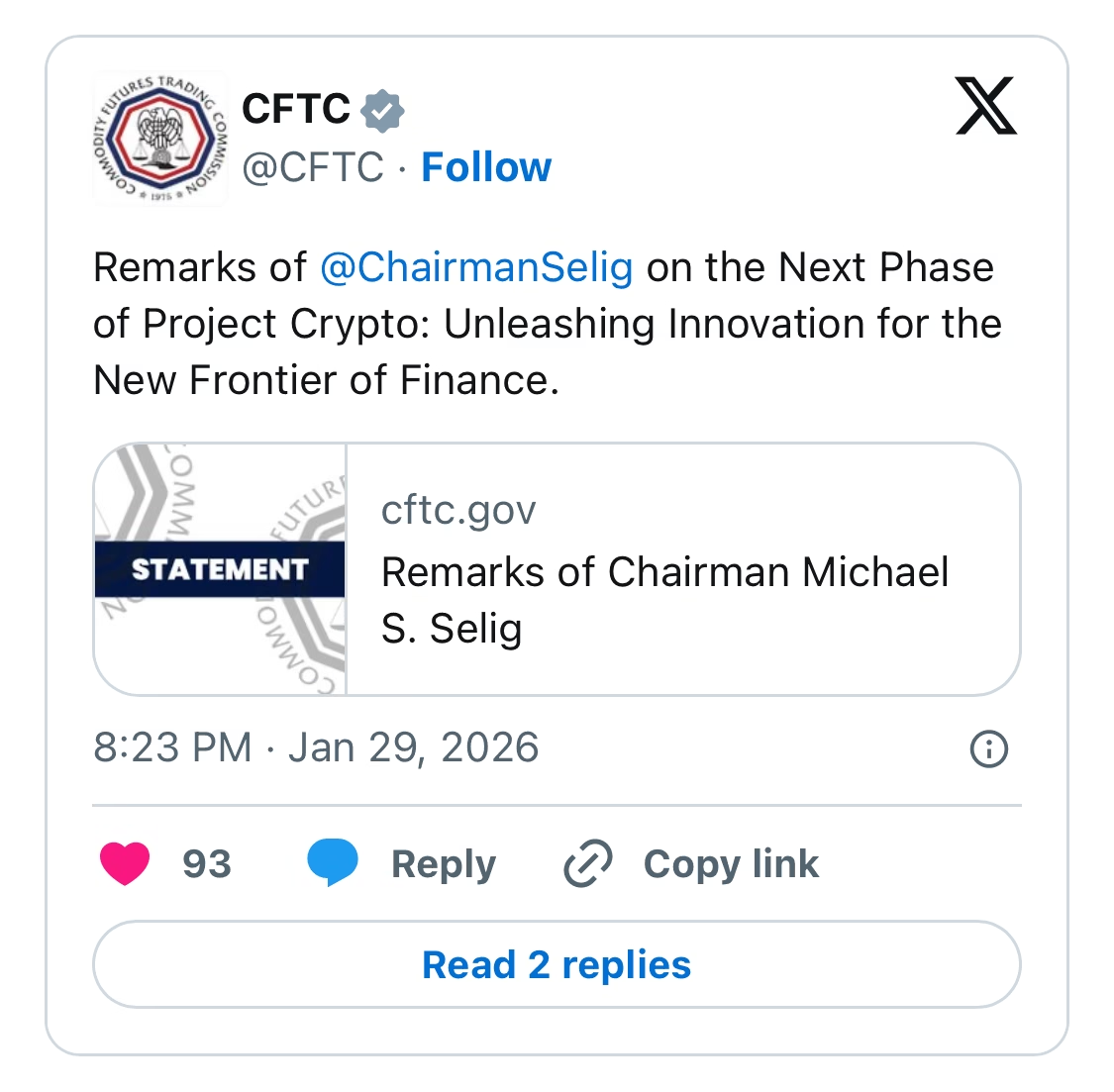
The move was confirmed on Thursday by CFTC Chairman Michael Selig during his first public remarks since assuming the role.
Selig said prediction markets regulation will be a near-term priority for the agency as trading volumes on platforms such as Polymarket and Kalshi surge into the billions.
According to Selig, the CFTC intends to establish clearer and more consistent standards for event contracts which is a product category the agency has overseen for more than two decades while allowing lawful innovation to continue within defined regulatory boundaries.
“It is time for clear rules and a clear understanding that the CFTC supports lawful innovation in these markets,” Selig said.
The renewed push on prediction markets regulation comes as event-based trading platforms expand rapidly across politics, economics, and popular culture.
Once considered niche products, prediction markets now attract global participation from traders seeking real-time exposure to headline-driven outcomes.
Polymarket has emerged as a leading venue, particularly for political contracts, with individual markets sometimes generating tens or hundreds of millions of dollars in trading volume.
The platform’s growth has intensified regulatory scrutiny as crypto-native infrastructure increasingly blurs the lines between derivatives trading, gaming, and financial speculation.
Selig framed prediction markets regulation as part of a broader effort to modernize market oversight, positioning the CFTC as a regulator capable of adapting to evolving financial instruments without stifling competition.
“Today marks the beginning of a new chapter for the CFTC,” Selig said.
He added that regulatory clarity, inter-agency coordination, and what he described as “permissionless innovation” within the bounds of US law will guide the agency’s approach to prediction markets regulation.
A central pillar of the new prediction markets regulation agenda is the development of a formal rulemaking process for event contracts.
Selig said the current framework has proven difficult to apply consistently, leaving platforms and traders exposed to regulatory uncertainty.
As an initial step, Selig said he has directed CFTC staff to withdraw a 2024 proposed rule that would have prohibited political and sports-related event contracts.
He also ordered the withdrawal of a 2025 staff advisory that warned registered entities against offering sports-related event contracts while related litigation was ongoing.
“Second, looking ahead, and in the spirit of markets that trade on expectations, I have directed CFTC staff to move forward with drafting an event contracts rulemaking,” Selig said.
Clearer prediction markets regulation, he argued, is necessary to determine which contracts fall under CFTC jurisdiction, how they should be structured, and what safeguards are required to protect market integrity.
Selig also emphasized the importance of inter-agency coordination in shaping the future of prediction markets regulation, particularly as distinctions between commodities, securities, and digital assets continue to blur.
He confirmed that the CFTC is working with the Securities and Exchange Commission through an initiative known as Project Crypto, aimed at clarifying jurisdictional boundaries and developing a more coherent taxonomy for digital financial products.
“And thanks to the leadership of President Trump, ‘Operation Chokepoint 2.0’ is history, regulation by enforcement is dead, the GENIUS Act is law, Congress is on the cusp of passing market structure legislation, and the U.S. is now the crypto capital of the world,” Selig said.
As part of this effort, the CFTC will reassess its participation in pending court cases related to event contracts and work toward joint interpretations with the SEC under Title VII of the Dodd-Frank Act.
The objective is to clarify distinctions between commodity options, swaps regulated by the CFTC, and security-based swaps overseen by the SEC.
State-level gaming regulators have raised concerns about the expansion of event-based trading, but Selig signaled that prediction markets regulation must evolve to reflect the growing role these instruments play in modern financial markets.
For policymakers, the coming rulebook will test whether Washington can balance innovation with oversight.
For traders and platforms, the direction of prediction markets regulation may determine whether these markets continue to grow onshore under clear federal rules or face renewed legal and regulatory friction.



Copyright © 2025 - The Bit Gazette.