


- Trending
- Comments
- Latest

Spot Bitcoin exchange-traded funds recorded $562 million in inflows on Monday, snapping a four-day outflow streak that saw $1.5 billion exit the products last week.
The reversal came as BTC prices rebounded from weekend lows below $75,000 to trade above $79,000, though analysts caution that institutional selling pressure and macroeconomic uncertainty could limit further gains.
“The latest Bitcoin ETF inflow is significant as it shows renewed investor interest after last week’s liquidation wave,” said James Butterfill, Head of Research at CoinShares. “However, structural pressures in the market, combined with macro uncertainties, mean caution is still warranted.”
The renewed Bitcoin ETF inflow coincided with a sharp recovery in BTC prices. Bitcoin briefly fell below $75,000 over the weekend before surging to an intraday high above $79,000 on Monday, according to CoinGecko.
Analysts note that ETF inflows are highly sensitive to short-term BTC price fluctuations. Alex Thorn, Head of Research at Galaxy Digital, explained:
“BTC is currently trading roughly 7.3% below the average ETF create cost basis of $84,000, though it dipped as much as 10% below that level on Saturday. Historically, this cost basis serves as a near-term support zone for inflows.”

Thorn added that Bitcoin’s realized price, around $56,000, often acts as another underlying support level for long-term investors, suggesting that inflows may stabilize if prices approach these benchmarks.
While Bitcoin ETFs attracted $562 million on Monday, Ether ETFs failed to record any inflows, posting minor outflows of $2.9 million. Analysts interpret this divergence as a sign that investors continue to favor Bitcoin as the primary hedge amid ongoing volatility.
“The Bitcoin ETF inflow highlights investor confidence in BTC’s role as a store of value, even as broader crypto assets remain under pressure,” Butterfill said. “Ether ETFs, by contrast, continue to see outflows as traders prioritize liquidity and risk management.”
Despite Monday’s inflow, the market faces persistent challenges. Large-scale institutional selling, uncertainty surrounding U.S. monetary policy, and global geopolitical tensions continue to weigh on ETFs and digital assets.
Butterfill emphasized: “Unfavorable capital flows, Bitcoin’s decoupling from money supply trends, and geopolitical uncertainty are likely to limit further inflows in the short term. That said, structural factors such as concerns about currency depreciation suggest potential for future catch-up inflows.”
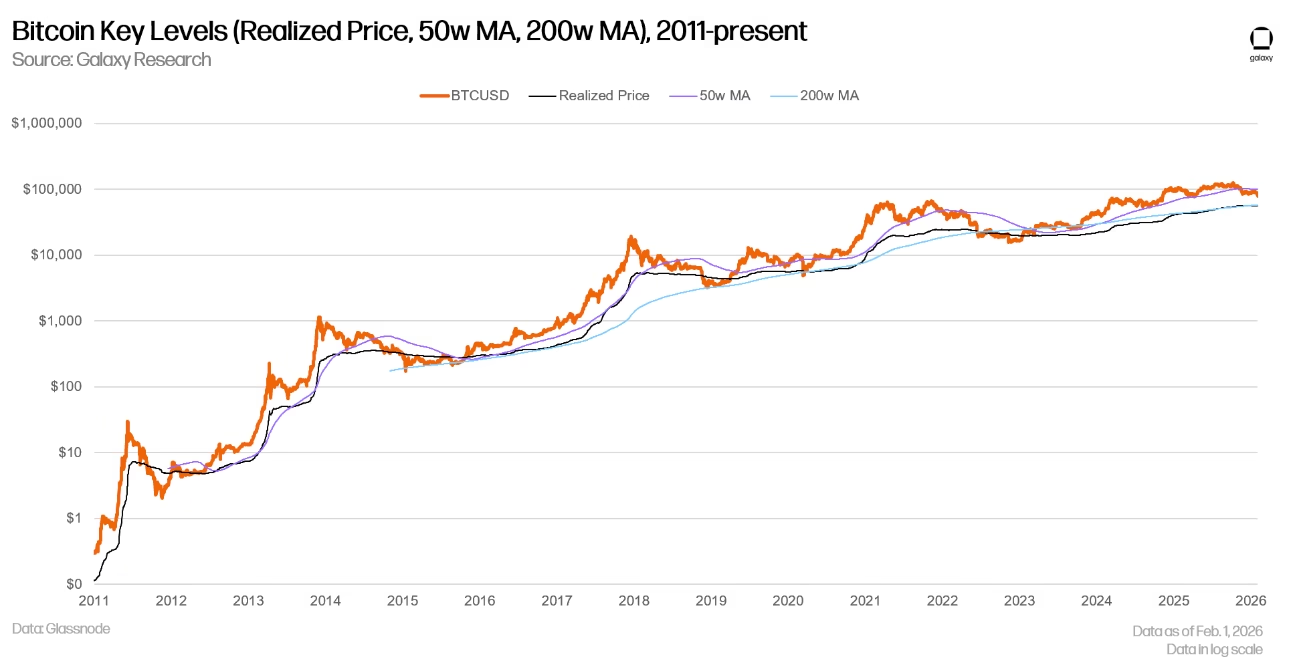
Galaxy Digital’s Thorn added that previous ETF inflows have historically aligned with BTC’s cost basis, and Monday’s $562 million inflow is consistent with investors taking advantage of short-term dips to add exposure.
So far this year, Bitcoin ETFs have experienced $1 billion in net outflows, highlighting how volatile investor appetite remains. CoinShares recently reported that crypto exchange-traded products lost another $1.7 billion last week, doubling outflows compared to the prior week.
“Even with the fresh Bitcoin ETF inflow, the market’s overall direction remains cautious,” Thorn said. “ETF flows tend to be cyclical, and while inflows indicate renewed interest, sustained gains depend on broader liquidity trends and macro stability.”
Market watchers note that the latest inflows, while meaningful, are still relatively modest compared to cumulative outflows over the past month. Analysts warn that any extended rally in ETF inflows will likely require either stronger BTC price momentum or a more stable macroeconomic environment.
Despite headwinds, the $562 million Bitcoin ETF inflow offers some optimism for institutional and retail investors alike. The data suggest that investors are still willing to increase exposure to BTC during temporary dips, even as Ether and other digital assets remain under selling pressure.
“The Bitcoin ETF inflow is an important gauge of market sentiment,” Butterfill said. “Even amid macro challenges, investors are selectively adding to positions, indicating confidence in BTC’s long-term fundamentals.”
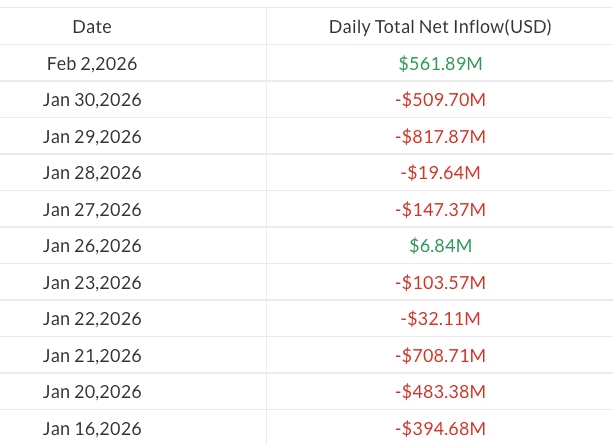
Thorn echoed the sentiment, noting that ETF inflows historically serve as a bellwether for broader institutional confidence:
“When inflows return, even modestly, it reflects a willingness among investors to accumulate at levels near ETF cost basis. It’s a key signal for near-term support.”
Monday’s Bitcoin ETF inflow of $562 million partially offsets recent heavy outflows, illustrating the cyclical nature of crypto investment and the cautious optimism among institutional participants.
While macroeconomic uncertainties and institutional selling continue to pressure the market, inflows suggest that investors remain willing to add BTC exposure at key support levels.
As analysts watch ETF flows closely, the near-term outlook may remain volatile. Yet the return of inflows, even in a challenging environment, underscores that Bitcoin ETFs continue to serve as a primary channel for institutional capital into digital assets.



Copyright © 2025 - The Bit Gazette.