




- Trending
- Comments
- Latest

Tether has significantly scaled back capital-raising ambitions that would have valued the stablecoin issuer at up to $500 billion, according to a Financial Times report, as investors pushed back on the lofty price tag amid regulatory uncertainty and transparency concerns.
The company behind USDT, the world’s largest stablecoin with $185 billion in circulation, had explored raising $15 billion to $20 billion but is now considering a smaller $5 billion round—or no fundraising at all—casting fresh doubt on long-rumored plans for a public listing.
According to a report by the Financial Times, Tether had initially explored raising between $15 billion and $20 billion at a valuation that would have placed it among the most valuable private companies in the world. That valuation would have rivaled global heavyweights such as SpaceX, OpenAI, and ByteDance.
However, sources familiar with the talks said investor enthusiasm quickly cooled. Backers reportedly balked at the lofty valuation, citing regulatory uncertainty, lingering transparency concerns around reserves, and historical allegations related to illicit use of USDT.
This investor resistance forced a rethink of Tether ipo fundraising, with discussions now centered around a much smaller $5 billion raise—or none at all. The shift reflects a broader recalibration across crypto markets, where investors are increasingly unwilling to underwrite sky-high valuations without clearer regulatory and governance frameworks.
Interest in a possible public listing gained traction in September 2025 when BitMEX co-founder Arthur Hayes reignited speculation, suggesting that a Tether IPO could dwarf Circle’s earlier public debut.
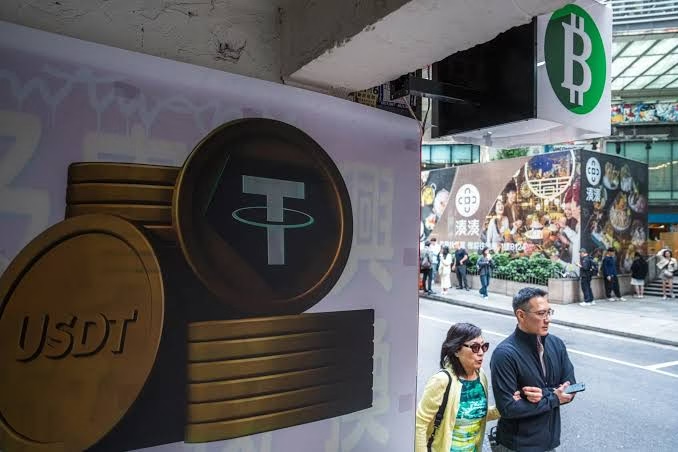
At the time, Hayes argued that Tether’s scale—anchored by more than $185 billion in circulating USDT—and its highly profitable business model gave it a structural advantage over rivals. His comments amplified chatter around Tether ipo fundraising, pushing expectations toward a blockbuster listing.
Yet market reality has proven less forgiving. While Tether dominates stablecoin issuance, investors appear less willing to price the firm like a tech unicorn amid heightened regulatory oversight of stablecoins globally.
Despite the fundraising pullback, Tether’s financial position remains strong. The company reported approximately $10 billion in profits for 2025, down around 23% year-on-year due to Bitcoin price weakness, but partially offset by gains on gold holdings and interest income from U.S. Treasurys.
That profitability reduces the operational necessity of Tether ipo fundraising, reinforcing management’s long-held position that the firm does not need outside capital to function.
Paolo Ardoino, Tether’s CEO, pushed back against claims that the company was actively seeking a massive raise.
“That number is not our goal. It’s our maximum,” Ardoino said, according to the report. “If we were selling zero, we would be very happy as well.”
The statement highlights that any fundraising effort is more strategic than financial—aimed at partnerships or credibility rather than survival.
Still, caution around Tether ipo fundraising has been reinforced by a recent assessment from S&P Global Ratings, which flagged growing exposure to higher-risk assets within Tether’s reserves.
According to Reuters, S&P noted increased allocations to Bitcoin, gold, corporate bonds, secured loans, and other investments that carry market and credit risk, while also pointing to limited disclosures around custodians and counterparties.
“Tether continues to provide limited information on the creditworthiness of its custodians, counterparties, or bank account providers,” S&P said, highlighting factors that could concern public-market investors.
The assessment does not threaten Tether’s dominance but adds another layer of scrutiny at a time when stablecoin issuers are under intensifying regulatory pressure worldwide.
The retreat from aggressive Tether ipo fundraising timelines has inevitably reshaped expectations around a public listing. While an IPO no longer appears imminent, it has not been ruled out.
Recent developments could still pave the way. U.S. stablecoin legislation under President Donald Trump, along with Tether’s rollout of a U.S.-compliant stablecoin product, may help the firm address regulatory hurdles that previously made a listing unlikely.
If market conditions improve and transparency standards evolve, analysts say a 2026 IPO remains possible—though likely at a valuation far below earlier speculation.
Beyond Tether itself, the fundraising retreat sends a broader signal to the crypto industry. Even the most profitable and systemically important firms are no longer immune to valuation discipline.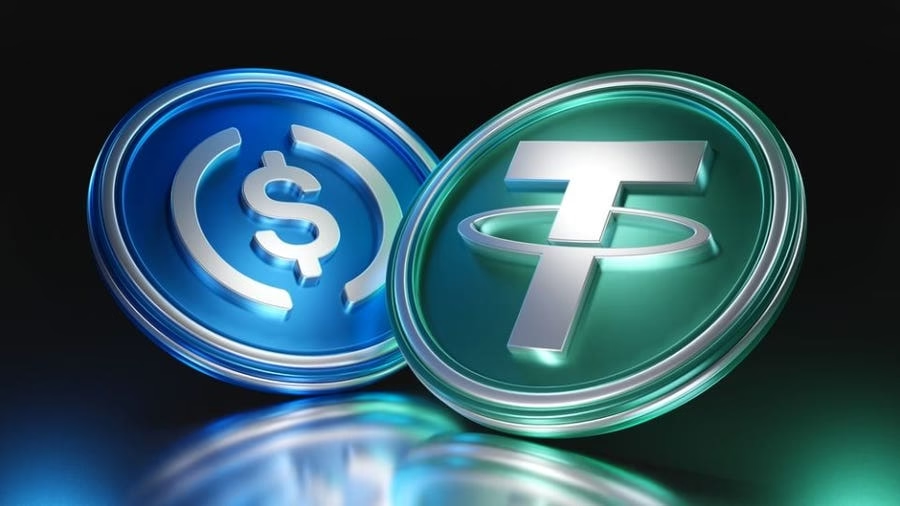 As the issuer of crypto’s de facto reserve currency, Tether’s approach to Tether ipo fundraising reflects a growing emphasis on sustainability, disclosure, and profitability over hype-driven narratives.
For other crypto firms eyeing public markets, the message is clear: strong fundamentals matter more than headline valuations.
Ardoino has previously stated that Tether does not need to go public—and the latest developments reinforce that stance. Still, he has stopped short of closing the door entirely.
For now, Tether ipo fundraising appears to be an option rather than a necessity. Whether it ultimately leads to a public listing will depend less on speculation and more on regulatory clarity, market stability, and investor trust.



Copyright © 2025 - The Bit Gazette.