

- Trending
- Comments
- Latest

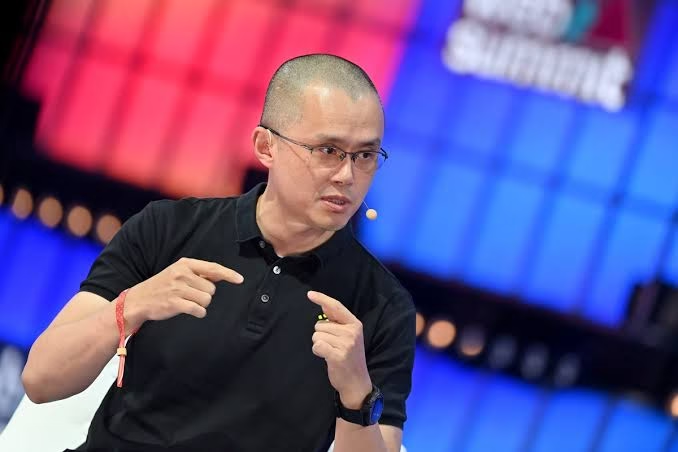
Binance founder Changpeng Zhao has issued a fresh warning to the crypto community after uncovering what he described as a sophisticated Ai impersonation scam using deepfake images of himself on social media.
In a post shared on X, Zhao—widely known as CZ—revealed that scammers are deploying artificial intelligence to fabricate images that falsely depict him alongside other individuals, creating the illusion of legitimacy. The Ai impersonation scam is designed to lure unsuspecting users into trusting fraudulent accounts that appear connected to the Binance founder.
According to Zhao, the operation involves impersonators presenting themselves as people “close to him,” using AI-generated visuals to support their claims. One such account, which Zhao highlighted publicly, reportedly boasts over 863,000 followers, underscoring how large audiences can be exposed to a single Ai impersonation scam if left unchecked.
Zhao explained that the scam account uses a real photograph from a BNB Chain event held in Korea as its profile banner. While the original image is authentic, scammers have allegedly manipulated it using AI tools to generate additional fake images that appear to show Zhao posing with various individuals.
This blending of real and fabricated content is a hallmark of modern Ai impersonation scam tactics, making detection increasingly difficult for everyday users. By anchoring fake visuals to legitimate events, scammers can blur the line between reality and fiction.

“The photos look real at first glance,” Zhao implied in his post, “but they are not.”
To help users protect themselves, Zhao outlined several visual inconsistencies that may indicate an Ai impersonation scam. One of the most obvious, he said, is clothing.
“I do not wear blue or purple,” Zhao noted, adding that these colors frequently appear in the fake images. He also highlighted irregular image quality—where faces or bodies appear at different resolutions within the same photo—another common sign of AI-generated content.
Experts in digital forensics have echoed this concern. Hany Farid, a professor at the University of California, Berkeley, and a leading authority on digital manipulation, has previously warned that generative AI tools can now create highly convincing forgeries.
“We are entering an era where seeing is no longer believing,” Farid said in earlier commentary on deepfakes, a reality that makes the Ai impersonation scam threat particularly dangerous in financial communities.
Zhao also suggested that some of the fake visuals may have been derived from a genuine photograph of him alongside Leonard Aster, CEO of Aster. By using real reference material, scammers can generate believable composites that pass casual inspection.

This technique—known as image seeding—is increasingly common in Ai impersonation scam operations, according to cybersecurity analysts. It allows bad actors to create entire libraries of fake content from a single authentic image.
The warning comes amid a broader rise in AI-driven fraud across the crypto industry. Blockchain analytics firm Chainalysis has reported that social engineering scams, including impersonation schemes, remain one of the leading causes of user losses in digital assets.
While Chainalysis did not comment directly on Zhao’s case, the firm has previously stated that AI tools are “significantly lowering the barrier to entry for sophisticated fraud.” That assessment aligns with the growing prevalence of the Ai impersonation scam Zhao described.
Binance itself has repeatedly cautioned users to verify accounts, avoid unsolicited messages, and rely only on official communication channels.
In his post, Zhao urged the crypto community to stay alert and question accounts that claim personal connections to him or other high-profile figures. Verification, he stressed, remains the strongest defense against an Ai impersonation scam.
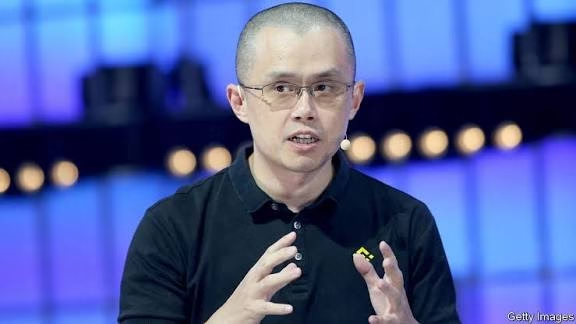
He also reaffirmed that Binance and its leadership do not solicit investments, payments, or private conversations through direct messages on social media.
The Binance founder added that while the company welcomes honest and constructive feedback, users should be wary of accounts using emotional appeals, urgency, or exclusivity—classic hallmarks of impersonation fraud.
Zhao’s alert serves as a reminder that reputation alone is no longer a reliable shield against fraud. As AI tools become more accessible, even the most recognizable figures in crypto can be weaponized in an Ai impersonation scam.
For users, the takeaway is clear: double-check identities, scrutinize images, and resist pressure to act quickly. For platforms, the incident renews calls for stronger detection tools and faster response mechanisms to curb AI-driven deception.
As Zhao’s warning makes plain, the next phase of crypto security will not be fought solely on-chain, but in the battle against manipulated images, synthetic identities, and the rapidly evolving Ai impersonation scam threat.



Copyright © 2025 - The Bit Gazette.