

- Trending
- Comments
- Latest

A Taiwanese national who operated one of the world’s largest darknet drug marketplaces has been sentenced to 30 years in federal prison after the platform facilitated more than $105 million in narcotics transactions using cryptocurrency.
Rui-Siang Lin, 24, received the sentence Tuesday in Manhattan federal court after pleading guilty to narcotics conspiracy, money laundering, and pharmaceutical distribution charges related to Incognito Market, which he operated under the alias “Pharaoh” from October 2020 until abruptly shutting it down in March 2024.
Lin pleaded guilty in December 2024 to narcotics conspiracy, money laundering, and conspiracy to distribute misbranded and adulterated pharmaceuticals. U.S. District Judge Colleen McMahon imposed the sentence in Manhattan federal court after reviewing evidence of Lin’s leadership role at Incognito market.
According to the Justice Department, the platform operated from October 2020 until March 2024, when Lin abruptly shut it down. During that period, Incognito market processed more than 640,000 drug transactions involving hundreds of thousands of users across multiple countries.
“Rui-Siang Lin was one of the world’s most prolific drug traffickers,” said U.S. Attorney Jay Clayton. “He used the internet and cryptocurrency to distribute more than $105 million worth of illegal drugs across the globe.”
Prosecutors said Lin exercised near-total control over Incognito market, overseeing its technical infrastructure, finances, vendor approvals, customer disputes, and daily operations. Vendors paid an upfront registration fee to join the platform, followed by a 5% commission on every completed transaction.

That revenue funded servers, employee wages, and continued development of Incognito market, while lining Lin’s pockets. Authorities estimate Lin personally earned more than $6 million in profits.
The site was designed to mimic a legitimate e-commerce platform. Users created accounts with usernames and passwords, browsed thousands of listings, and completed purchases with cryptocurrency, all while believing their identities were protected.
At the heart of the operation was an internal crypto payment system known as the “Incognito Bank.” This system allowed buyers and sellers on Incognito market to store digital assets in site-based wallets, masking transaction trails between users.
Once a transaction was marked complete, funds were automatically released from the buyer’s account to the vendor. Prosecutors said the system was deliberately engineered to frustrate law enforcement tracking efforts.
Despite these safeguards, investigators were ultimately able to follow blockchain activity and uncover Lin’s financial footprint.
The Justice Department revealed that Incognito market sold a wide range of narcotics, including heroin, cocaine, LSD, MDMA, methamphetamine, ketamine, and alprazolam. More than 1,000 kilograms each of cocaine and methamphetamine passed through the platform.
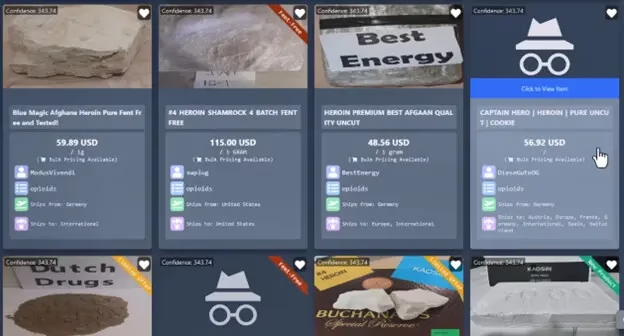
In January 2022, Lin authorized vendors to openly sell opiates, a move prosecutors say dramatically escalated the platform’s harm. Vendors began listing prescription drugs advertised as legitimate, including oxycodone tablets that were later found to contain fentanyl.
“While Lin made millions, his crimes had devastating consequences,” Clayton said. “He is responsible for at least one tragic death and worsened the opioid crisis for hundreds of thousands of families.”
In March 2024, Lin suddenly shut down Incognito market without warning. Prosecutors say he simultaneously stole at least $1 million in cryptocurrency that buyers and vendors had stored in the platform’s internal bank.
He then attempted to extort users by threatening to release transaction histories and crypto wallet addresses unless additional payments were made. A message posted on the site read: “YES, THIS IS AN EXTORTION!!!”
The move mirrored tactics seen in other dark web exit scams, but it also accelerated law enforcement efforts to locate and arrest Lin.
Despite his expertise in cybercrime, Lin made critical errors. Federal agents traced the domain registration for Incognito market to Lin after he used his real name, phone number, and home address during setup.
Lin was arrested in May 2024. Taiwanese media later reported that he studied at National Taiwan University and completed civilian alternative service in St. Lucia, where he ironically trained police officers on cybercrime and cryptocurrency investigations.
The collapse of Incognito market sends a clear signal to illicit crypto marketplaces that anonymity tools are not foolproof. U.S. officials say blockchain transparency, combined with traditional investigative techniques, continues to erode the perceived safety of dark web operations. As authorities dismantle increasingly sophisticated platforms, the case underscores a broader reality: crypto-enabled crime may scale quickly, but accountability often arrives just as fast.
For Lin, the rise of Incognito market ended not in anonymity—but in a federal prison sentence that will define the rest of his life.



Copyright © 2025 - The Bit Gazette.