


- Trending
- Comments
- Latest

Senior executives from hedge funds, market makers, banks, and digital asset firms will gather in Hong Kong on February 9 for Liquidity 2026, an institutional summit examining how traditional finance and blockchain-based assets are converging into unified trading infrastructure.
Now just days away, the event is expected to draw senior decision-makers from hedge funds, market makers, high-frequency trading firms, family offices, banks, asset managers, custodians, exchanges, and technology providers. Together, they will examine how multi asset markets are reshaping global trading, liquidity provision, and financial infrastructure.
The summit, supported by BeInCrypto as a media partner, comes at a moment when traditional finance and digital assets are converging faster than ever.
Now in its fourth consecutive year, the Liquidity Summit has evolved into a key institutional forum focused on the structural transformation of global markets. What began as a dialogue around digital liquidity has expanded into a broader examination of multi asset markets spanning equities, fixed income, derivatives, digital assets, tokenized real-world assets, and stablecoins.
“Institutions are no longer thinking in silos,” said an LTP spokesperson. “They are designing systems that allow capital to move seamlessly across multi asset markets, with consistent risk management and execution standards.”
This year’s agenda reflects that shift. Discussions will focus on how institutions are building unified trading, clearing, and custody frameworks capable of supporting both traditional instruments and blockchain-based assets.
Unlike retail-focused crypto conferences, Liquidity 2026 is designed around operational reality. Sessions will address the practical challenges institutions face as they scale participation in multi asset markets, including capital efficiency, collateral management, and settlement interoperability.
According to organizers, the goal is to move beyond experimentation and toward institutional-grade execution.
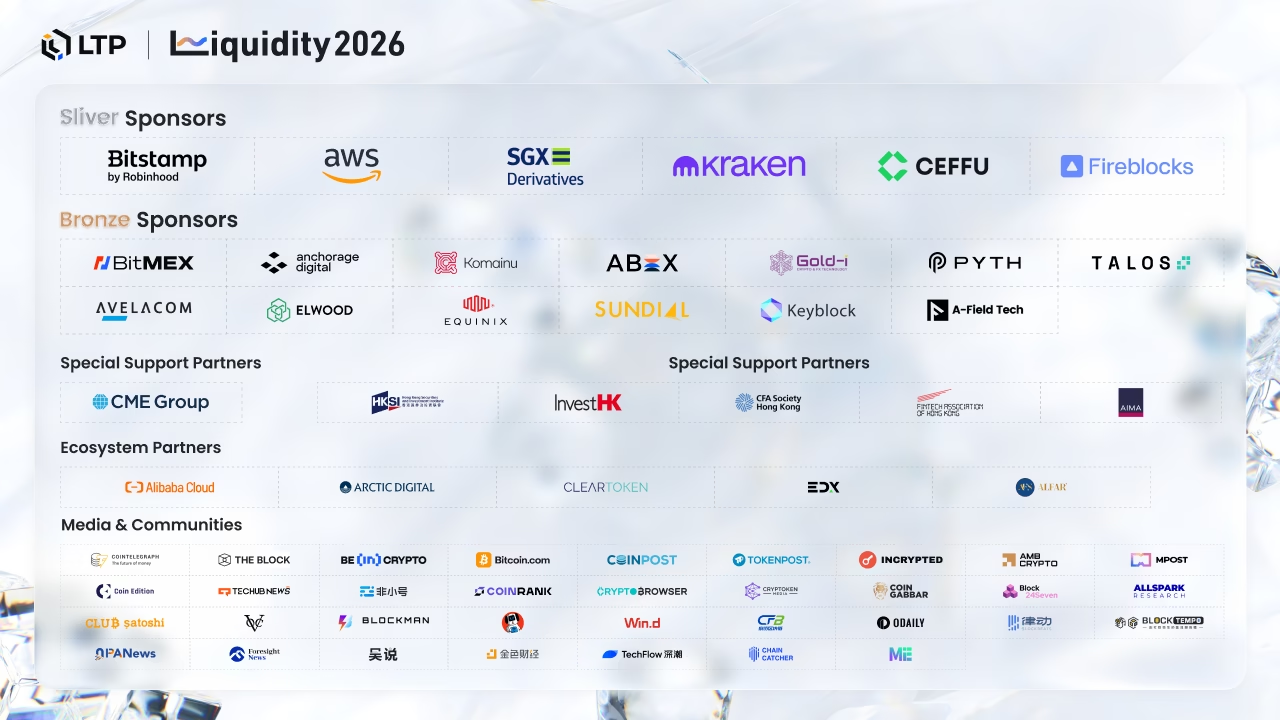
The sponsor lineup reflects growing confidence in multi asset markets as a long-term institutional strategy. Silver sponsors include Bitstamp by Robinhood, AWS, SGX, Kraken, Ceffu, and Fireblocks—spanning execution, cloud infrastructure, custody, and market access.

Bronze sponsors such as BitMEX, Anchorage, Komainu, Talos, Pyth Network, Equinix, Elwood, and Avelacom further underscore the depth of institutional engagement across trading technology, connectivity, and risk systems supporting multi asset markets.
Additional support from CME Group, along with organizations like CFA Institute, AIMA, InvestHK, and the FinTech Association of Hong Kong, highlights the summit’s relevance beyond digital-asset-native firms.
“Events like Liquidity 2026 are where institutional standards are set,” said a senior executive from a participating exchange. “This is where multi asset markets stop being theoretical and become operational.”
The timing of the summit is notable. As global macro uncertainty persists and regulatory clarity improves across major jurisdictions, institutions are increasingly viewing multi asset markets as a way to diversify risk, improve capital efficiency, and access new yield opportunities.
Tokenization, in particular, is accelerating this transition. By enabling assets such as credit instruments, commodities, and funds to trade on shared infrastructure, tokenization is collapsing barriers between asset classes and reinforcing the relevance of multi asset markets.

“Everything is becoming collateral,” noted one agenda brief. “That fundamentally changes how liquidity is sourced and deployed across multi asset markets.”
Liquidity 2026 is structured to prioritize dialogue over presentation. Panels and closed-door sessions are designed to facilitate candid exchanges between institutions operating at scale.
Organizers say the summit’s value lies in its ability to bring competing firms into the same room to discuss shared challenges—ranging from fragmented liquidity to regulatory alignment across multi asset markets.
“The future of trading will be defined by collaboration,” said an LTP representative. “No single institution can build this alone.”
LTP is a global institutional prime broker built to support professional participants operating across multi asset markets. The firm delivers end-to-end services including execution, clearing, settlement, custody, and financing, applying traditional financial standards to blockchain-enabled infrastructure.
LTP operates through a network of regulated entities across Hong Kong, the BVI, Spain, Australia, and the UAE, supporting institutional clients with compliant access to both traditional and digital markets.
As Liquidity 2026 approaches, the message is clear: multi asset markets are no longer an emerging trend—they are becoming the foundation of the next global financial system.



Copyright © 2025 - The Bit Gazette.