


- Trending
- Comments
- Latest

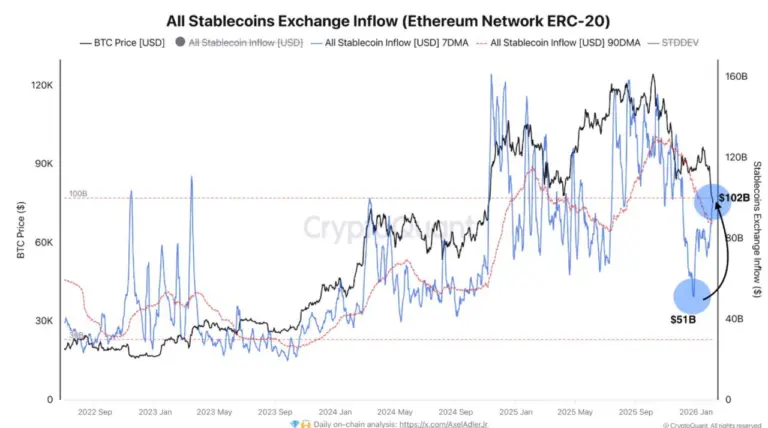
Stablecoin deposits on major cryptocurrency exchanges have surged to a weekly average of nearly $98 billion, roughly double the levels seen in late December, suggesting traders are positioning capital for potential deployment despite ongoing market weakness, according to on-chain data from CryptoQuant.
CryptoQuant analyst Darkfost published an analysis this week showing the surge in stablecoin inflow on major exchange networks. After sinking as low as around $51 billion in late December, weekly average inflows have now climbed to nearly $98 billion, surpassing the 90-day moving average of about $89 billion.
“The significant rise in stablecoin inflow suggests that capital deployment has accelerated in recent weeks,” Darkfost wrote, noting that the trend is “a positive signal, as it shows that investor interest is gradually returning at this level of correction.”
Analysts say this renewed stablecoin inflow reflects more than just technical repositioning: it could indicate that traders are accumulating dry powder — holding dollar-pegged tokens in anticipation of future deployments — even as the price action remains volatile.
Even with the surge in stablecoin inflow, prices have not stabilized. Bitcoin — the bellwether for the entire crypto ecosystem — has seen major losses over the past quarter. According to multiple reports, BTC’s decline has dropped its valuation to levels last seen before key 2024 political events and major market peaks.
Other market indicators mirror this strain: leading Bitcoin exchange-traded funds (ETFs) have experienced heavy outflows, with one fund seeing its worst drop in more than a year as investors struggle to find conviction.
Yet the rising stablecoin inflow paints a slightly more nuanced picture of market dynamics. Even as leverage unwinds and sellers dominate price action, a growing pool of dollar-pegged tokens sitting on exchanges may offer potential fuel for future buying — whether into Bitcoin, Ethereum, or altcoins.
Stablecoins — digital tokens pegged to fiat currencies like the U.S. dollar — serve as a primary on-and-off ramp in crypto markets. Traders and institutions often convert volatile assets into stablecoins during periods of uncertainty, preserving capital while retaining the ability to quickly re-enter markets.
Historically, sharp increases in stablecoin inflow have sometimes preceded broader shifts in asset prices. That’s because elevated stablecoin deposits on exchanges can provide the liquidity necessary for fresh buying once sentiment improves.
However, analysts caution that this relationship isn’t deterministic.
“Although the surge in stablecoin inflow signals growing participation, selling pressure remains too strong to be fully absorbed,” Darkfost added, underscoring that markets still struggle under bearish dynamics.
The uptick in stablecoin inflow comes as crypto liquidity patterns continue to shift. Broader metrics show that while bitcoin and major altcoins have seen elevated selling pressure, the stablecoin market — particularly tokens like USDT and USDC — remains highly active.
Recent industry data indicates that stablecoin net issuance and market capitalization have ballooned over the past year, reflecting increased usage beyond pure trading, including decentralized finance and settlement functions.

At the same time, market participants are increasingly watching regulatory developments, institutional flows, and macroeconomic indicators that could impact future asset prices.
Analysts at major financial firms say that a sustained rotation back into risk assets could hinge on improvements in broader liquidity conditions or macro sentiment.
While the recent jump in stablecoin inflow offers a glimmer of optimism for some investors, risks remain pervasive. The sustained sell-off has inflicted losses on miners, institutional holders, and retail traders alike, eroding confidence and tightening liquidity.
Moreover, negative sentiment indicators — including persistent ETF outflows and slowing transaction volumes — could temper any near-term recovery.
Still, market observers argue that the surge in stablecoin inflow should not be dismissed. This trend may be the early stage of a capitalization shift, suggesting that many investors view current prices as a potential entry point.
“We’re seeing capital return to crypto via stablecoins — and while the market hasn’t bottomed, this could be the precursor to broader engagement,” said a veteran quantitative strategist who requested anonymity due to client confidentiality.

As crypto markets tread water amid broader economic uncertainty, stablecoin inflow stands out as an unexpected yet critical metric. The doubling of capital moving into stablecoins on exchanges reflects a market still beset by selling pressure — but one where interest and liquidity could be quietly rebuilding.
Whether this trend ultimately translates into bullish sentiment remains to be seen, but for now, the stablecoin inflow narrative adds a compelling layer to how investors interpret the ongoing downturn.



Copyright © 2025 - The Bit Gazette.