


- Trending
- Comments
- Latest

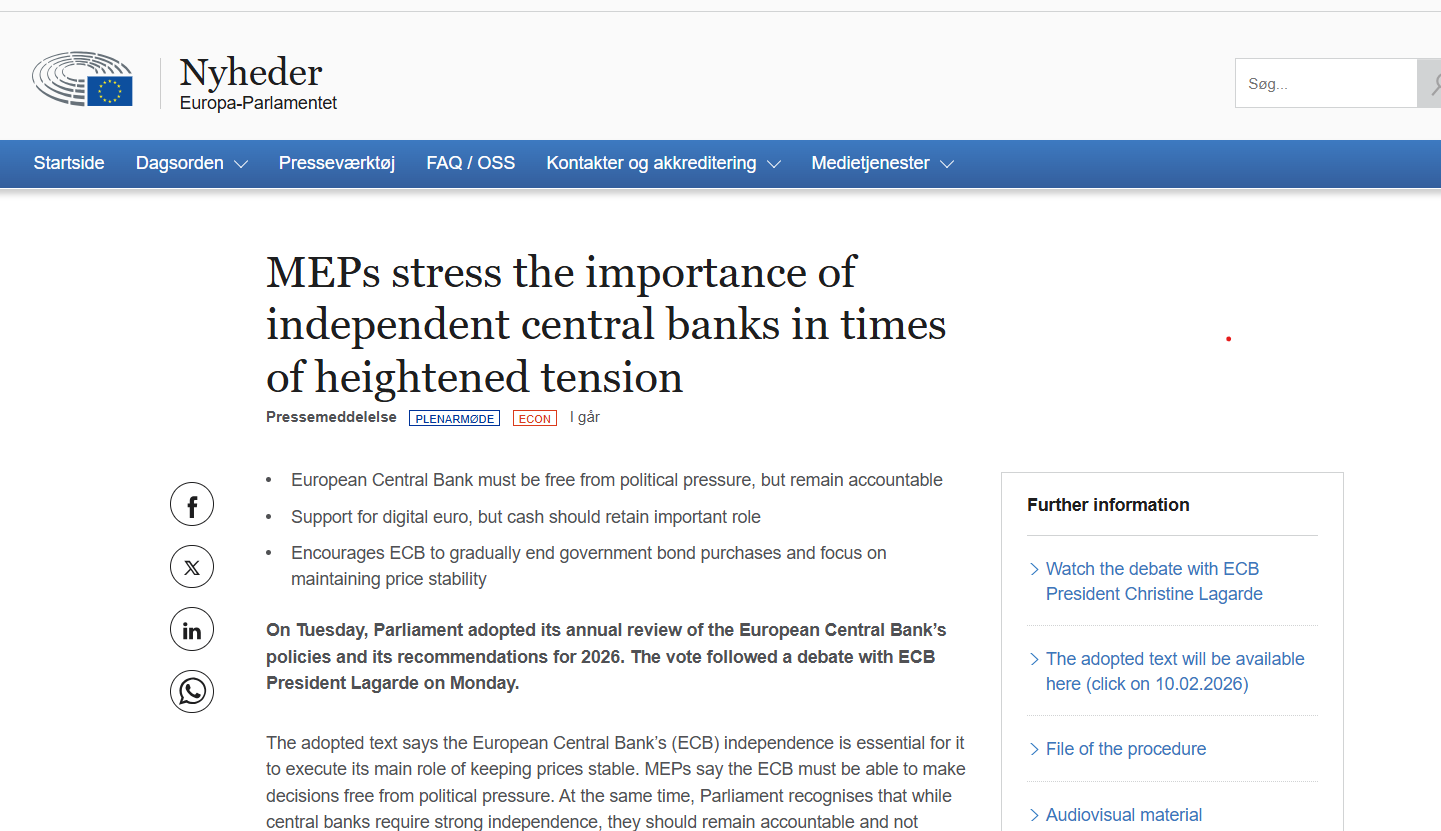
The European Parliament has voted 443 to 71 to endorse the European Central Bank’s digital euro project, describing it as “essential” to EU monetary sovereignty and a necessary counterweight to foreign card networks, Big Tech payment platforms, and privately issued stablecoins.
The resolution, adopted with 117 abstentions, marks the strongest political mandate the digital euro has received since the ECB first proposed the initiative, and signals that Europe’s payments infrastructure is now firmly a matter of geopolitical strategy rather than technical policy.
At the heart of the parliamentary backing is concern over Europe’s heavy reliance on non-EU payment providers and private digital instruments. The adopted text stresses that public money in digital form could act as a counterweight to foreign card networks, Big Tech payment rails and privately issued stablecoins.
Lawmakers argued that without credible digital euro plans, Europe risks losing control over a critical layer of its financial infrastructure. Retail payments, once viewed as mundane plumbing, are now seen as strategic assets in an era of economic rivalry and sanctions.

The vote sends a clear signal that the European Parliament sees digital euro plans as a way to anchor Europe’s payments future firmly within EU governance and legal frameworks.
Alongside its support for the digital euro, Parliament strongly reaffirmed the importance of central bank independence. Members of the European Parliament (MEPs) emphasized that while digital euro plans deserve political backing, they must not become a lever for political interference in monetary policy.
During the plenary debate, Johan Van Overtveldt, an MEP and former Belgian finance minister, warned that the independence of the ECB “is not a technical detail.”
“History shows that political interference with central banks invariably leads to inflation, financial instability and even nasty political turmoil,” Van Overtveldt told lawmakers, drawing applause from across the chamber.
His remarks reflected concerns that debates around digital euro plans could blur institutional boundaries if not carefully managed.
Van Overtveldt argued that reaffirming ECB independence is even more critical in today’s global environment. He likened monetary and financial stability to essential utilities such as water and electricity — often taken for granted until they fail.
In that context, digital euro plans are being framed as part of a broader resilience strategy rather than a radical overhaul of money. Parliament’s resolution stresses that cash must continue to play an important role in the euro area economy and confirms that both physical cash and a digital euro would be legal tender.
This dual-track approach is intended to reassure citizens that digital euro plans are about choice and stability, not forcing a cashless society.
Support for digital euro plans also reflects a growing narrative among policymakers that central bank digital money should be treated as a public good. Proponents argue that just as cash ensures universal access to public money in the physical world, a digital euro would preserve that access online.
Last month, ECB executive board member Piero Cipollone described the digital euro as “public money in digital form,” explicitly linking the project to rising geopolitical tensions and what he called the “weaponisation of every conceivable tool.”
According to Cipollone, digital euro plans are about ensuring Europe has a retail payment system “fully under our control” and built on European infrastructure rather than foreign schemes.
The parliamentary resolution aligns with that view, framing digital euro plans as a hedge against strategic dependencies. Lawmakers warned that without a strong public digital payment option, Europe could become increasingly reliant on non-EU platforms during times of crisis.
Earlier in January, a group of 70 economists and policy experts urged MEPs to “let the public interest prevail” when shaping digital euro plans. In an open letter, they cautioned that private stablecoins and foreign payment giants could gain disproportionate influence over Europe’s digital payments if public alternatives lag behind.

Their warning added intellectual weight to the Parliament’s stance, reinforcing the idea that digital euro plans are about safeguarding long-term autonomy, not crowding out innovation.
While the vote represents a strong political endorsement, it does not eliminate the technical, legal and societal questions surrounding digital euro plans. Privacy safeguards, offline functionality, limits on holdings and the impact on banks remain under active discussion.
The European Council has already endorsed both online and offline versions of the digital euro, signaling institutional momentum across EU bodies. Still, final decisions will rest on legislative negotiations and the ECB’s design choices.
What is clear is that digital euro plans now enjoy broad parliamentary legitimacy at a time when global financial systems are becoming increasingly politicized.
For markets and policymakers alike, the Parliament’s vote sends a message: Europe intends to remain a monetary power in the digital age. By backing digital euro plans while defending ECB independence, lawmakers are attempting to balance innovation with institutional credibility.
As geopolitical tensions persist and digital finance accelerates, the success or failure of digital euro plans may shape not just how Europeans pay, but how Europe positions itself in the global financial order.



Copyright © 2025 - The Bit Gazette.