


- Trending
- Comments
- Latest

Japan’s SBI Shinsei Bank is offering shareholders the option to receive dividends in XRP rather than cash, marking one of the first times a regulated bank in the country has embedded a cryptocurrency directly into its shareholder rewards structure.
The move, announced by SBI Shinsei Bank, a subsidiary of SBI Holdings, positions the lender at the forefront of digital asset integration within Japan’s regulated financial sector. By offering SBI Shinsei Bank XRP dividends, the institution aims to provide flexibility for investors while deepening its involvement in blockchain-based financial services.
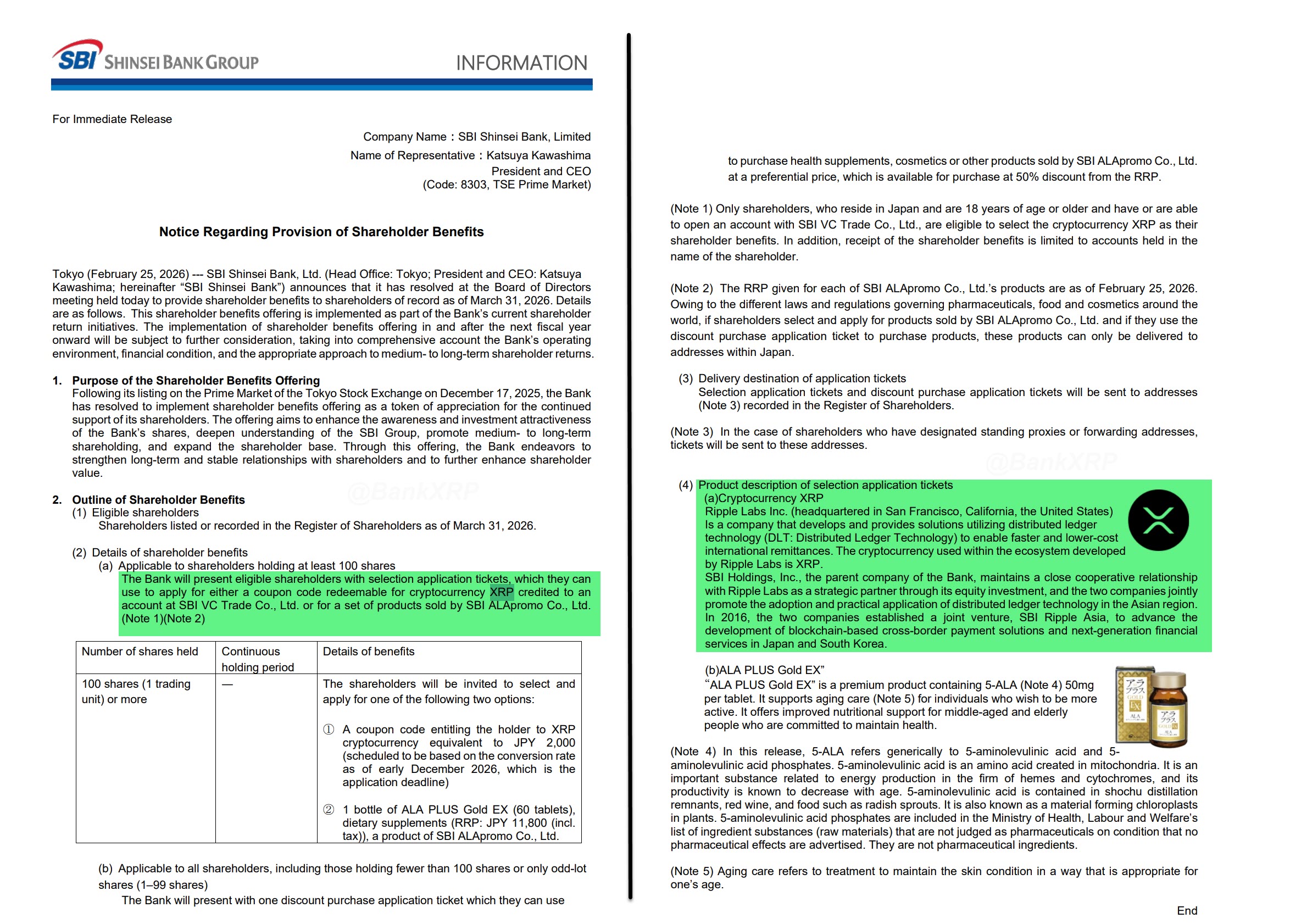
The decision comes amid broader efforts by SBI Holdings to expand its digital asset footprint, including plans to issue a ¥10 billion (approximately $64.5 million) blockchain-based bond with XRP-linked rewards. Together, these initiatives underscore the group’s strategy of bridging conventional banking with cryptocurrency infrastructure.
Under the new framework, shareholders eligible as of March 31, 2026, can opt to receive dividends either in fiat currency or through the SBI Shinsei Bank XRP payout channel. This marks one of the first instances in Japan where a regulated banking subsidiary has formally incorporated cryptocurrency into its dividend distribution structure.
By integrating SBI Shinsei Bank XRP dividends into its shareholder rewards system, the bank offers investors direct exposure to a digital asset without requiring them to purchase it separately on exchanges. The option provides flexibility: recipients may hold XRP as a speculative investment, use it within SBI’s growing digital ecosystem, or convert it into fiat currency.
Market analysts view the SBI Shinsei Bank XRP initiative as a practical step toward mainstream crypto adoption among traditional investors.
Rather than launching a standalone crypto product, the bank has embedded digital assets within an established financial mechanism—dividend payments—potentially lowering the psychological and operational barriers for shareholders.
The SBI Shinsei Bank XRP dividend program aligns with SBI Holdings’ broader blockchain ambitions. The parent company is preparing to issue a ¥10 billion blockchain-based bond that will incorporate XRP-related incentives, reinforcing its commitment to distributed ledger technology.
SBI Holdings has long maintained a close relationship with Ripple Labs, the company behind the XRP Ledger. Earlier this month, CEO Yoshitaka Kitao addressed reports suggesting the firm held $10 billion worth of XRP tokens.
“We are invested in Ripple Labs, not holding $10 billion in XRP tokens,” — Yoshitaka Kitao, CEO, SBI Holdings. His clarification underscored that the company’s strategic interest lies in infrastructure and ecosystem development rather than speculative token accumulation.
Through the SBI Shinsei Bank XRP initiative, the group continues to integrate XRP into areas such as cross-border remittances and digital payments. By embedding cryptocurrency into dividend distributions, SBI extends XRP’s utility beyond payments and into shareholder relations.
Analysts suggest the SBI Shinsei Bank XRP model could serve as a blueprint for other Japanese corporations evaluating crypto integration. By allowing dividends in digital form, the bank demonstrates how blockchain assets can coexist with traditional financial structures without displacing them.
The innovation reflects a broader trend of financial institutions experimenting with tokenized products while remaining within regulatory guardrails. The SBI Shinsei Bank XRP dividend option does not eliminate cash payouts but complements them, offering optionality rather than replacement.
Unverified reports have also indicated that SBI may explore integrating XRP with R3 Corda, a distributed ledger platform widely used in enterprise blockchain applications. While no formal announcement has confirmed this development, such a move would further signal SBI’s ambition to deepen its blockchain infrastructure.
For shareholders, the SBI Shinsei Bank XRP program provides tangible benefits. Investors gain exposure to a digital asset within a familiar corporate framework, reducing the friction typically associated with entering cryptocurrency markets.
At the same time, the bank reinforces its identity as a hybrid financial institution operating at the intersection of regulated banking and decentralized technology.
The launch of the SBI Shinsei Bank XRP dividend option marks a milestone in Japan’s evolving digital asset landscape. By blending established shareholder practices with blockchain-based rewards, the bank strengthens SBI Holdings’ mission to advance XRP adoption both domestically and internationally.
Rather than positioning cryptocurrency as a parallel financial system, SBI Shinsei Bank has woven it into an existing corporate process. The SBI Shinsei Bank XRP approach illustrates how digital assets can be introduced incrementally, aligning innovation with investor choice and regulatory oversight.
As Japan continues to refine its digital asset policies, initiatives like SBI Shinsei Bank XRP may shape how other financial institutions approach crypto integration. For now, the bank’s shareholders will be among the first in the country to experience dividends not only in yen, but also in a blockchain-based asset that reflects the changing architecture of modern finance.



Copyright © 2025 - The Bit Gazette.