

- Trending
- Comments
- Latest

Every follow, like, and interaction you make online builds a hidden map of your digital relationships. This “social graph” powers everything you see. Yet on most platforms, you don’t own it. That imbalance is now driving the rise of alternatives that are decentralized and designed to return control to users.
Built on blockchain-based protocols, the decentralized social graph allows multiple applications to access the same network of relationships breaking the dominance of centralized platforms like traditional social media.
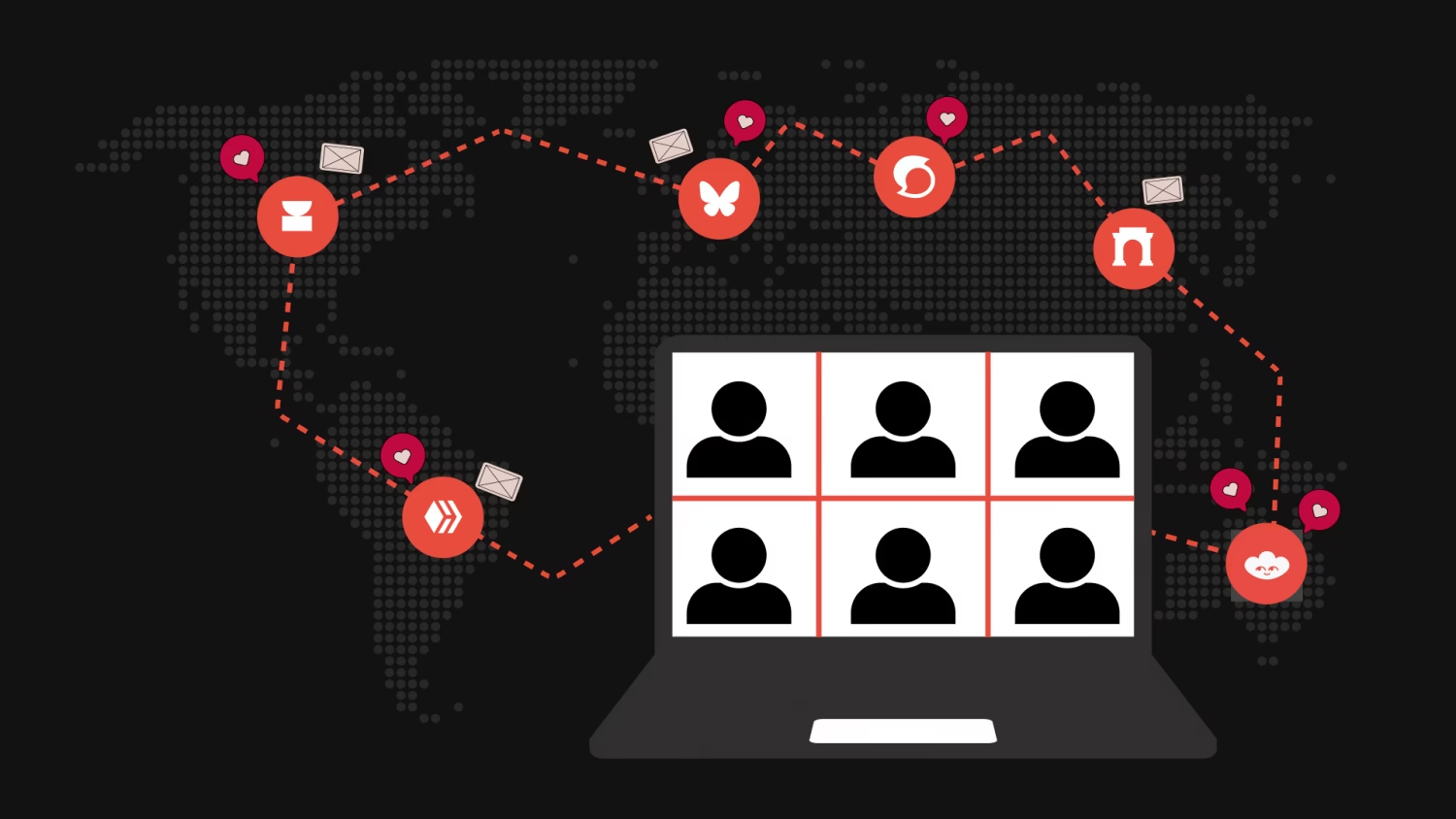
A decentralized social graph refers to a shared, blockchain-based map of relationships who follows whom, who interacts with what that is not controlled by a single company. Instead of being stored on private servers, this data exists across decentralized networks or protocols.
In traditional platforms, social graphs are owned by companies. Your followers, posts, and interactions are tied to a single app, making it difficult to leave without losing your audience. The decentralized social graph changes that dynamic by making identity and connections portable.
Protocols like Farcaster and Lens are leading this model. They allow users to maintain a persistent identity that can move across different apps, ensuring that no single platform controls their digital presence.
This shift turns social media from a product into infrastructure—something developers can build on rather than own.
The decentralized social graph operates through blockchain-based identity layers combined with distributed data systems. At its core, it separates identity from application.
For example, Farcaster uses a hybrid model where identity is anchored on-chain while posts and interactions are handled off-chain for speed and scalability.
Lens Protocol, on the other hand, stores profiles, posts, and connections directly on-chain, often as NFTs, making the entire social graph programmable and composable.
This architecture allows multiple apps to plug into the same social graph. A user can switch between apps without losing followers or content, similar to how email works across different providers.
Importantly, the decentralized social graph also enables interoperability. Developers can build new experiences feeds, marketplaces, or creator tools on top of shared user data without needing permission from a central authority.
The rise of the decentralized social graph is driven by growing dissatisfaction with centralized platforms and increasing demand for data ownership.
According to industry analysis, decentralized social graphs are becoming a “critical infrastructure layer” that reduces platform risk and prevents data silos.
At the same time, the decentralized social graph is enabling new economic models. Creators can monetize directly through tokens, NFTs, or on-chain interactions without relying on platform-controlled revenue systems.
This shift is also attracting developers. Instead of building isolated social networks, teams can now build on shared infrastructure, accelerating innovation and reducing barriers to entry.
Despite its promise, the decentralized social graph faces significant challenges.
Scalability remains a key issue. Fully on-chain systems can be slow and expensive, while hybrid models introduce trade-offs between decentralization and performance. Different protocols are experimenting with solutions, but no standard has fully emerged.
User experience is another barrier. Compared to traditional platforms, decentralized social applications can be complex, requiring wallets, fees, or technical understanding that limit mainstream adoption.
There are also governance concerns. While the decentralized social graph reduces platform control, it does not eliminate power structures entirely. Protocol developers, node operators, and interface providers can still influence how systems operate.
Finally, content moderation remains unresolved. Without centralized control, enforcing standards around harmful or illegal content becomes more difficult, raising questions about how networks can scale responsibly.



Copyright © 2025 - The Bit Gazette.