- Trending
- Comments
- Latest

Jack Dorsey confirmed Thursday that Block will cut more than 4,000 jobs, reducing its workforce from over 10,000 to just under 6,000, in a sweeping restructuring he attributed not to financial distress but to pandemic-era over-hiring and a deliberate pivot toward AI-driven operations.
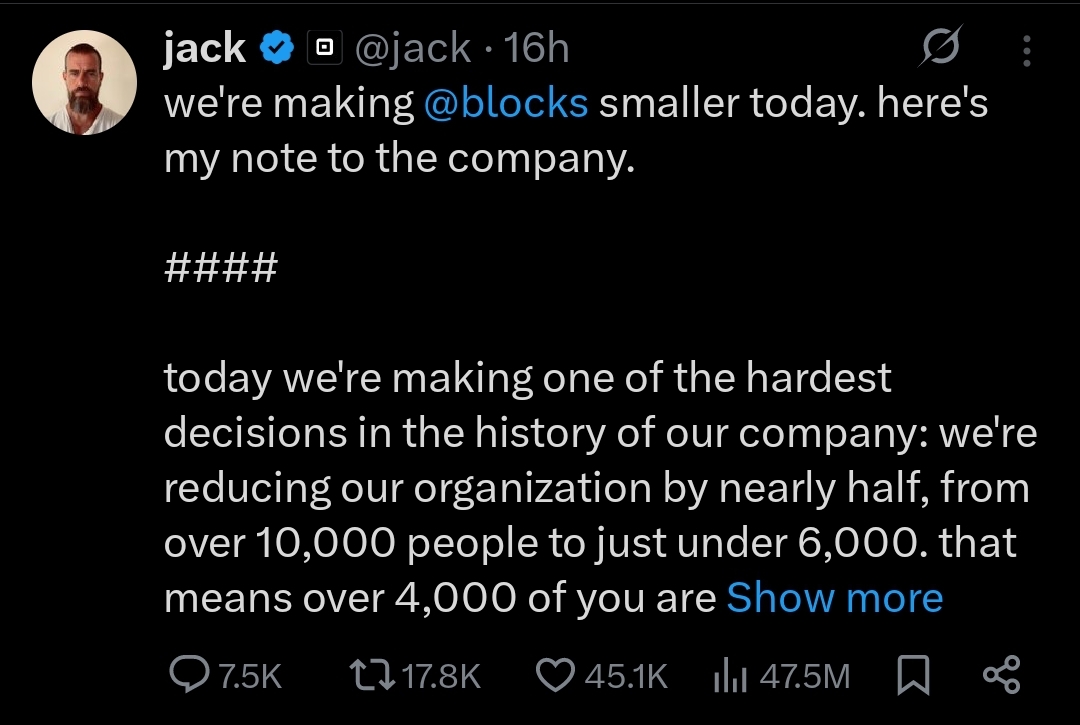
In a note to staff, CEO Jack Dorsey said more than 4,000 employees would either be asked to leave or enter consultation, marking one of the most significant reductions in the company’s history.
The block layoff was communicated companywide in a single day, with all employees informed whether they were departing, entering consultation, or remaining. Dorsey described the move as a decisive restructuring rather than a response to financial weakness, saying the business remains strong even as its operating model evolves.
“Today we’re making one of the hardest decisions in the history of our company: we’re reducing our organization by nearly half, from over 10,000 people to just under 6,000,” — Jack Dorsey, CEO, Block.
As part of the block layoff, affected employees will receive 20 weeks of salary plus one additional week per year of tenure, equity vested through the end of May, six months of healthcare coverage, continued access to corporate devices, and a $5,000 stipend to support their transition. Employees outside the United States will receive comparable packages aligned with local legal requirements.
Dorsey emphasized transparency in how the block layoff would unfold. Communication channels such as Slack and email will remain open through Thursday evening Pacific Time to allow departing employees to say goodbye. A live video session was scheduled for 3:35 p.m. Pacific to address staff directly.
“We’re not going to just disappear people from Slack and email and pretend they were never here,” — Jack Dorsey, CEO, Block.
The approach, he acknowledged, may feel uncomfortable but was intended to preserve a sense of humanity during the process.
Dorsey stated clearly that the block layoff was not driven by revenue decline or financial distress. “We’re not making this decision because we’re in trouble. Our business is strong,” he wrote, noting that gross profit continues to grow, customer numbers are increasing, and profitability is improving.
However, he acknowledged structural missteps during the pandemic expansion period.
“Yes we over-hired during covid because I incorrectly built 2 separate company structures (Square & Cash App) rather than 1, which we corrected mid 2024,” — Jack Dorsey, CEO, Block.
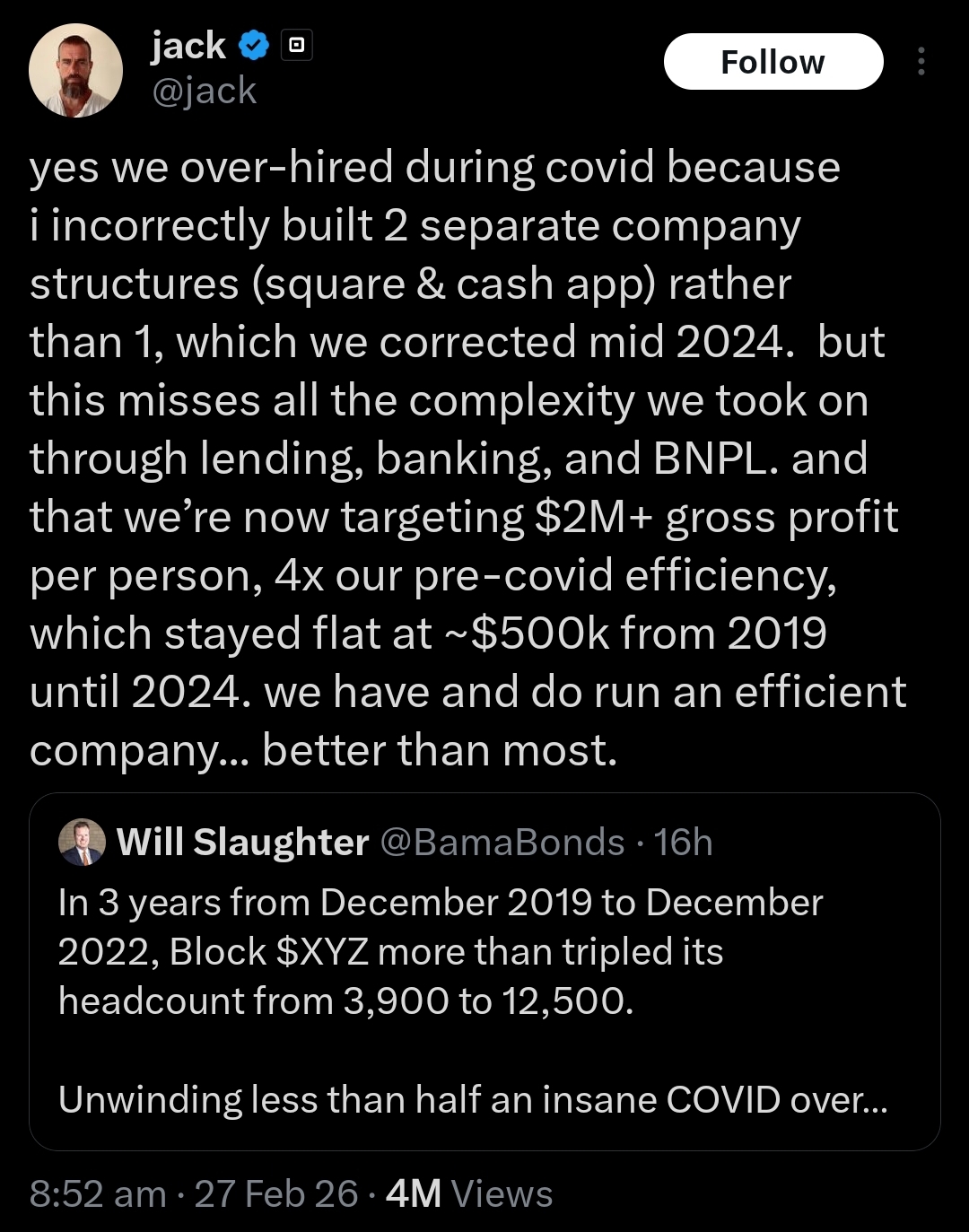
According to Dorsey, that duplication compounded complexity, particularly as the company expanded into lending, banking, and buy now, pay later (BNPL) services. Those moves added operational layers that the current block layoff seeks to streamline.
He also pointed to new performance targets driving the restructuring. The company is now aiming for more than $2 million in gross profit per employee—four times its pre-COVID efficiency level. From 2019 through 2024, gross profit per person remained roughly flat at about $500,000.
“We have and do run an efficient company… better than most,” — Jack Dorsey, CEO, Block.
The block layoff, he suggested, is intended to align staffing levels with those heightened productivity goals while integrating artificial intelligence tools more deeply into operations.
Beyond cost considerations, the block layoff signals a broader pivot toward intelligence-centered workflows. Dorsey wrote that AI tools the company is building and deploying internally are enabling smaller, flatter teams to accomplish more, fundamentally altering what it means to operate the business.
He said he faced two choices: gradually reduce headcount over time or act decisively now. “I had two options: cut gradually over months or years as this shift plays out, or be honest about where we are and act on it now. I chose the latter,” he wrote.
The block layoff, in his view, avoids repeated rounds of uncertainty that could undermine morale and customer confidence. Instead, he argued, a smaller organization will provide the flexibility to grow “on our own terms” rather than reacting incrementally to external pressures.
To employees who are leaving, Dorsey expressed gratitude and regret. “You built what this company is today. That’s a fact that I’ll honor forever,” he wrote, adding that the decision does not reflect individual performance.
For those staying, he said he would take ownership of the decision and asked them to help build the next phase of the company with intelligence “at the core of everything we do.”



Copyright © 2025 - The Bit Gazette.