

- Trending
- Comments
- Latest

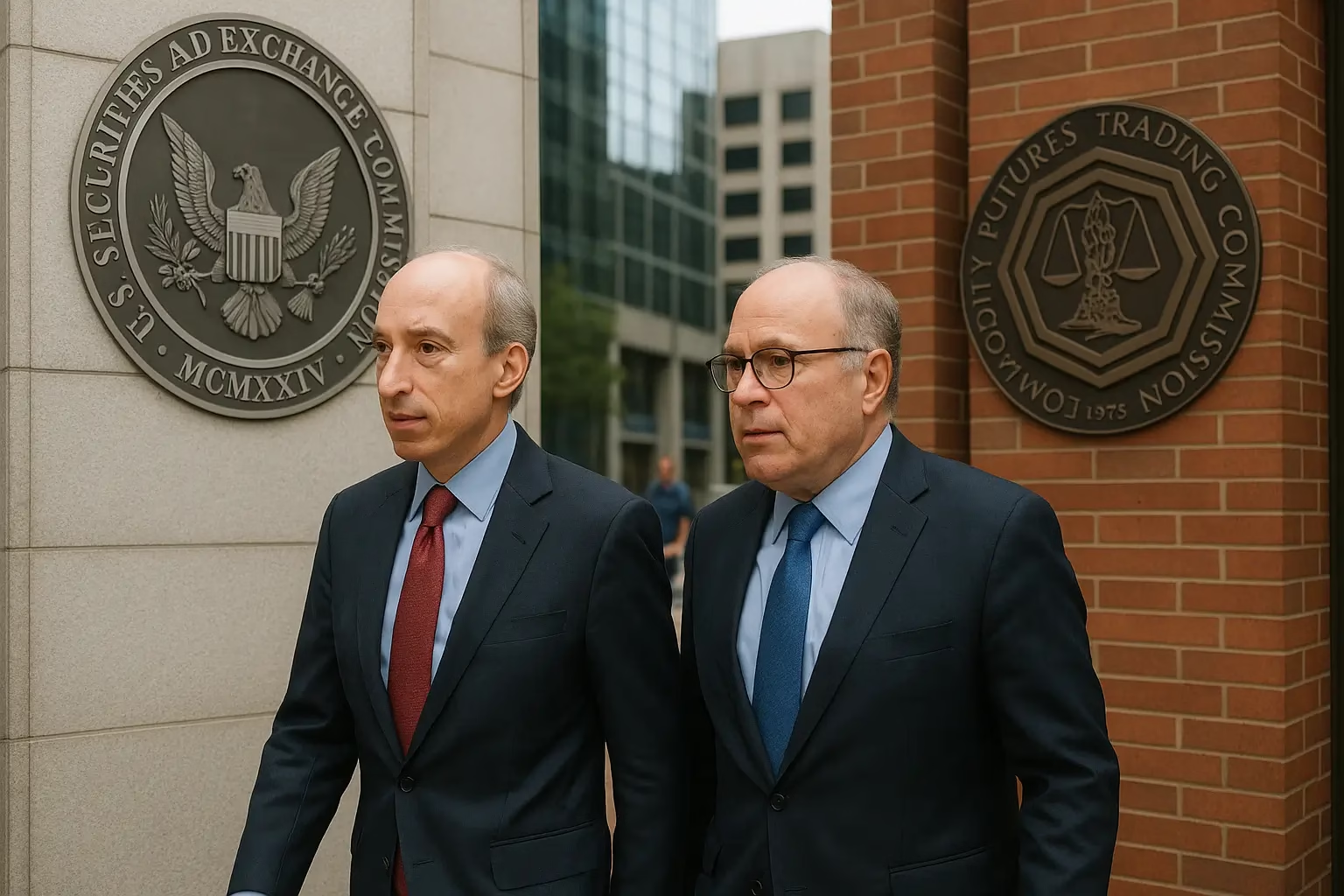
A new step toward SEC-CFTC Harmonization is underway after the U.S. Commodity Futures Trading Commission (CFTC) and the U.S. Securities and Exchange Commission (SEC) announced a historic memorandum of understanding designed to strengthen cooperation between the two regulators.
The agreement, announced on March 11, 2026, outlines plans for closer collaboration between the agencies on regulatory oversight, market monitoring, and enforcement across financial markets, including the fast-growing digital asset sector.
Advocates of SEC-CFTC Harmonization say the initiative could resolve long-standing regulatory uncertainty surrounding cryptocurrencies by aligning how the two agencies interpret and enforce financial rules.
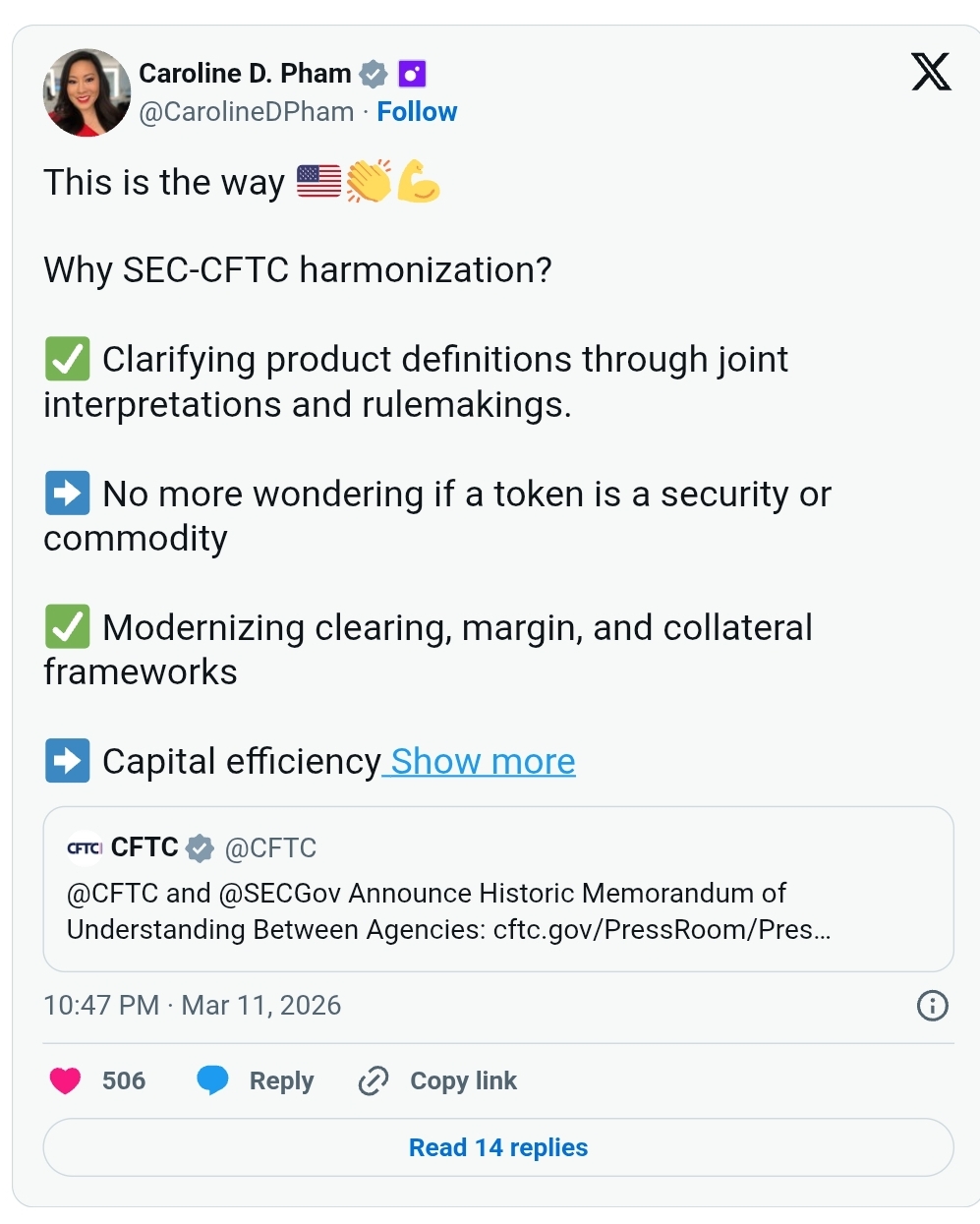
Caroline D. Pham, a commissioner at the CFTC, welcomed the development and emphasized the benefits of stronger coordination between regulators.
“This is the way,” Pham wrote in a public statement supporting the SEC-CFTC Harmonization initiative.
The move reflects increasing pressure on U.S. regulators to provide clearer guidance on how digital assets should be classified and supervised.
For years, market participants have struggled with overlapping jurisdiction between the SEC and CFTC, particularly when determining whether a crypto token should be treated as a security or a commodity.
Supporters of SEC-CFTC Harmonization argue that closer cooperation between the agencies could eliminate much of that ambiguity.
One of the primary goals of SEC-CFTC Harmonization is to clarify how financial products—particularly cryptocurrencies—are defined under U.S. law.
According to the CFTC announcement, the agencies intend to work together on joint interpretations and rulemaking that will provide clearer definitions for digital asset products.
Pham highlighted this objective, noting that clearer classifications would benefit investors, exchanges, and regulators alike.
“Clarifying product definitions through joint interpretations and rulemakings,” Pham explained, would mean there is “no more wondering if a token is a security or commodity.”
Such clarity has become increasingly important as cryptocurrency markets expand and financial institutions explore blockchain-based trading products.
The lack of consistent definitions has previously led to regulatory uncertainty, legal disputes, and compliance challenges for exchanges and trading platforms operating in the United States.
Advocates of SEC-CFTC Harmonization believe that aligning the agencies’ interpretations could create a more predictable regulatory environment while maintaining oversight of emerging technologies.
Beyond classification issues, SEC-CFTC Harmonization also aims to modernize key elements of financial market infrastructure.
Pham noted that regulators are exploring updates to clearing systems, margin requirements, and collateral frameworks to better reflect the realities of digital markets.
“Modernizing clearing, margin, and collateral frameworks,” she said, would allow “capital efficiency [to drive] liquidity formation and better prices.”
These changes could affect a wide range of financial market participants, including exchanges, clearinghouses, and intermediaries that operate across both securities and derivatives markets.
Supporters say the SEC-CFTC Harmonization effort may reduce operational complexity for businesses that must comply with both agencies’ regulatory frameworks.
Pham said one goal is “reducing frictions for dually registered exchanges, trading venues, and intermediaries,” which would help cut regulatory red tape.
Industry analysts have long argued that overlapping requirements from the SEC and CFTC can create compliance burdens for firms that operate in both markets.
Through SEC-CFTC Harmonization, regulators hope to streamline rules without weakening market safeguards.
Another major component of SEC-CFTC Harmonization involves improving how regulators collect and analyze market data.
Pham noted that the agencies are working toward more unified regulatory reporting systems covering trade data, funds, and intermediaries.
“Streamlining regulatory reporting for trade data, funds, and intermediaries,” she said, could help lower compliance costs while improving the quality of market data available to regulators.
In addition to reporting improvements, the two agencies plan to coordinate cross-market examinations, risk monitoring, economic analysis, and enforcement activities.
Pham summarized the benefits of the collaboration by stating that regulators would become “stronger, faster, cheaper together.”
The SEC-CFTC Harmonization initiative also reflects broader policy goals in Washington, where lawmakers and regulators have been debating how to maintain U.S. leadership in the digital asset industry.
Supporters believe that clearer rules and better coordination between agencies could help position the United States as a global hub for blockchain innovation.
Pham pointed to that objective directly, describing the broader aim of the initiative as creating “a fit-for-purpose regulatory framework for crypto assets and other emerging technologies.”
If successful, SEC-CFTC Harmonization could reshape the regulatory landscape for cryptocurrencies and other digital financial products, providing a more unified approach to oversight while addressing long-standing gaps between securities and derivatives regulation.



Copyright © 2025 - The Bit Gazette.