

- Trending
- Comments
- Latest

The Carrousel du Louvre is designed to be a fortress for the world’s most priceless physical art. But during Paris Blockchain Week, the most valuable assets weren’t hanging securely on the walls, they were walking out the front doors on USB drives.
Inside the venue, institutional attendees wearing sharp suits debated the finer points of tokenised treasuries, zero-knowledge proofs, and the future of decentralised finance. Executives from Goldman Sachs, JPMorgan, BNP Paribas, and HSBC sat alongside blockchain founders and French ministers. It was a sterile, highly intellectual vision of the future of money.
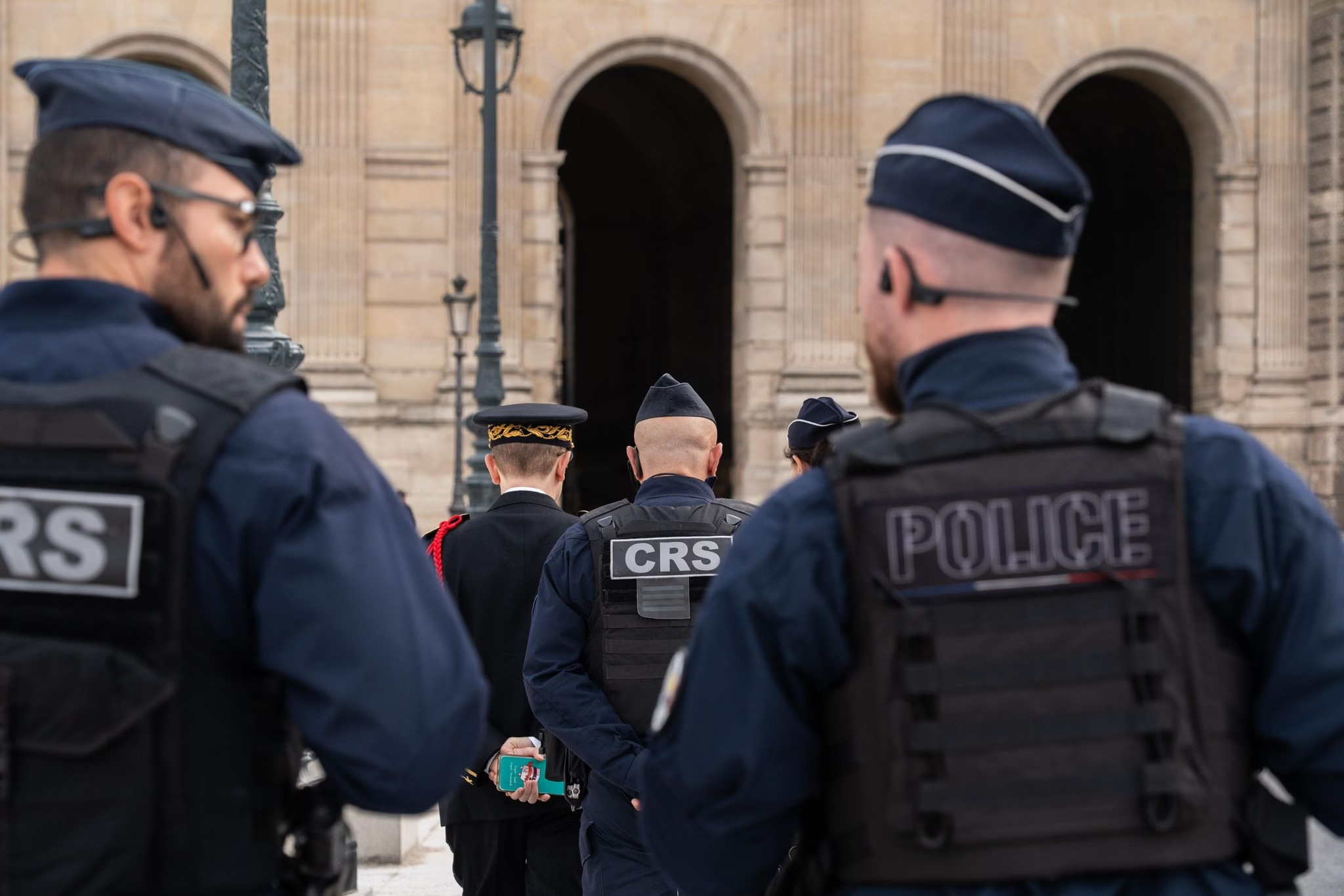
Outside the venue, the reality of Web3 was considerably more alarming. On the night of April 14, police motorcades escorted Paris Blockchain Week guests through the streets to a VIP dinner at the Palace of Versailles.
Conference co-founder Charlie Meraoud told BFM: “We’ve doubled our security measures this year.” The Block’s Head of Growth, Tim Copeland, posted from the convoy: “Was pretty wild to have a police escort through Paris last night.”
This is not a vibe. This is a data problem.
France has recorded 41 crypto-linked kidnappings since January 2026. That is one attack every 2.5 days. The country now accounts for roughly 40% of all wrench attack cases across Europe.
For the last decade, crypto security was treated almost exclusively as a software problem. You worried about phishing links, drained smart contracts, and compromised seed phrases. The hacker was a faceless avatar in a basement on the other side of the world.
That threat model is obsolete.
As blockchain forensics have become sophisticated enough to trace wallets to individuals, and as crypto wealth has become increasingly visible through conference appearances, LinkedIn profiles, data breaches, and even leaked tax records, criminals have reached a simple and brutal conclusion: it is significantly easier to hack a human than it is to hack the blockchain.
Why spend months writing complex exploit code to bypass a multi-signature firewall when you can execute a “$5 wrench attack”? The term describes the lowest-cost vector in cybersecurity: physical coercion. You don’t need to break the encryption. You need to break the person holding the keys.
According to CertiK, wrench attacks rose 75% globally in 2025, reaching 72 confirmed cases. France accounted for 19 of them — more than any other country on earth. In 2026, the pace has accelerated dramatically. French authorities have now logged 41 crypto-linked kidnappings since January, an average of one every 2.5 days.
Jean-Didier Berger, France’s minister delegate to the interior ministry, confirmed these figures at Paris Blockchain Week and announced that a “more stringent response plan” is being developed alongside Interior Minister Laurent Nuñez.
Two days before the conference opened, four attackers stormed a family home in Burgundy. They tied up the father, a crypto entrepreneur, seized approximately €10,000 in cash and valuables, and threatened him with mutilation in an attempt to force access to his digital holdings.
Here is the detail that should stop every self-custody advocate cold: the attackers discovered the family’s crypto was held in a time-locked wallet, a security mechanism that restricts access to funds until a preset future date. Unable to extract the assets immediately, they abducted the man’s wife and eleven-year-old son and demanded a €400,000 ransom.
A security feature designed to protect digital wealth directly triggered a physical kidnapping.
France’s elite GIGN unit, 100 officers rescued the mother and child from a hotel room in Val-de-Marne the following morning. No ransom was paid. Four suspects were arrested. The family survived.
This case did not occur in isolation. In February, a magistrate and her elderly mother were held for 30 hours after criminals targeted her crypto entrepreneur partner.
In March, a couple in their late 50s lost $1 million in Bitcoin to criminals who had posed as police officers to gain entry to their home. In January, an attempted attack targeted Binance France CEO David Princay. And in January 2025, Ledger co-founder David Balland was kidnapped with his wife; before they were freed, attackers severed his finger and sent footage of it to his business partner as a ransom demand.
A time-locked wallet was supposed to protect the family’s crypto. Instead, it triggered the kidnapping of a mother and her eleven-year-old child.
Traditional high-net-worth individuals have spent centuries building layers of abstraction between themselves and their wealth: trusts, corporate entities, institutional custodians, and legacy banking infrastructure. If a conventional millionaire is mugged, the attacker might obtain a watch and a credit card that can be cancelled within minutes.
If a crypto founder is coerced into unlocking a hardware wallet, millions of dollars can move irreversibly across the globe in seconds. There is no fraud department. There is no transaction reversal. The blockchain operates with absolute, permanent finality.
This is the structural vulnerability that blockchain’s most celebrated property, immutability, has created. The feature that makes crypto censorship-resistant also makes it theft-proof for exactly no one once a human being is in the room.
Making matters worse: the data breach problem has given criminals a targeting layer they never previously had. Reports in French media have documented cases where leaked tax data, Waltio platform breaches, and even social media visibility have been used to identify and locate crypto holders before attacks. The richest targets are, in many cases, not difficult to find.
The physical threat is creating a visible and accelerating divide in how the industry actually operates, as opposed to how it talks about itself.
Institutions and large holders are moving assets into heavily regulated custodians utilising Multi-Party Computation (MPC) networks, firms like Fireblocks, Copper, and Anchorage, that distribute key control across multiple parties and jurisdictions, making physical coercion structurally ineffective. They are legally and physically outsourcing the risk. No single individual holds a key that an attacker can extract.
Meanwhile, the average retail user is still being handed a 24-word seed phrase and told to write it on a piece of metal and hide it somewhere safe.
Web3 was built on the promise of financial sovereignty, the idea that you don’t need a bank to secure your wealth. Paris Blockchain Week 2026, conducted under police escort and in the shadow of France’s worst year of crypto kidnappings, has provided a clear-eyed test of that promise.
Financial sovereignty is real. But it has a physical cost that the industry has been remarkably slow to acknowledge, and almost entirely unwilling to build infrastructure around.
The feature that makes crypto censorship-resistant also makes it theft-proof for exactly no one once a human being is in the room.
The French government’s response is moving faster than most expected. Berger confirmed that a prevention platform is already live and drawing thousands of registrations. A coordinated action plan with Interior Minister Nuñez is expected in the coming weeks. At Paris Blockchain Week, Berger told attendees directly that France’s internal security forces would be fully mobilised to shield crypto holders from physical harm.
Whether this is sufficient is a different question. Forty-one kidnappings in less than four months suggests the threat is scaling faster than any prevention platform can absorb. And France’s ambition to position Paris as Europe’s premier crypto hub, complete with MiCA-aligned regulation, major institutional conferences, and a pipeline of blockchain infrastructure investment, is now in direct tension with its emergence as the world’s most dangerous country to visibly hold digital assets.
That is not a regulatory problem. It is a reputational and security infrastructure problem. And it will not be solved by doubling the bus escort.
The industry needs to have an honest conversation about physical security that goes beyond hardware wallet recommendations and seed phrase hygiene. MPC custody, operational security training, reduced public visibility of holdings, and coordinated government intelligence-sharing are not optional extras for the wealthy. They are becoming baseline requirements for anyone with meaningful crypto exposure in a world where that exposure is increasingly identifiable.
We have successfully decentralised the money. In doing so, we have completely decentralised the danger.
The conference inside the Louvre was about the future of finance. The police motorcade outside was about the present reality of holding it.
Both deserve equal attention.



Copyright © 2025 - The Bit Gazette.