
- Trending
- Comments
- Latest

Centralized exchanges process an estimated 85% of all cryptocurrency trading volume globally, making them the primary gateway for billions in daily transactions. Yet their dominance masks critical vulnerabilities: FTX’s 2022 collapse exposed the dangers of poor governance and missing transparency, triggering calls for mandatory proof-of-reserves and stricter regulatory oversight.
Today, CEXs face existential pressure from decentralized alternatives and governments demanding accountability—forcing platforms to choose between convenience and control, or risk losing institutional confidence.
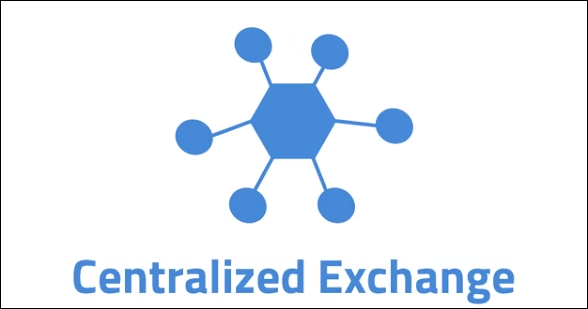
A centralized exchange (CEX) is a digital platform where users buy, sell, and trade cryptocurrencies under the control of a single company.
Major players such as Binance, Coinbase, and Kraken dominate this space, processing billions of dollars in daily trading volume.
According to CoinMarketCap, centralized exchanges account for the majority of global crypto trading volume, showing their influence over price discovery and market stability.
“Centralized exchanges play a critical role in onboarding new users into crypto.”
Brian Armstrong, in a public statement on Coinbase’s blog.
Centralized exchanges function similarly to traditional stock exchanges. They act as intermediaries, matching buyers and sellers while holding custody of users’ funds.
When investors deposit crypto or fiat, the exchange controls those assets through internal wallets.
Key features include:
Order books: Matching buy and sell orders
Custodial wallets: Holding user funds
Liquidity pools: Ensuring smooth trading
Compliance systems: Meeting regulatory requirements
Unlike decentralized platforms, users do not control their private keys on a CEX. This convenience comes at the cost of trust users must rely on the platform’s security and integrity.
For example, Coinbase operates under strict U.S. regulations, offering transparency and investor protections, while Binance has faced regulatory scrutiny across multiple jurisdictions.
“Security and compliance are non-negotiable in building long-term trust.” Changpeng Zhao, speaking at a global fintech conference.
Despite their convenience, centralized exchanges have been at the center of some of the crypto industry’s most significant failures.
The collapse of FTX in 2022 highlighted the dangers of poor governance and lack of transparency.
Custodial risk: Users can lose funds if the exchange is hacked or collapses.
Regulatory pressure: Governments may restrict or shut down operations.
Liquidity crises: Mismanagement can lead to withdrawal freezes.
Market manipulation: Centralized control may influence pricing
The FTX crisis triggered global calls for stricter oversight and proof-of-reserves systems, forcing exchanges to demonstrate that they hold sufficient assets to cover user deposits.
According to Vitalik Buterin, commenting on exchange transparency in a blog post, he said trrust cannot be assumed; it must be verified.
For investors, this marked a turning point, emphasizing the importance of due diligence and risk management when using centralized platforms.
While centralized exchanges remain dominant, decentralized exchanges (DEXs) are gaining traction as alternatives that eliminate intermediaries.
However, each model comes with trade-offs:
For new investors, centralized exchanges often provide the simplest entry point.
However, experienced users increasingly diversify by moving assets to private wallets or using DEX platforms to reduce exposure.
The future of centralized exchanges will likely be shaped by tighter regulation, improved transparency, and competition from decentralized platforms.
Governments worldwide are introducing frameworks to monitor crypto activities, which could either legitimize or constrain exchange operations.
At the same time, innovations such as proof-of-reserves, hybrid exchange models, and enhanced security protocols aim to rebuild investor confidence.
Centralized exchanges remain indispensable but no longer unquestioned. Understanding how they work, their risks, and their evolving role is essential for navigating today’s volatile digital asset market.



Copyright © 2025 - The Bit Gazette.