






- Trending
- Comments
- Latest


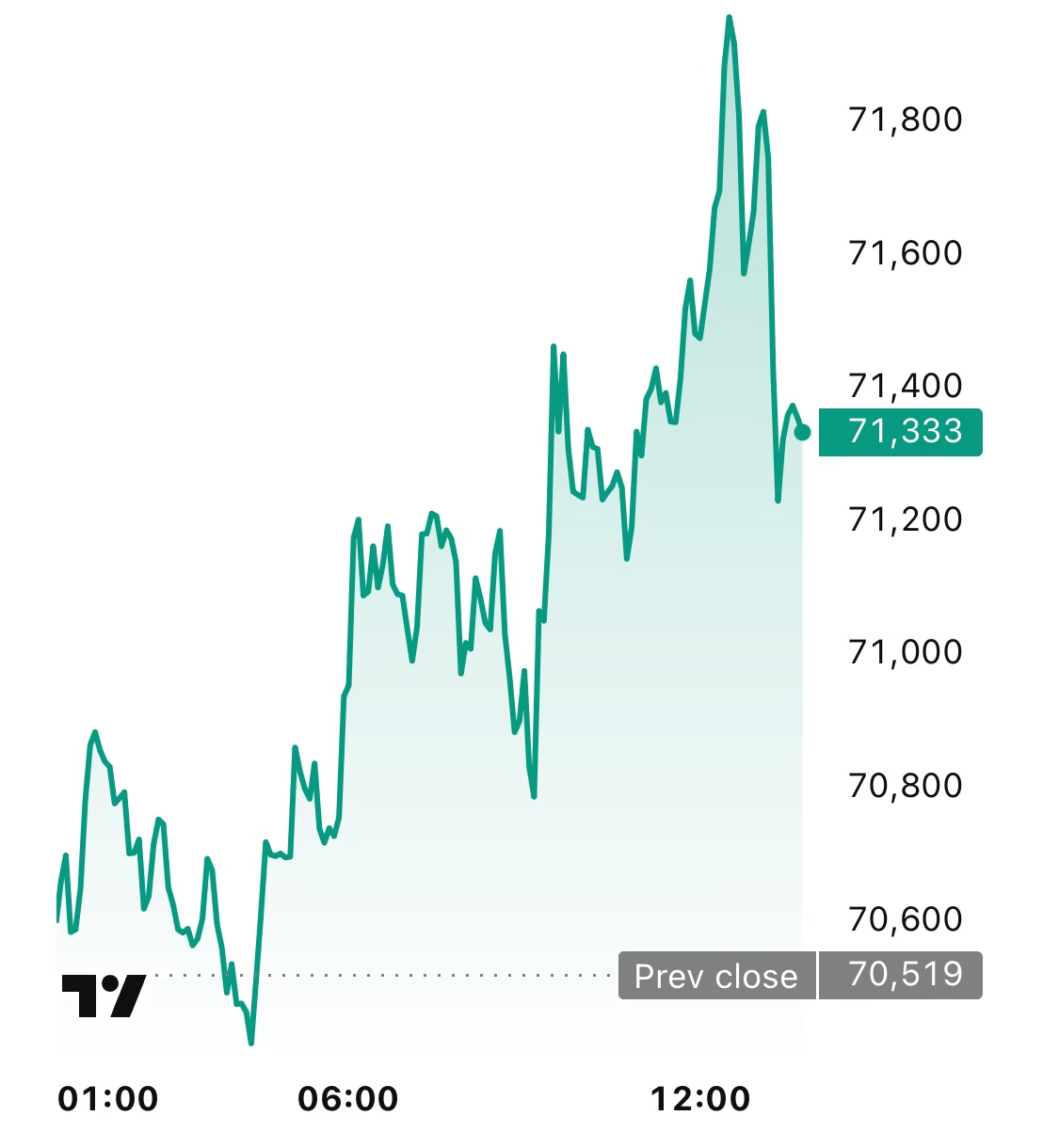
Global conflict does more than reshape geopolitics as it reshapes money. In recent years, Bitcoin has increasingly behaved like a “wartime barometer”: when stakes rise on the battlefield or in diplomatic tensions, demand for the world’s largest cryptocurrency spikes, not because of speculation but because of safety-seeking behavior.
What was once a fringe digital asset is now being treated by investors as a non-sovereign store of value, one that can withstand sanctions, capital controls, and currency collapse.
This shift did not happen overnight. Bitcoin’s evolution into a safe haven is rooted in how modern conflict disrupts traditional markets and exposes vulnerabilities in fiat systems.
In times of crisis, the traits that once made Bitcoin controversial; decentralization, censorship resistance, and borderless liquidity have become its strongest value propositions.
Historically, war and geopolitical tension have caused capital flight away from risk assets toward traditional safe havens like gold, U.S. Treasuries, and the Swiss franc. Bitcoin is now joining that list.
1. Bitcoin Is Non‑Sovereign Money
Unlike fiat currencies controlled by central banks, Bitcoin’s monetary policy is fixed and predictable.
There is no government that can print more Bitcoin in response to war spending, sanctions, or fiscal strain. This makes it especially appealing when trust in sovereign currency weakens.
In war-torn economies such as during the 2022 Ukraine invasion, Bitcoin served as an immediate alternative store of value that could not be devalued or seized by government fiat.
2. Censorship Resistance in Practice
During conflicts, governments often restrict capital flows. Bank accounts can be frozen, international transfers blocked, and digital banking restricted.
Bitcoin operates outside these channels, providing a financial escape hatch unavailable in traditional safe havens.
3. Global Liquidity at All Hours
Unlike gold or equities, Bitcoin markets never close. In times of crisis, 24/7 liquidity allows investors to access capital exactly when needed.
While Bitcoin remains volatile in normal markets, historical patterns suggest it often acts defensively during geopolitical stress:
These trends position Bitcoin as a dual-nature asset: risky in normal conditions, defensive under extraordinary circumstances.
Bitcoin is not replacing gold or sovereign bonds as it is complementing them. Each safe haven has unique strengths and limitations:
Gold
•Strength: Millennia of trust
•Limitation: Illiquid, expensive storage
U.S. Treasuries
•Strength: Highest credit safety
•Limitation: Sensitive to inflation and interest rates
Swiss Franc
•Strength: Stability
•Limitation: Tied to a sovereign economy
Bitcoin
•Strength: Non-sovereign, censorship resistant
•Limitation: High volatility, regulatory uncertainty
Bitcoin’s edge in wartime scenarios lies in its programmability, portability, and independence traits that traditional assets cannot fully replicate.
Bitcoin’s status as a safe haven is debated:
These factors show that Bitcoin is a conditional safe haven, not a universal replacement.
The “wartime barometer” effect illustrates a profound shift: money is no longer solely defined by nation-states. During crises, people migrate capital to systems they trust to survive chaos and Bitcoin is increasingly that system.
As global tensions persist, Bitcoin’s safe-haven narrative will strengthen, shaping how investors think about risk, liquidity, and sovereignty in financial markets.



Copyright © 2025 - The Bit Gazette.

