







- Trending
- Comments
- Latest


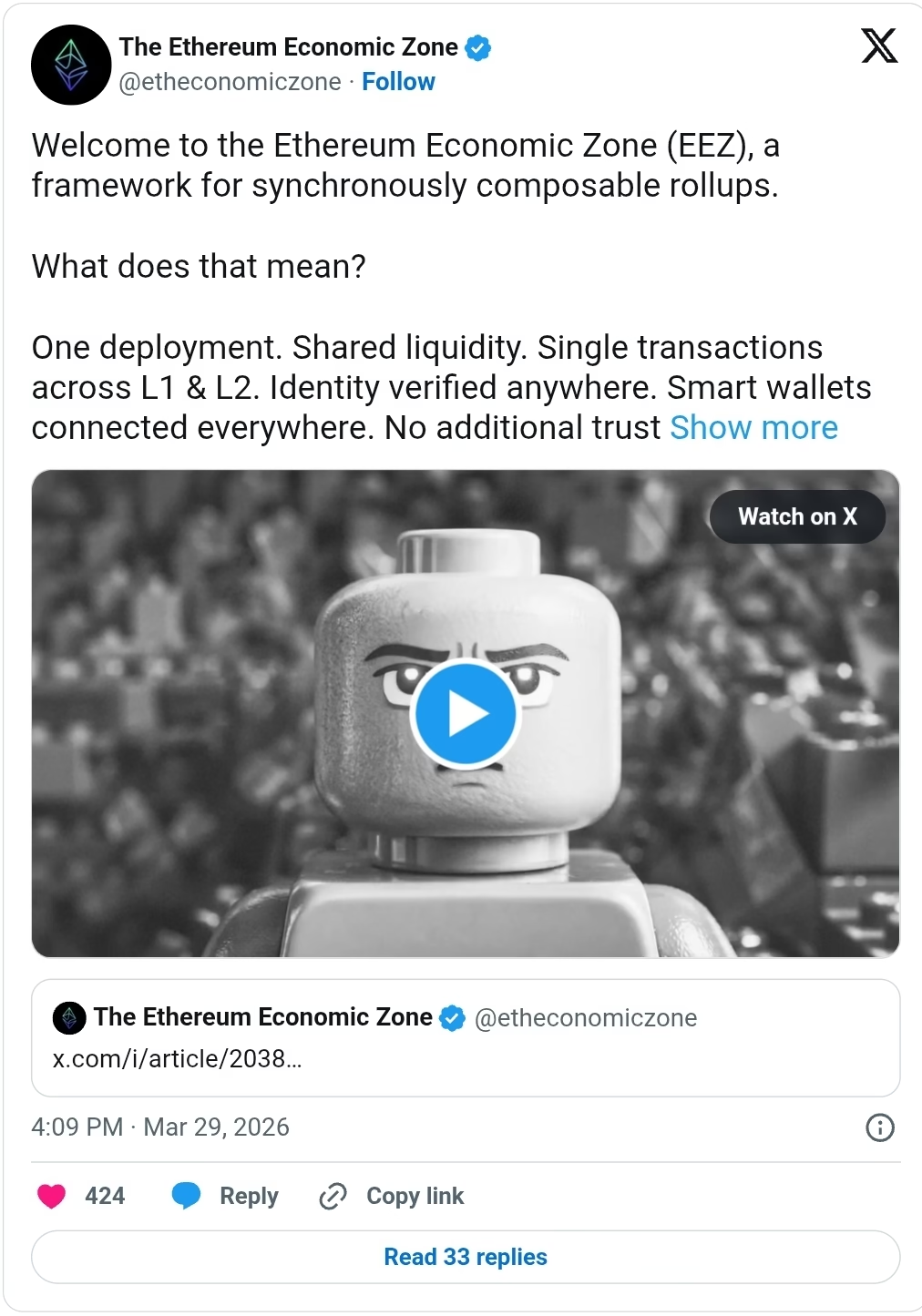
The Ethereum Foundation and a coalition of ecosystem developers unveiled the Ethereum Economic Zone on March 30, 2026, at the EthCC conference in Cannes—a unified framework designed to dissolve fragmentation across layer-2 networks and streamline interactions between previously isolated scaling solutions.
The move comes as Ethereum continues to dominate tokenized asset settlement, accounting for 61.4% of the market, with approximately $206.2 billion in value recorded on-chain, according to Token Terminal data. The Ethereum Economic Zone seeks to ensure that this growth is not undermined by structural inefficiencies within its multi-chain architecture.
Ethereum’s position at the center of real-world asset (RWA) tokenization has strengthened significantly over the past year, with the Ethereum Economic Zone now positioned as a foundational upgrade to sustain that momentum.
Data shows that the total value of tokenized assets on Ethereum has risen by more than 40% compared to the same period last year. This surge reflects increasing institutional and developer interest in blockchain-based financial instruments, particularly in sectors such as stablecoins, tokenized securities, and decentralized finance (DeFi).
However, as adoption accelerates, the need for a more cohesive infrastructure has become apparent. The Ethereum Economic Zone is intended to ensure that rising capital inflows are efficiently utilized rather than trapped within isolated networks.
Ethereum’s scaling strategy has long relied on L2 networks to reduce congestion and transaction costs. While effective in improving throughput, this approach has introduced fragmentation—one of the key issues the Ethereum Economic Zone aims to resolve.
Currently, many L2 networks function as independent ecosystems. Users often need to transfer assets between chains using bridges, a process that can be slow, expensive, and vulnerable to operational risks. Developers also face inefficiencies, as they frequently replicate infrastructure across multiple chains to maintain compatibility.
This fragmentation has led to liquidity silos, where capital remains locked within specific networks instead of flowing freely across the ecosystem. The Ethereum Economic Zone addresses this by creating a unified environment where applications and assets can interact seamlessly, reducing friction for both users and developers.
The Ethereum Economic Zone was introduced by a coalition of leading Ethereum stakeholders, including Gnosis, Zisk, and the Ethereum Foundation. The announcement at EthCC in Cannes marks a coordinated effort to tackle one of the ecosystem’s most persistent structural issues.
Under the Ethereum Economic Zone, applications deployed on different L2 networks can interact instantly without relying on traditional bridging mechanisms. This eliminates a major bottleneck in cross-chain operations and significantly improves user experience.
The framework also unifies liquidity across participating networks, enabling capital to move freely rather than remain confined within individual chains. This is expected to enhance market efficiency and reduce the complexity of managing assets across multiple platforms.
Importantly, the Ethereum Economic Zone maintains ETH as the primary transaction token across the ecosystem, reinforcing consistency and simplifying the user experience. By standardizing core elements of the network, the initiative aims to reduce fragmentation without compromising the benefits of L2 scalability.
The introduction of the Ethereum Economic Zone signals a shift in how Ethereum approaches scalability—moving from a collection of loosely connected networks to a more integrated economic system.
By addressing fragmentation, the Ethereum Economic Zone could unlock new efficiencies in capital allocation, application development, and user interaction. This is particularly significant as competition intensifies among blockchain platforms seeking to dominate the tokenized asset market.
At the same time, the initiative underscores the challenges of scaling decentralized networks without compromising usability. The success of the Ethereum Economic Zone will likely depend on widespread adoption among developers and L2 operators.
As Ethereum continues to lead in tokenized asset settlement, the Ethereum Economic Zone represents a strategic effort to future-proof its infrastructure, ensuring that growth is matched by efficiency and interoperability.



Copyright © 2025 - The Bit Gazette.

