

- Trending
- Comments
- Latest

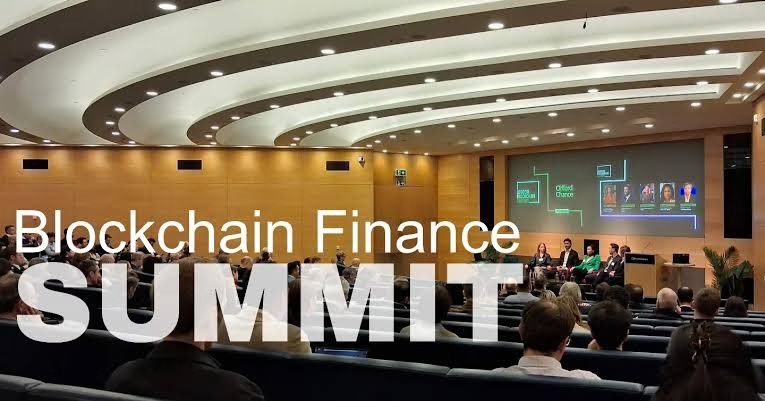
At the London Blockchain Finance Summit on March 12, 2026, financial institution leaders, regulators, and blockchain technologists converged on a shared diagnosis: interoperability barriers, spanning technology, governance, and regulatory frameworks, are the primary constraint on blockchain’s integration into global finance.
The London Blockchain Finance Summit gathered executives from major banks, fintech firms, and blockchain companies, all aligned around a shared goal: translating blockchain from pilot projects into real-world financial infrastructure. Yet despite optimism, discussions repeatedly returned to a central issue—fragmentation.
At the heart of the London Blockchain Finance Summit discussions was a consensus that interoperability is the defining challenge for blockchain’s future in finance. Participants emphasized that systems must communicate seamlessly, not only across different blockchain networks but also between institutions and jurisdictions.
The London Blockchain Finance Summit featured panels and keynotes that focused on bridging these divides, with speakers arguing that without interoperability, blockchain risks remaining siloed and inefficient. The challenge extends beyond technology into governance and regulation, where inconsistent rules across regions create friction for global adoption.
One speaker captured the issue succinctly:
“Public blockchains don’t understand borders and a lot of friction is created by having to contend with different regulations in different jurisdictions.” — Summit speaker
This sentiment echoed across sessions at the London Blockchain Finance Summit, where stakeholders from both TradFi and DeFi stressed the need for common standards and coordinated regulatory approaches.
A recurring theme at the London Blockchain Finance Summit was the need for regulatory clarity and alignment. While blockchain technology continues to mature, participants agreed that institutional adoption will remain limited without consistent legal frameworks.
As one speaker noted: “Regulation is the main driver for blockchain adoption.”, Summit speaker
The London Blockchain Finance Summit examined how varying global approaches—from the European Union’s MiCA framework to evolving legislation in the United States and limited regulation in other jurisdictions—create uncertainty for financial institutions and innovators.
Representatives from regulatory bodies indicated a willingness to support innovation while maintaining oversight. This approach includes integrating digital assets into existing financial systems rather than creating entirely new legal structures.
At the London Blockchain Finance Summit, regulators highlighted initiatives such as sandbox environments that allow firms to test blockchain-based products under supervision. These efforts aim to balance innovation with risk management, providing a pathway for broader adoption.
Beyond regulatory concerns, the London Blockchain Finance Summit underscored the economic case for blockchain—particularly its potential to unlock capital efficiency through tokenization.
Speakers at the London Blockchain Finance Summit pointed out that traditional financial systems often lock capital in illiquid assets, limiting flexibility and slowing transactions. Blockchain-based tokenization, by contrast, enables real-time settlement, improved transparency, and reduced reliance on intermediaries.
Peter Left, Head of Digital and Market Innovation at Lloyds Banking Group, referenced a recent pilot demonstrating these benefits:
“This groundbreaking initiative proves that digital assets can be used in regulated financial markets under existing legal frameworks here in the UK. It’s a major step forward in demonstrating how tokenization can enhance collateral efficiency, reduce friction, and unlock new trading opportunities.” — Peter Left
The London Blockchain Finance Summit also highlighted collaborative efforts such as the Bank for International Settlements’s Project Agorá, which explores tokenized cross-border payments within existing regulatory systems.
These examples reinforced a key message: blockchain’s value proposition lies not just in innovation, but in measurable improvements to financial operations.
Despite the challenges, the overall tone of the London Blockchain Finance Summit was one of cautious optimism. Participants acknowledged that while barriers remain, progress is being made through pilot projects, regulatory engagement, and institutional collaboration.
Victoria McLoughlin of the Financial Conduct Authority emphasized a supportive regulatory stance, noting the importance of fostering innovation without defaulting to restrictive policies. The London Blockchain Finance Summit reflected this balance between oversight and encouragement.
Closing the event, David Palmer of Pair Point stressed the importance of commitment from financial institutions:
“Banks and financial institutions must be willing to upgrade their best product.” — David Palmer
The London Blockchain Finance Summit ultimately positioned interoperability, regulatory unity, and a clear business case as the pillars of future adoption. As financial institutions weigh the costs of transformation, the success of ongoing pilots and collaborations may determine whether blockchain becomes a foundational layer of global finance.
With its next event scheduled for July focusing on real-world asset tokenization, the London Blockchain Finance Summit continues to serve as a platform for shaping how blockchain integrates into the financial system.



Copyright © 2025 - The Bit Gazette.