







- Trending
- Comments
- Latest

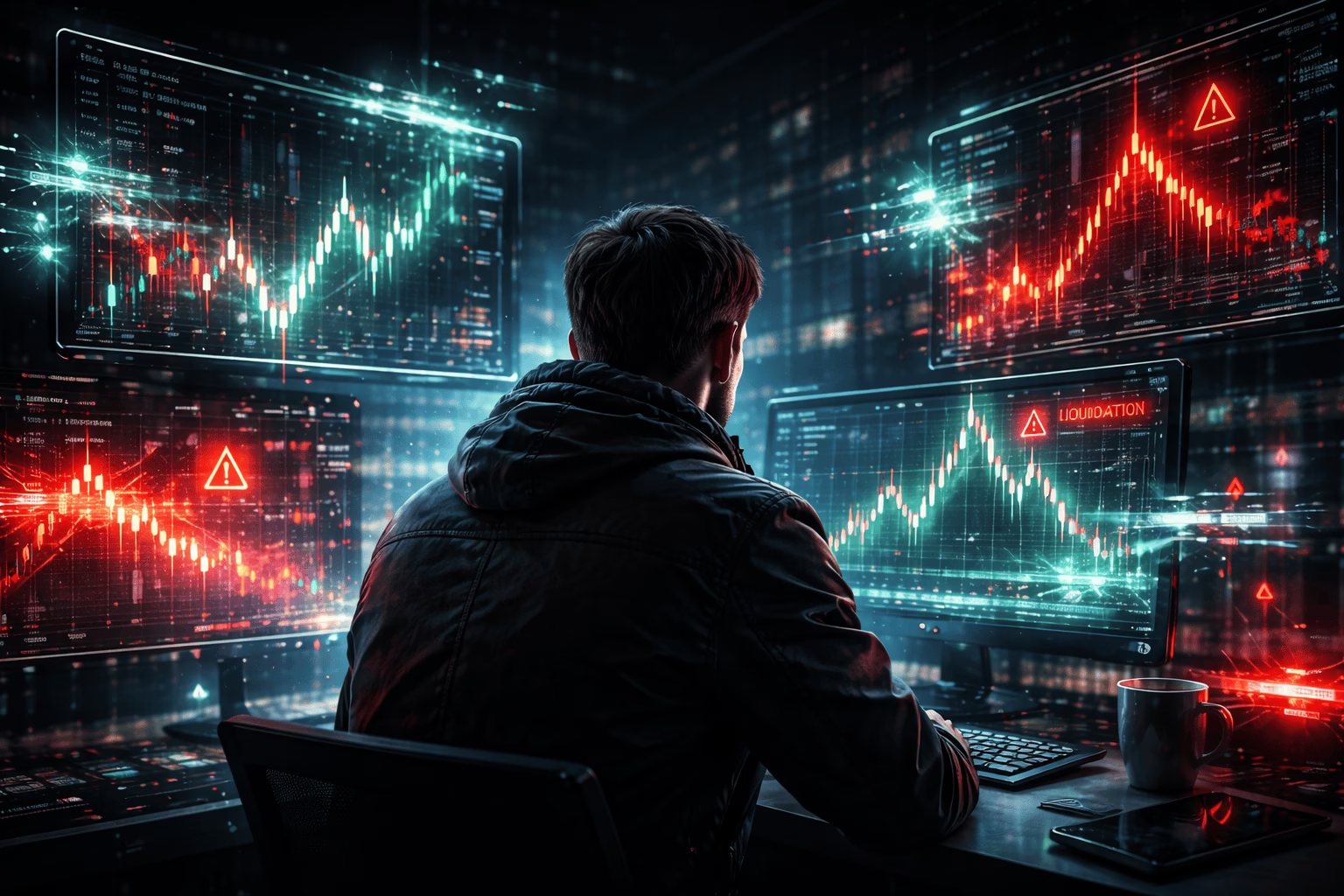
The $100K delusion is no longer just about price targets but it’s about trust. Retail traders are increasingly relying on AI tools for signals, predictions, and market analysis but there’s a problem: AI doesn’t always know when it’s wrong.
In crypto markets, where speed and volatility amplify every decision, AI hallucinations are beginning to translate into real losses. The result is a new kind of risk as one where false information doesn’t just mislead, it liquidates.
The $100K delusion is fueled by a shift in how retail participants interact with the market.
Instead of conducting independent research, many traders now rely on AI tools to:
These systems present answers with confidence, often without clearly communicating uncertainty.
This creates a dangerous dynamic. When AI-generated outputs appear authoritative, traders are more likely to act on them without verification.
AI hallucinations occur when a model generates information that appears accurate but is false or unsupported.
In crypto trading, this can take several forms:
Because crypto markets already operate in an information-scarce environment, these hallucinations can spread quickly and influence behavior before being questioned.
The $100K delusion thrives in this gap between confidence and accuracy.
The transition from misinformation to liquidation is surprisingly fast.
A trader receives a bullish AI-generated signal. They enter a leveraged position expecting upward movement. The market moves in the opposite direction.
Liquidation follows.
This pattern is becoming more common as traders:
The issue is not just that AI can be wrong as it’s that it can be wrong convincingly.
Crypto markets amplify the risks of AI hallucinations more than traditional finance.
Unlike regulated markets, crypto:
Assets like Bitcoin can react instantly to narratives, making them highly sensitive to misinformation.
In this environment, even small inaccuracies can trigger large price movements or cascading liquidations.
One of the most dangerous aspects of the $100K delusion is psychological.
AI does not express doubt the way humans do. It delivers outputs in a structured, confident tone even when the information is flawed.
This creates:
Retail traders are not just following AI as they are trusting it.
The impact of the $100K delusion is not evenly distributed.
The most exposed participants are:
More experienced participants tend to treat AI as a supplement, not a decision-maker. Retail traders often do the opposite.
The timing is not accidental.
Three trends are converging:
Together, they create an environment where AI-driven decisions are becoming normalized.
The $100K delusion is not just about unrealistic price expectations as it is about outsourcing judgment to systems that are not designed for financial certainty.
AI is not going away. If anything, its role in trading will continue to expand.
But the current trajectory raises a critical issue:
accuracy is being replaced by accessibility.
If traders continue to treat AI outputs as signals rather than suggestions, the market may see:
The $100K delusion is not just about whether Bitcoin reaches a price target.
It is about how decisions are being made along the way.
When confidence is generated artificially and acted upon blindly, the result is not just bad trades as it is systemic fragility at the retail level.
AI was meant to assist decision-making. Instead, in many cases, it is replacing it.
And in a market as unforgiving as crypto, that distinction matters.



Copyright © 2025 - The Bit Gazette.

