







- Trending
- Comments
- Latest

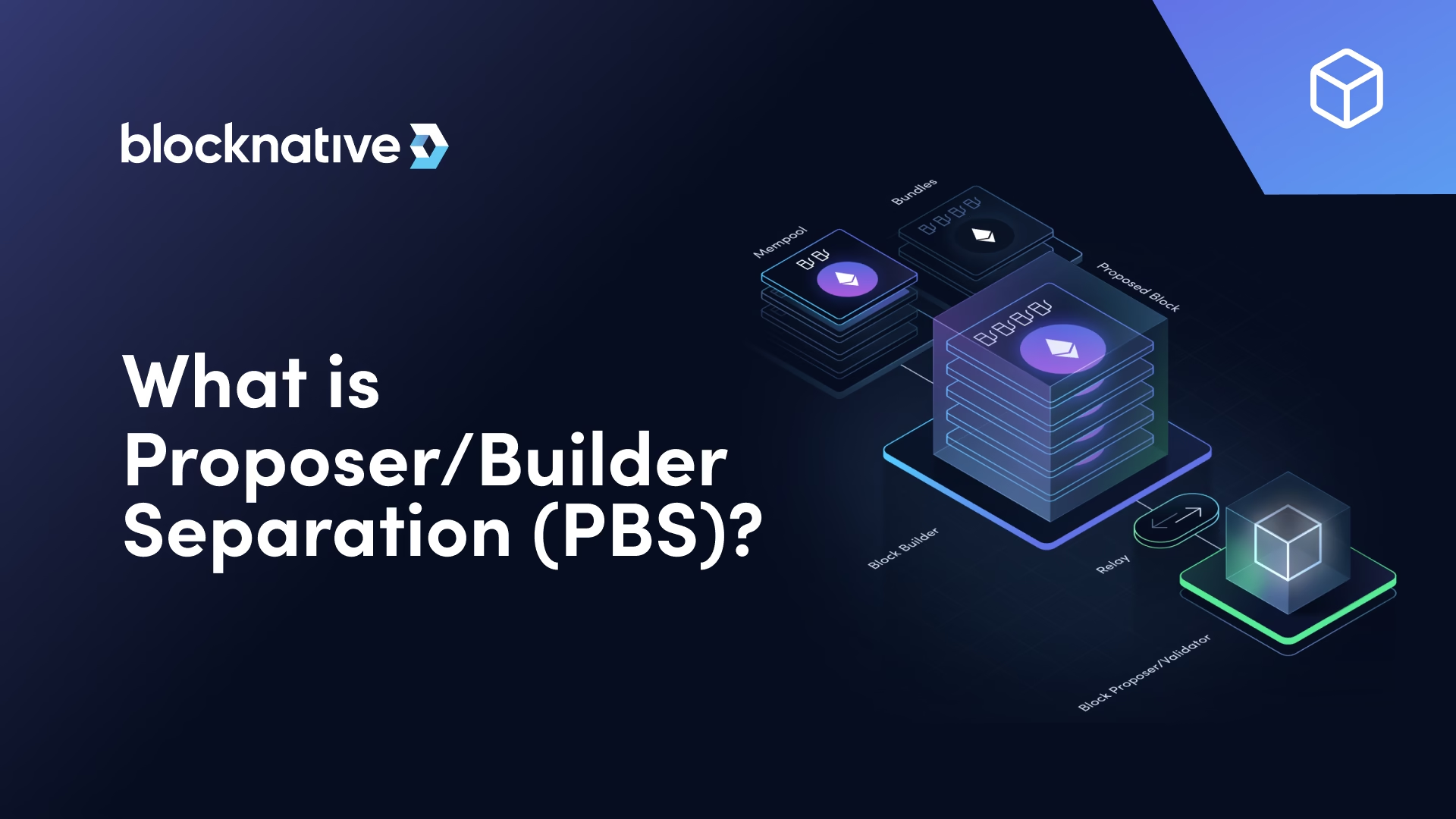
Every time a block is added to Ethereum, someone decides which transactions go in, in what order, and at what price. For years, that power sat with validators, and with it came the opportunity to extract profit by manipulating transaction sequencing, a practice known as MEV.
Proposer-builder separation is Ethereum’s structural response: a design that splits block construction from block publication, introducing market competition where a single actor once had unchecked control.
In the evolving architecture of blockchain systems, particularly within Ethereum, proposer-builder separation (PBS) has emerged as a critical concept aimed at improving how blocks are constructed and validated.
PBS splits the responsibilities of block creation between two distinct actors which are proposers, and builders.
Proposers are responsible for selecting and publishing blocks, while builders specialize in assembling those blocks by selecting and ordering transactions.
This model addresses growing concerns around Maximal Extractable Value (MEV), the profit validators or miners can extract by reordering or inserting transactions.
PBS introduces a marketplace dynamic where builders compete to produce the most valuable block, while proposers simply choose the highest bid.
This separation is designed to reduce centralization risks and improve network efficiency. For a deeper technical overview, see Ethereum’s research documentation.
For crypto investors, PBS is not just a technical upgrade, it directly impacts network trust, validator incentives, and long-term value stability.
By isolating block construction from block proposal, PBS reduces the ability of individual validators to manipulate transaction ordering for profit.
This is particularly important in decentralized finance (DeFi), where front-running and sandwich attacks have historically eroded user confidence.
Ethereum founder, Vitalik, says PBS is a key step toward minimizing harmful MEV and making Ethereum more credibly neutral.
In practical terms, it means they are more predictable transaction outcomes, reduced manipulation risk, and improved fairness for retail users.
Investors should view PBS as part of Ethereum’s broader effort to strengthen its position as the leading smart contract platform.
Under PBS, the workflow is divided into a few key steps:
This system is already partially implemented through MEV-Boost, a middleware developed by Flashbots that enables validators to outsource block building.
In a recent report, it was noted that MEV-Boost allows validators to access a competitive block-building market, increasing their rewards without additional complexity.
However, current implementations are still considered off-chain solutions. The long-term goal is to integrate PBS directly into Ethereum’s protocol, often referred to as enshrined PBS.
Despite its advantages, PBS is not without controversy or technical hurdles. Critics argue that introducing specialized builders could lead to new forms of centralization, where a small number of sophisticated entities dominate block construction.
Additionally, concerns remain around transparency and censorship. If builders control transaction ordering, they could theoretically exclude certain transactions based on economic or regulatory pressures.
Ethereum researchers are actively working on solutions, including cryptographic techniques like commit-reveal schemes and encrypted mempools, to ensure that PBS does not compromise decentralization.
Looking ahead, PBS is expected to play a central role in Ethereum’s roadmap, particularly as the network scales and competition among Layer 1 blockchains intensifies.
Proposer-builder separation represents a fundamental shift in how blockchain networks handle transaction ordering and block production.
For crypto investors, it signals Ethereum’s commitment to reducing manipulation, improving fairness, and maintaining its competitive edge.
While challenges remain, PBS is seen as a necessary evolution in the fight against MEV abuse and centralization risks.



Copyright © 2025 - The Bit Gazette.

