


- Trending
- Comments
- Latest

Crypto exchange Bybit added the Rwandan franc to its peer-to-peer platform on April 6, 2026, and the National Bank of Rwanda responded the same day, reminding residents that cryptocurrency transactions involving the local currency remain illegal under Rwandan law.
In a statement shared on X, the central bank clarified that under the current legal framework, crypto-assets cannot be used for payments, conversions involving the franc, or peer-to-peer trading. The Rwanda crypto ban applies broadly to both individuals and financial institutions operating within the country.
Regulators emphasized that the Rwandan franc remains the only recognized legal tender, underscoring the government’s continued commitment to maintaining monetary control and financial stability. The move highlights ongoing tensions between global crypto expansion and national regulatory frameworks.
The enforcement of the Rwanda crypto ban is rooted in concerns over consumer protection and systemic risk. Authorities issued a strong warning to residents, cautioning against engaging in crypto-related transactions involving the franc.
“Serious financial risks and no recourse in case of loss,” — National Bank of Rwanda, in a statement on X.
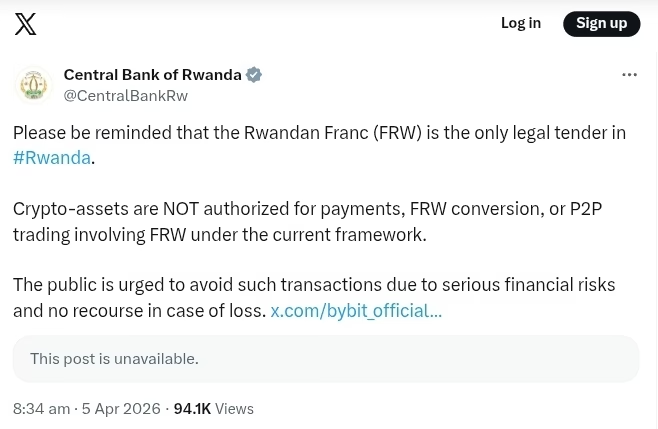
This warning reflects broader regulatory concerns about the volatility of digital assets, lack of investor protections, and the potential for financial losses without legal safeguards. The Rwanda crypto ban also extends to licensed financial institutions, which are explicitly prohibited from facilitating conversions between FRW and crypto-assets.
By reinforcing these restrictions, regulators aim to limit exposure to unregulated financial products and prevent potential disruptions to the domestic financial system. The Rwanda crypto ban thus serves as both a protective measure for consumers and a safeguard for national economic stability.
The Rwanda crypto ban is not a new development but part of a long-standing policy position. Since 2018, Rwanda has maintained a cautious and restrictive approach toward cryptocurrencies, prioritizing financial system integrity and currency sovereignty.
At the same time, the government has explored alternatives through innovation. Efforts are underway to develop a state-backed digital currency, the e-franc rwandais, which remains in the proof-of-concept phase and could advance to pilot testing in the future.
In parallel, the Capital Market Authority has proposed a draft regulatory framework aimed at supporting “responsible innovation” in the crypto sector. However, even within this framework, the Rwanda crypto ban remains intact, with strict limitations on the use of crypto as legal tender, as well as restrictions on mining activities, mixer services, and tokens linked to the franc.
Data from Chainalysis indicates that Rwanda ranks relatively low in crypto adoption compared to regional peers such as Nigeria and South Africa. This trend aligns with the country’s regulatory posture, where the Rwanda crypto ban continues to shape market participation.
Despite regulatory resistance, Bybit has continued to expand its global footprint, including the introduction of new fiat on-ramps and product offerings. The addition of Rwandan franc support on its P2P platform appears to have tested the boundaries of the Rwanda crypto ban, triggering swift clarification from authorities.
As of press time, Bybit has not issued an official response to the central bank’s statement. However, the exchange has been actively pursuing growth strategies, including the rollout of stablecoin yield products and fixed-income-style investment options aimed at attracting users during uncertain market conditions.
The situation underscores the growing friction between global crypto platforms and national regulators. While exchanges seek to broaden access and increase adoption, policies such as the Rwanda crypto ban highlight the limits imposed by local legal frameworks.
Ultimately, the reaffirmation of the Rwanda crypto ban signals that Rwanda remains firmly committed to its cautious approach, even as the global crypto industry continues to evolve. The coming months may determine whether regulatory frameworks adapt to accommodate innovation or maintain strict boundaries in the face of rapid technological change.



Copyright © 2025 - The Bit Gazette.