







- Trending
- Comments
- Latest


Audits check whether code is written correctly. They do not check whether the people operating that code can be manipulated, compromised, or deceived. The Drift Protocol hack is the latest demonstration of what happens when those two things are treated as the same problem, and they are not.
While audits check if code is written correctly, they often fail to validate if the underlying economic logic or human operations are secure, leading to hacks even on audited protocols.
For over half a decade, audits have functioned as DeFi’s security currency. A protocol with multiple audit reports signals legitimacy, reliability, and reduced risk. But the Drift Protocol hack exposes the ceiling of that model.
Audits secure what they can see code paths, logic flaws, execution risks. They do not secure relationships, internal processes, or human judgment. Drift followed the industry playbook: audits completed, security posture maintained, expectations met. Yet none of that mattered because the attack bypassed the code layer entirely.
This creates a dangerous imbalance. As the industry overinvests in code-level defenses, it underinvests in the operational layer where trust is negotiated daily. Data from Chainalysis already shows a growing share of exploits emerging from off-chain vectors phishing, credential compromise, and insider manipulation.
The implication is simple: audits are necessary, but no longer sufficient.
What defines the Drift Protocol hack is not just the breach, but the method. This was not a technical exploit it was a human one.
Relationships were built. Trust was earned. Legitimacy was performed over time.
This is the evolution of crypto risk. Attackers are shifting from exploiting vulnerabilities in code to exploiting vulnerabilities in coordination. As Immunefi notes in its 2025 losses report, operational security failures are becoming a dominant cause of losses across Web3.
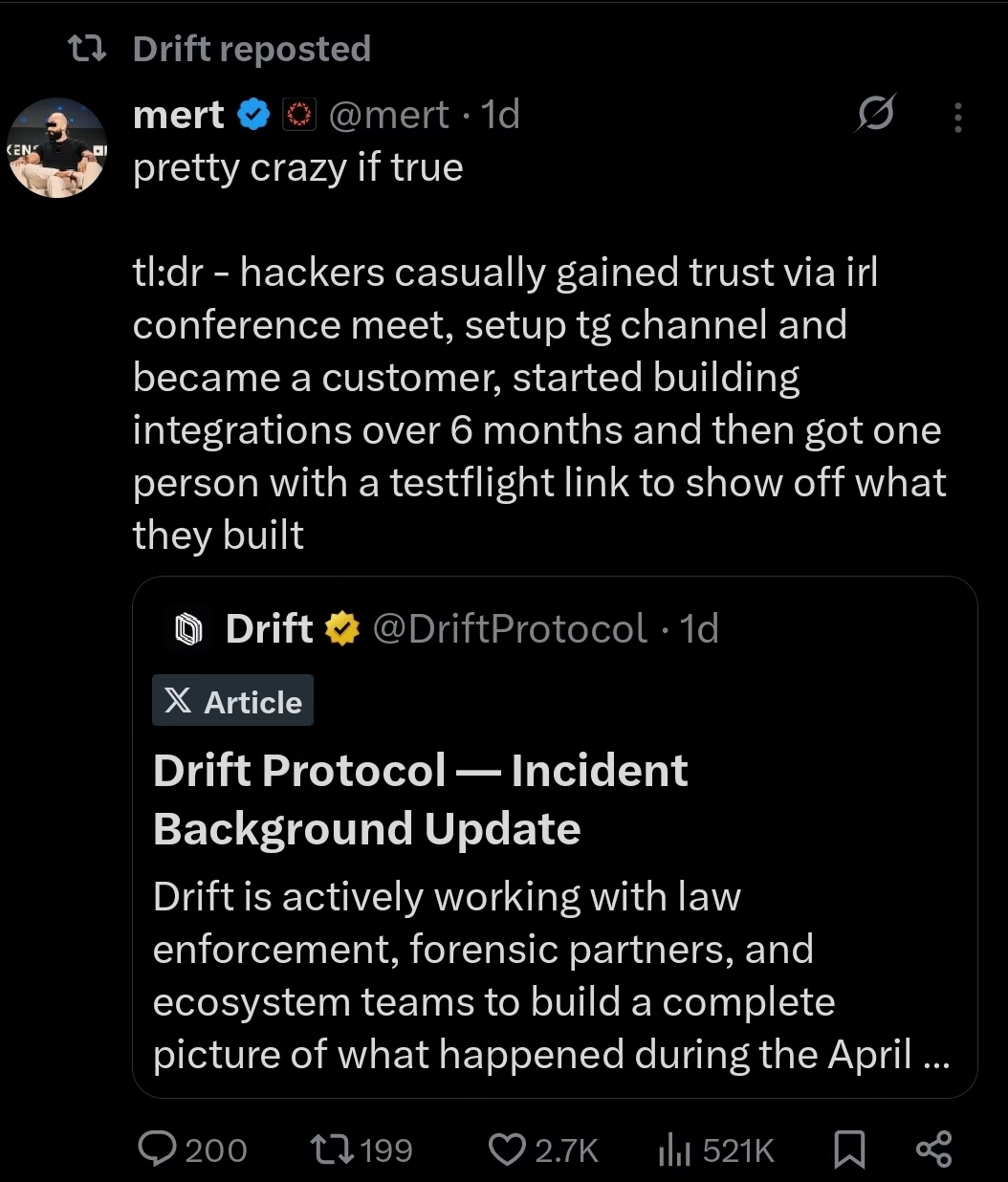
The uncomfortable reality is that social engineering scales better than smart contract exploitation. You cannot patch human psychology. You cannot audit a conversation in a private channel or a handshake at a conference. By the time the attack executes, the outcome has often already been decided.
The Drift Protocol hack makes one thing clear: the technical layer is no longer the primary battlefield.
Multisignature wallets are often presented as a solution to centralized risk distribute keys, distribute trust. But this model carries a hidden assumption: that keyholders themselves are secure.
That assumption is fragile.
In practice, multisig security collapses to its weakest participant. Compromise a subset of signers through phishing, malware, or long-term infiltration and the system begins to unravel. The Drift Protocol hack illustrates how attackers increasingly target individuals rather than infrastructure.
This is not a failure of multisig technology, but of how it is operationalized. Without strict controls device isolation, secure communication channels, enforced protocols multisig becomes a psychological safeguard more than a technical one.
Decentralization of keys does not equal decentralization of risk. In many cases, it redistributes risk into less visible, less controlled human layers.
The core lesson is not incremental it is structural. The industry’s security model is incomplete.
DeFi has built sophisticated defenses around code, but has largely ignored the human systems that operate that code. This creates what the Bank for International Settlements describes as “accountability gaps” in decentralized structures, where responsibility is fragmented and oversight is unclear.
Closing this gap requires a shift in how security is defined:
Some institutional platforms are already moving in this direction. Fireblocks’ security architecture emphasizes layered defenses that integrate human and system-level protections. But across DeFi, adoption remains inconsistent.
Protocols that continue to prioritize only code security are mispricing their exposure. Those that recognize and mitigate DeFi human trust risk may emerge as structurally more resilient in a maturing market.
The deeper truth is this: DeFi did not eliminate trust it redistributed it. And in doing so, it created new, underprotected surfaces where that trust can be exploited.
Until the industry confronts this reality, incidents like the Drift Protocol hack will not be exceptions they will be patterns.



Copyright © 2025 - The Bit Gazette.

