


- Trending
- Comments
- Latest

In Lagos, a freelance designer quotes her rates in USDT. A spare parts importer mentally converts every price to dollars before agreeing to a deal. A small business owner tracks the naira-dollar rate before setting his prices each morning. None of this is policy, it is survival, and it is reshaping how value moves across one of Africa’s largest economies.
To understand the rise of the Lagos digital dollar trend, you have to start with a simple premise: people move away from systems that fail them. In Nigeria, persistent currency depreciation and inflation have eroded confidence in the naira, forcing individuals and businesses to look for more stable alternatives.
This is not unique to Nigeria, but the scale and speed at which it is happening in Lagos make it particularly significant. The city has effectively become ground zero for a broader West African financial shift.
Stablecoins have emerged as the backbone of the Lagos digital dollar trend, offering a practical workaround to the limitations of traditional banking.
Assets like USDT and USDC allow users to hold dollar-denominated value without needing access to foreign bank accounts. This accessibility has fundamentally changed how people interact with money.
According to Chainalysis, Sub-Saharan Africa continues to rank among the fastest-growing crypto regions globally, with stablecoins playing a dominant role in transaction volumes. That data reflects something deeper: the Lagos digital dollar trend is not speculative it is functional.
What makes this shift more powerful is that it is moving beyond savings into pricing behavior. The Lagos digital dollar trend is increasingly influencing how goods and services are valued.

Freelancers now quote rates in dollars, importers benchmark costs against stablecoin equivalents, and even small businesses informally adjust prices based on exchange rate movements.
This signals a deeper transformation. When pricing starts to shift, the entire economic framework begins to follow, and the Lagos digital dollar trend becomes more than just a he it becomes a standard.
At the same time, a parallel financial system is quietly taking shape. The Lagos digital dollar trend is enabling users to bypass traditional banking infrastructure entirely.
Transactions that once required intermediaries can now be executed peer-to-peer within minutes. This shift is being accelerated by informal networks—WhatsApp groups, OTC brokers, and community-based exchanges—which are spreading adoption faster than any centralized system could.
As Balaji Srinivasan has noted in broader discussions on digital currencies, people naturally gravitate toward systems that preserve their economic agency. In Lagos, that principle is playing out in real time through the Lagos digital dollar trend.
This evolution is not without friction. Regulators, including the Central Bank of Nigeria, have historically taken a cautious stance toward cryptocurrency activity.
However, the Lagos digital dollar trend is advancing regardless of regulatory posture. When financial tools become essential for daily survival, adoption tends to outpace policy. This creates a growing tension between control and necessity, one that policymakers will eventually have to address.
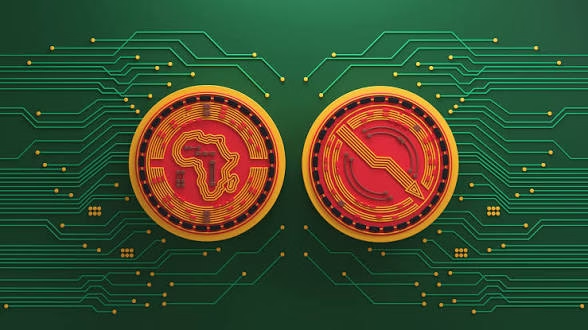
Beyond Nigeria, the implications of the Lagos digital dollar trend are spreading across West Africa. Similar patterns are emerging in neighboring economies, where stablecoin usage is rising and dollar-based thinking is becoming more common. What started as a localized response is evolving into a regional recalibration of financial behavior.
The Lagos digital dollar trend is no longer just about Lagos—it is becoming a blueprint for how emerging markets adapt to currency instability.
Still, it would be naive to ignore the risks. The Lagos digital dollar trend introduces new dependencies, particularly on external monetary systems and digital infrastructure. There are also concerns around regulatory crackdowns, platform security, and long-term monetary sovereignty.
If a significant portion of economic activity shifts toward dollar-linked assets, local central banks may find their policy tools less effective. These are structural challenges that cannot be dismissed.
Yet for many participants, the trade-off is clear. The immediate stability offered by the Lagos digital dollar trend outweighs the uncertainties that come with it. This is the essence of the “Lagos Flip”—a gradual but decisive move away from reliance on local currency toward a more stable, digitally accessible alternative.
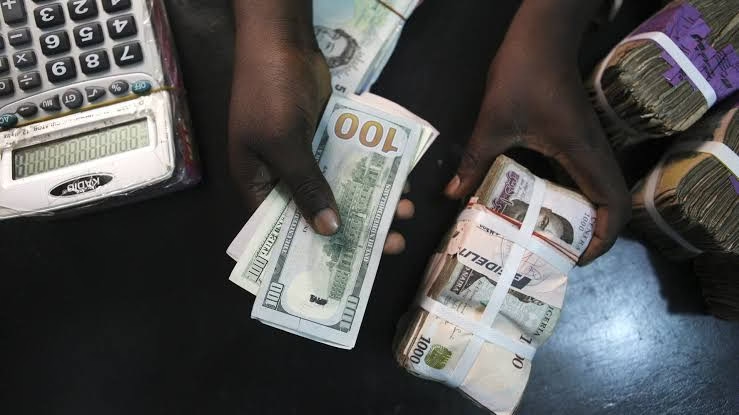
Ultimately, the Lagos digital dollar trend reflects a broader truth about financial systems: they are only as strong as the trust people place in them.
When that trust weakens, alternatives emerge often faster than expected. In Lagos, that transition is already well underway. What appears today as an emerging trend may soon become the default framework for how value is measured and exchanged across the region.



Copyright © 2025 - The Bit Gazette.