• Trending
  • Comments
  • Latest
AI People joins Dubai’s innovation one — Declares war on the forgetting of humanity

AI People joins Dubai’s Innovation One program: Declares war on the forgetting of humanity

07/22/2025 - Updated on 07/23/2025
XRP community

Ripple CEO reassures community after SWIFT selects rival blockchain for pilot

02/10/2026
FBI nabs Nigerian ‘tech queen’ Sapphire Egemasi in multi-million dollar fraud scheme

FBI arrests Nigerian ‘tech queen’ Sapphire Egemasi in $1.3M heist targeting U.S. government

06/05/2025 - Updated on 06/17/2025
Polygon Discord Channel Hacked, Throws Crypto Community in Turmoil

Polygon Discord Channel Hacked, Throws Crypto Community in Turmoil

2
Bitcoin reclaims $107,000 as Iran-Israel ceasefire cools market tensions

Bitcoin reclaims $107,000 as Iran-Israel ceasefire cools market tensions

2

Hello world!

1
Tempo Zones

Tempo’s new privacy feature gives operators power to freeze accounts and crypto isn’t happy about it

04/17/2026
Decentralized identity could reshape Web3—if it ever gets adopted

Institutions just bet $584 million that Web3’s future is invisible

04/17/2026
Network Difficulty Adjustment

Bitcoin’s self-correcting clock: How difficulty adjustment keeps the network honest

04/17/2026
  • Trending
  • Comments
  • Latest
AI People joins Dubai’s innovation one — Declares war on the forgetting of humanity

AI People joins Dubai’s Innovation One program: Declares war on the forgetting of humanity

07/22/2025 - Updated on 07/23/2025
XRP community

Ripple CEO reassures community after SWIFT selects rival blockchain for pilot

02/10/2026
FBI nabs Nigerian ‘tech queen’ Sapphire Egemasi in multi-million dollar fraud scheme

FBI arrests Nigerian ‘tech queen’ Sapphire Egemasi in $1.3M heist targeting U.S. government

06/05/2025 - Updated on 06/17/2025
Polygon Discord Channel Hacked, Throws Crypto Community in Turmoil

Polygon Discord Channel Hacked, Throws Crypto Community in Turmoil

2
Bitcoin reclaims $107,000 as Iran-Israel ceasefire cools market tensions

Bitcoin reclaims $107,000 as Iran-Israel ceasefire cools market tensions

2

Hello world!

1
Tempo Zones

Tempo’s new privacy feature gives operators power to freeze accounts and crypto isn’t happy about it

04/17/2026
Decentralized identity could reshape Web3—if it ever gets adopted

Institutions just bet $584 million that Web3’s future is invisible

04/17/2026
Network Difficulty Adjustment

Bitcoin’s self-correcting clock: How difficulty adjustment keeps the network honest

04/17/2026
Friday, April 17, 2026
  • Login
The Bit Gazette
  • Home
  • Crypto News
  • Expert Analysis
  • Finance
  • Tech
  • Sponsored
  • Press Release
  • Opinion
No Result
View All Result
The Bit Gazette
No Result
View All Result
Home Crypto Explained

Bitcoin’s self-correcting clock: How difficulty adjustment keeps the network honest

As global hash power surges and fluctuates, Network Difficulty Adjustment remains the silent force keeping blockchain systems balanced and secure.

by Elizabeth Omotoke
2 hours ago
in Crypto Explained
Reading Time: 4 mins read
0
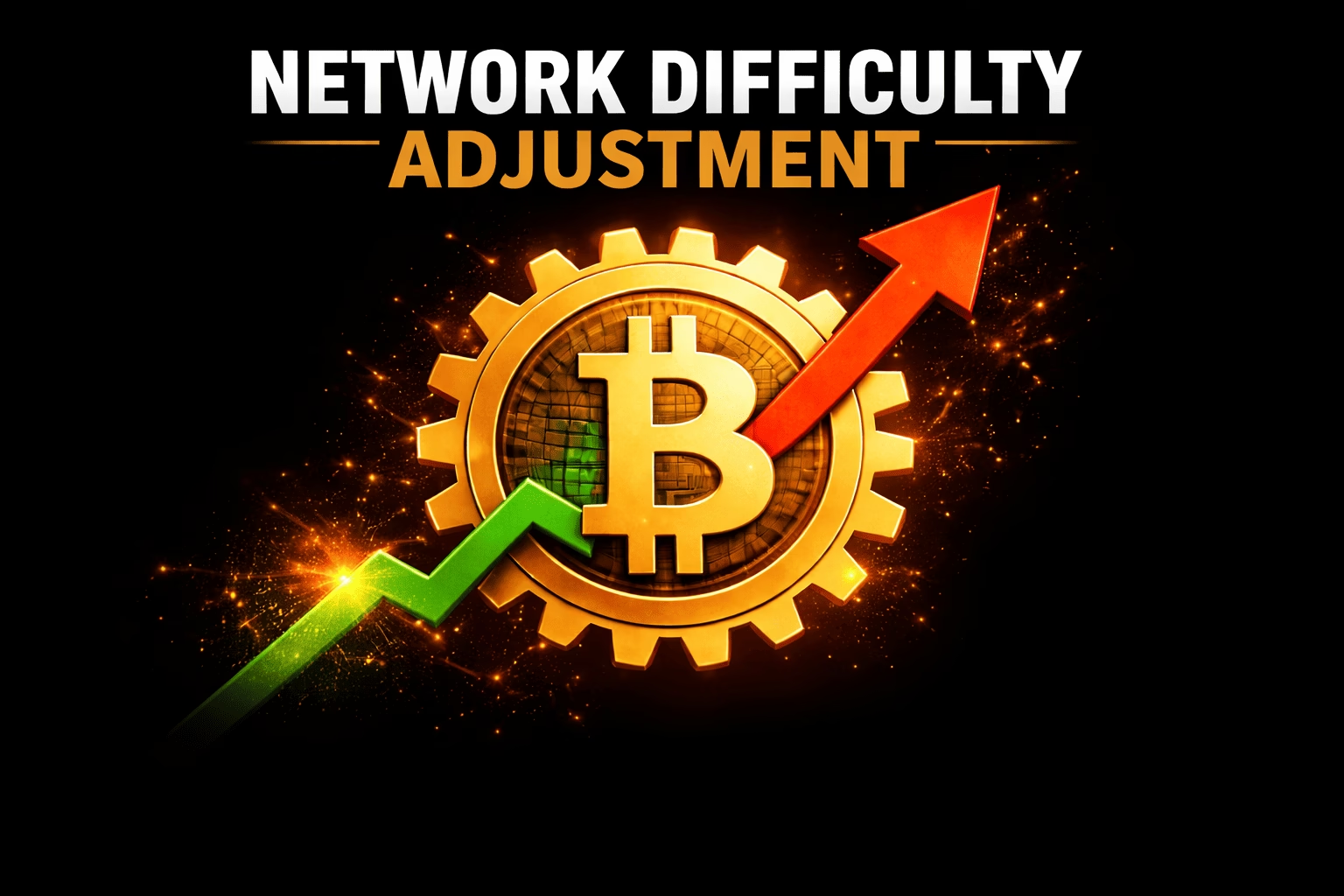
Network Difficulty Adjustment

Network Difficulty Adjustment

Share on FacebookShare on Twitter

Every ten minutes, Bitcoin is supposed to produce a block. It doesn’t always cooperate. Millions of machines join and leave the network constantly, hash rates swing, and energy economics shift overnight, yet the rhythm holds. That’s not an accident. It’s a self-correcting mechanism built into the protocol from day one.

Without Network Difficulty Adjustment, blockchain networks would struggle to function reliably. Periods of intense mining activity could flood the network with blocks, while sudden drops in participation could bring transaction processing to a crawl. Instead, Network Difficulty Adjustment acts as a built-in stabilizer, preserving both timing and trust.

What Network Difficulty Adjustment Really Means

At its core, Network Difficulty Adjustment determines how challenging it is for miners to validate a new block. Mining, the backbone of proof-of-work systems, requires solving complex cryptographic puzzles. The “difficulty” defines how hard that puzzle is at any given time.

As more miners join the network, computational power—known as hash rate—rises sharply. Network Difficulty Adjustment responds by increasing the complexity of the puzzle, ensuring blocks are not produced too quickly. Conversely, when miners exit and hash power drops, Network Difficulty Adjustment lowers the barrier, allowing block production to continue at a steady pace.

Why Network Difficulty Adjustment Is Critical to Blockchain Health

Most blockchain networks operate with a target block time. For instance, Bitcoin aims to produce a block roughly every 10 minutes. Network Difficulty Adjustment ensures that this schedule holds, regardless of external conditions.

If blocks are generated too quickly, the consequences can be severe: accelerated coin issuance, increased likelihood of chain splits, and reduced system stability. On the other hand, if block production slows, transaction confirmations lag, frustrating users and weakening network efficiency.

Network Difficulty Adjustment prevents both extremes. By continuously fine-tuning mining difficulty, it keeps issuance predictable and operations smooth.

As Satoshi Nakamoto explained in early design discussions, “The proof-of-work difficulty is determined by a moving average targeting a constant number of blocks per hour.” That principle remains foundational today.

How Network Difficulty Adjustment Works in Practice

The mechanics behind Network Difficulty Adjustment are straightforward but powerful. The system monitors how long it takes to mine a set number of blocks and compares that to the expected timeframe.

In Bitcoin, Network Difficulty Adjustment occurs every 2,016 blocks—roughly once every two weeks. If those blocks were mined faster than expected, difficulty increases. If they took longer, difficulty decreases.

This feedback loop allows Network Difficulty Adjustment to respond to real-world conditions without human intervention. Some newer blockchain networks have taken this concept further, implementing per-block adjustments that react instantly to changes in hash rate, improving responsiveness and efficiency.

Market Impact, Miner Economics, and Security

For miners, Network Difficulty Adjustment directly influences profitability. Higher difficulty means more computational effort and energy consumption, reducing margins unless offset by higher asset prices. Lower difficulty, by contrast, can temporarily boost rewards.

But beyond economics, Network Difficulty Adjustment is a cornerstone of blockchain security. A higher difficulty level makes it significantly more expensive for malicious actors to execute attacks, such as attempting to rewrite transaction history.

Recent trends highlight its growing importance. Mining difficulty on Bitcoin has repeatedly reached record highs, reflecting increased institutional participation and the deployment of advanced mining hardware. Meanwhile, networks like Ethereum have moved away from mining altogether following The Merge, replacing traditional mechanisms with validator-based systems.

Smaller blockchain projects, however, continue to grapple with volatile participation, where unstable Network Difficulty Adjustment can lead to erratic block times and inconsistent performance.

Conclusion

Network Difficulty Adjustment remains one of the most vital yet underappreciated components of blockchain architecture. By continuously balancing mining effort with network conditions, Network Difficulty Adjustment ensures stable block production, predictable issuance, and robust security.

Tags: Bitcoinblockchain fundamentalsBlockchain Securitycrypto miningdifficulty adjustmentdigital assetshash ratemining difficultymining economicsnetwork consensusnetwork stabilityproof-of-work
Share197Tweet123
Elizabeth Omotoke

Elizabeth Omotoke

  • Trending
  • Comments
  • Latest
AI People joins Dubai’s innovation one — Declares war on the forgetting of humanity

AI People joins Dubai’s Innovation One program: Declares war on the forgetting of humanity

07/22/2025 - Updated on 07/23/2025
XRP community

Ripple CEO reassures community after SWIFT selects rival blockchain for pilot

02/10/2026
FBI nabs Nigerian ‘tech queen’ Sapphire Egemasi in multi-million dollar fraud scheme

FBI arrests Nigerian ‘tech queen’ Sapphire Egemasi in $1.3M heist targeting U.S. government

06/05/2025 - Updated on 06/17/2025
Polygon Discord Channel Hacked, Throws Crypto Community in Turmoil

Polygon Discord Channel Hacked, Throws Crypto Community in Turmoil

2
Bitcoin reclaims $107,000 as Iran-Israel ceasefire cools market tensions

Bitcoin reclaims $107,000 as Iran-Israel ceasefire cools market tensions

2

Hello world!

1
Tempo Zones

Tempo’s new privacy feature gives operators power to freeze accounts and crypto isn’t happy about it

04/17/2026
Decentralized identity could reshape Web3—if it ever gets adopted

Institutions just bet $584 million that Web3’s future is invisible

04/17/2026
Network Difficulty Adjustment

Bitcoin’s self-correcting clock: How difficulty adjustment keeps the network honest

04/17/2026
The Bit Gazette

Copyright © 2025 - The Bit Gazette.

Navigate Site

  • About
  • Advertise
  • Privacy & Policy
  • Contact

Follow Us

Welcome Back!

Login to your account below

Forgotten Password?

Retrieve your password

Please enter your username or email address to reset your password.

Log In
No Result
View All Result
  • Home
  • Crypto News
  • Expert Analysis
  • Finance
  • Tech
  • Sponsored
  • Press Release
  • Opinion

Copyright © 2025 - The Bit Gazette.