

- Trending
- Comments
- Latest

Foundation is gone. The platform that sold Edward Snowden’s NFT for $5 million, hosted some of digital art’s most celebrated creators, and processed $230 million in primary sales couldn’t survive the market it helped create. Its closure isn’t just a business failure, it’s a verdict.
At its peak in 2021, Foundation embodied what many believed Web3 could become—a decentralized renaissance for digital artists. It processed over $230 million in primary NFT sales, hosted globally recognized creators, and even facilitated the sale of Stay Free by Edward Snowden. Back then, value was driven by culture. Ownership meant identity. Scarcity created status.
But the Web3 Art Gallery Collapse shows what happens when those drivers lose momentum. As speculative demand cooled, the market began asking harder questions mainly, what does this asset actually do?
Foundation’s attempted sale to Blackdove was supposed to be a lifeline. Instead, its collapse became confirmation.
Founder Kayvon Tehranian admitted the goal was continuity under new ownership. When that fell apart, there was no fallback. The platform could not sustain itself.
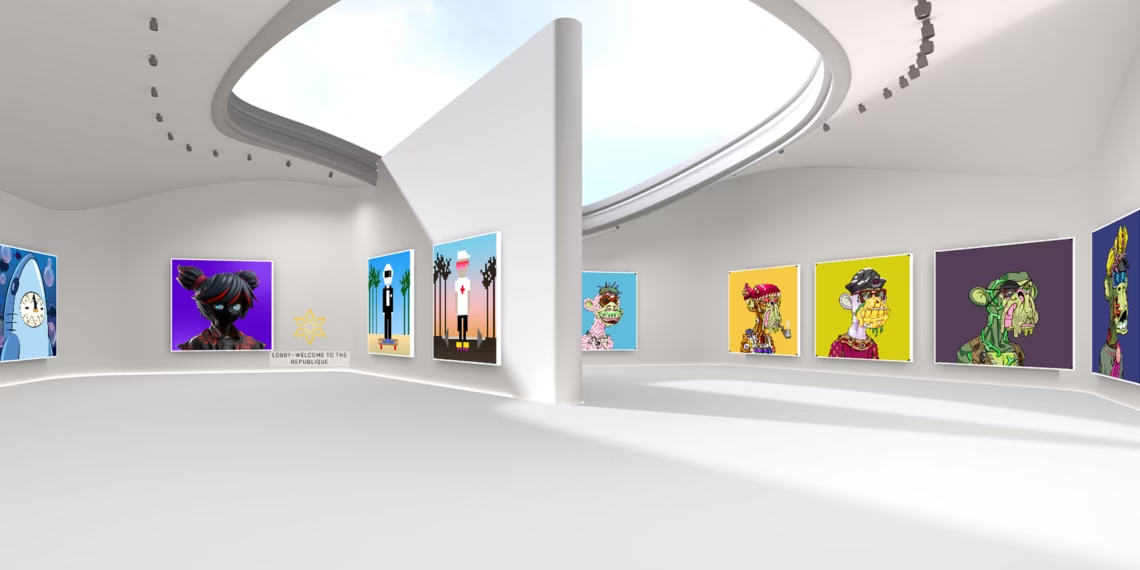
That moment didn’t cause the Web3 Art Gallery Collapse it exposed it. A business model built on primary sales and cultural hype simply couldn’t survive in a market where liquidity had dried up.
Here’s where the shift becomes undeniable. The Web3 Art Gallery Collapse is ultimately a story about capital moving elsewhere. Today’s crypto market prioritizes assets that generate yield, power ecosystems, or enable financial coordination.
Art NFTs especially standalone ones struggle in that environment.
Even within NFTs, the narrative has evolved toward gaming assets, digital identity, and real-world integrations. The idea of a curated digital gallery, once revolutionary, now feels incomplete.
Yat Siu has long argued that the next phase of Web3 centers on functional ownership. That perspective aligns directly with the realities driving the Web3 Art Gallery Collapse.
Blaming competitors misses the point. Yes, platforms like OpenSea and Blur dominate trading activity. But the Web3 Art Gallery Collapse wasn’t caused by them it was caused by a shrinking market.
When liquidity disappears, niche platforms are the first to feel it. Foundation’s reliance on new entrants and primary sales made it especially vulnerable. This is why the Web3 Art Gallery Collapse has played out across multiple platforms, not just one.
Here’s the part most people won’t say outright: the market overestimated demand for digital art at scale. That doesn’t mean digital art has no value. It means the infrastructure built around it was too large for the actual level of sustained demand. The Web3 Art Gallery Collapse is what happens when supply, expectations, and reality finally align.
The collapse doesn’t mark the end of NFT, but it does redefine them. Future platforms won’t rely solely on aesthetics. They’ll integrate utility, whether through gaming, finance, or identity layers. Art will still exist, but it won’t carry the ecosystem on its own.



Copyright © 2025 - The Bit Gazette.