







- Trending
- Comments
- Latest

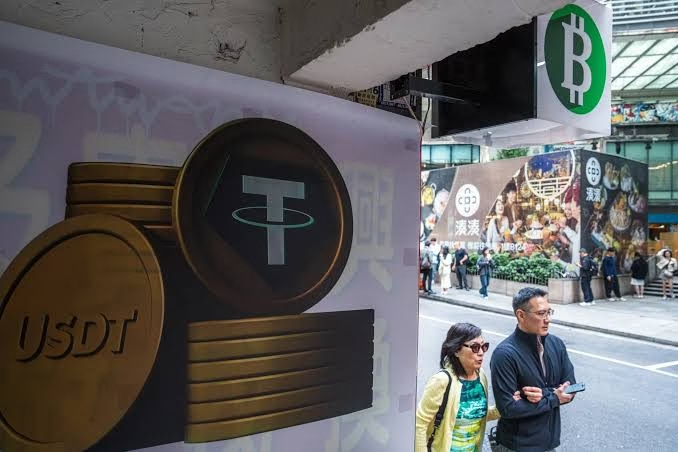
Few days back, $344 million vanished. Not stolen. Not lost to a forgotten private key. But frozen. In a coordinated ballet with U.S. law enforcement, Tether the private issuer of the $140 billion USDT stablecoin reached into the digital wallets of unidentified targets and simply turned off their money.
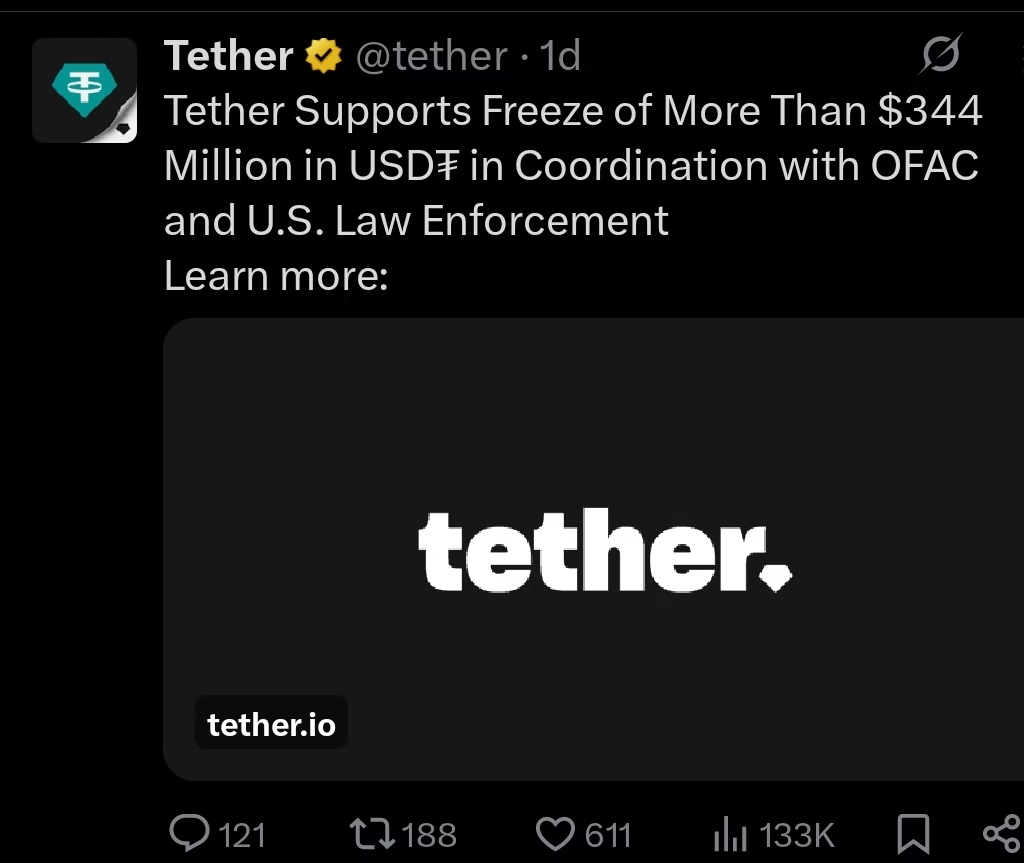
The crypto press called it a law enforcement win. It was nothing of the sort. It was a public execution of crypto’s oldest myth: that a token on a blockchain is yours.
Here is the uncomfortable truth that April 2026 just made undeniable. Your USDT is not money. It is a lease. And the landlord just kicked down the door.
Because USDT lives on Ethereum, Tron, and Solana, users suffer a category error. They see a public ledger, immutability, and self custody and conclude ownership. But blockchains only record movement. They do not confer sovereignty.
Tether latest freeze bringing its historical blacklist total to over $4 billion demonstrates a brutal architectural fact. The USDT smart contract contains a permissioned function. With a single signature, Tether can freeze, blacklist, burn, or reissue any token at will. Your balance is not a property right; it is a database entry that Tether allows you to use.
That $344 million was not seized through a court order though that may follow. It was switched off by a private company exercising a kill switch embedded in the code. If that does not unsettle you, you have not been paying attention.
We used to worry about central banks printing money. We forgot to worry about companies erasing it.
Tether now functions as a quasi monetary sovereign. It operates payment rails that move more value daily than many central bank real time settlement systems. It can censor transactions, enforce U.S. sanctions globally even in jurisdictions that reject them, and blacklist wallets without judicial review. This is not a bug. It is the entire compliance architecture.
What we are witnessing is the emergence of corporate monetary sovereignty a private actor that sits above nation states when it suits regulators, and alongside them when it suits itself. Tether does not just issue dollars. It polices them. And it has proven it will collaborate with any authority that asks nicely.
Bitcoin was invented to solve the Byzantine Generals Problem how to trust money without a central commander. Satoshi’s answer was proof of work and a decentralized network.
Stablecoins have done the opposite. They have rebuilt the commander. Only now, the commander wears a hoodie and reports to FinCEN.
The cypherpunk vision of censorship resistant money is alive in Bitcoin, Monero, and a few others. But stablecoins are not disrupting banks. They are becoming them. Programmable compliance means every USDT transaction is conditional on Tether’s ongoing permission. That is not peer to peer cash. It is a licensed ledger.
Let me introduce a concept the Sovereign Switch. Every USDT wallet has one. It is invisible, dormant, and absolute. Flip it, and your money becomes unspendable. You retain the private key. You see the balance. But the network refuses to move it.
In that moment, you discover that you never held dollars. You held access to a service. Tether is not a custodian. It is a gatekeeper. And gates close.
Call it what it is leased money. You pay no rent, but you own no equity. The issuer can evict you at any time, for any reason a regulator supplies.
This power is seductive and dangerous. In April 2026, the freeze served U.S. law enforcement targets. But what happens when the request comes from Beijing Or Moscow Or when two U.S. agencies disagree
Tether now holds a geopolitical lever. It can enforce sanctions faster than any bank. But due process Transparency Appeal Those are not in the smart contract. The same infrastructure that stops a scammer can stop a protester. The code does not distinguish. Only the issuer does.
And that issuer is not a court. It is a private company with a history of legal ambiguity and reserve opacity. We have handed the keys to the monetary firewall to an entity that was not long ago fined $41 million for lying about its reserves.
Here is the part that keeps risk managers awake. USDT is not a niche experiment. It underpins a massive share of trading activity and provides liquidity for much of decentralized finance lending markets. If trust in Tether neutrality weakens if users suddenly realize their balances are conditional the flight could be catastrophic.
We saw a preview in May 2022 during the Terra collapse. USDT briefly de pegged to $0.95 on panic alone. Now imagine a coordinated blacklist event that freezes a politically sensitive wallet holding $500 million in DeFi collateral. Liquidations cascade. Markets seize. And Tether the firefighter holds the matches.
This is not fearmongering. This is structural fragility dressed as stablecoin convenience.
For a decade, crypto promised to eliminate trust. No more banks. No more middlemen. Just math and signatures.
Tether just proved otherwise. Crypto did not eliminate trust. It relocated it. From regulated banks to unaccounted issuers. From public oversight to private blacklists. From your wallet to their server.
You do not own USDT. You are licensed to use it. And in April 2026, Tether reminded 344 million reasons why that distinction is the most important in finance today.
The sovereign switch exists. It works. And it is not yours.



Copyright © 2025 - The Bit Gazette.

