






- Trending
- Comments
- Latest

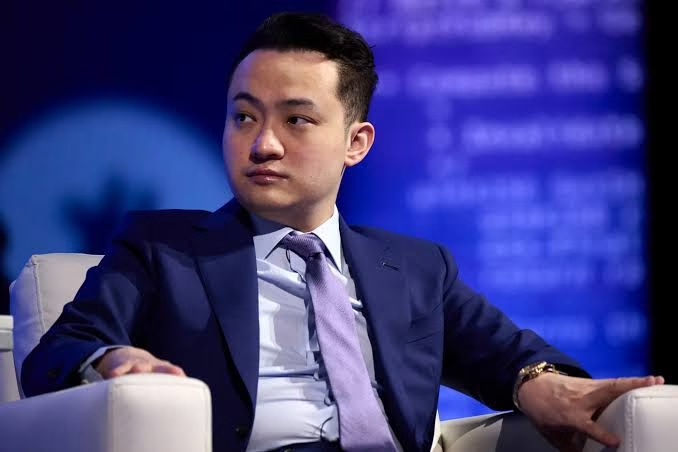
For nearly two weeks, crypto Twitter has been a battlefield. On one side stands Justin Sun, the flamboyant Tron founder and self described “victim.” On the other, World Liberty Financial, the DeFi project backed by the family of former President Donald Trump. And in the middle? A $6 million banana, a secret “blacklist” button, and allegations of extortion that would make a Wall Street short seller blush.
If you feel like you are late to this story, you are not alone. The details have been dripping out slowly, first a token freeze, then a lawsuit, then a meme war involving duct taped fruit.
This saga is not just another crypto spat. It is the moment the industry’s two biggest contradictions collided, decentralization versus control, and celebrity hype versus code.
Let me explain why this matters more than any banana.
For those just catching up, here is the skeleton of the story.
In late 2024, Justin Sun invested roughly $75 million into WLFI tokens, becoming one of the project’s largest backers and an advisor. WLFI, which counts Donald Trump as its “Chief Crypto Advocate” and his sons, Don Jr., Eric, and Barron, as co founders or ambassadors, was struggling with slow initial sales. Sun’s money and influence gave it a lifeline.
Then came September 2025. According to Sun’s federal lawsuit filed on April 21, 2026, WLFI suddenly blacklisted his wallet using a hidden “backdoor blacklisting function” embedded in its smart contract.
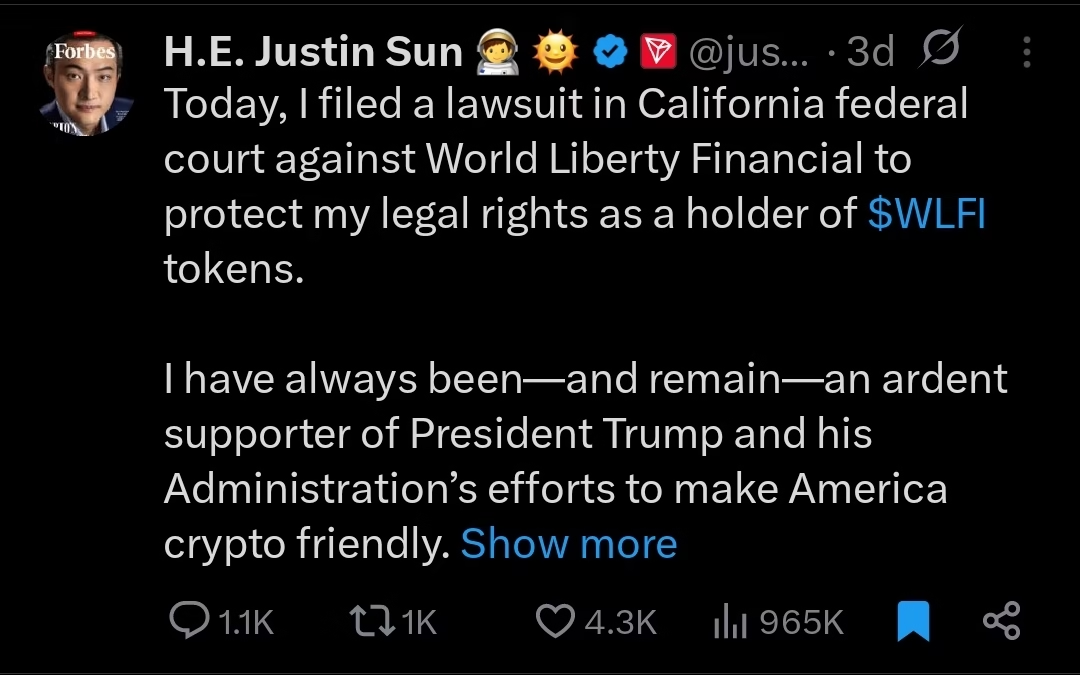
Sun claims he lost access to approximately $107 million in tokens and was stripped of his governance votes. Worse, he alleges WLFI threatened to permanently burn his frozen tokens unless he minted an additional $200 million in their USD1 stablecoin, a move he calls extortion.
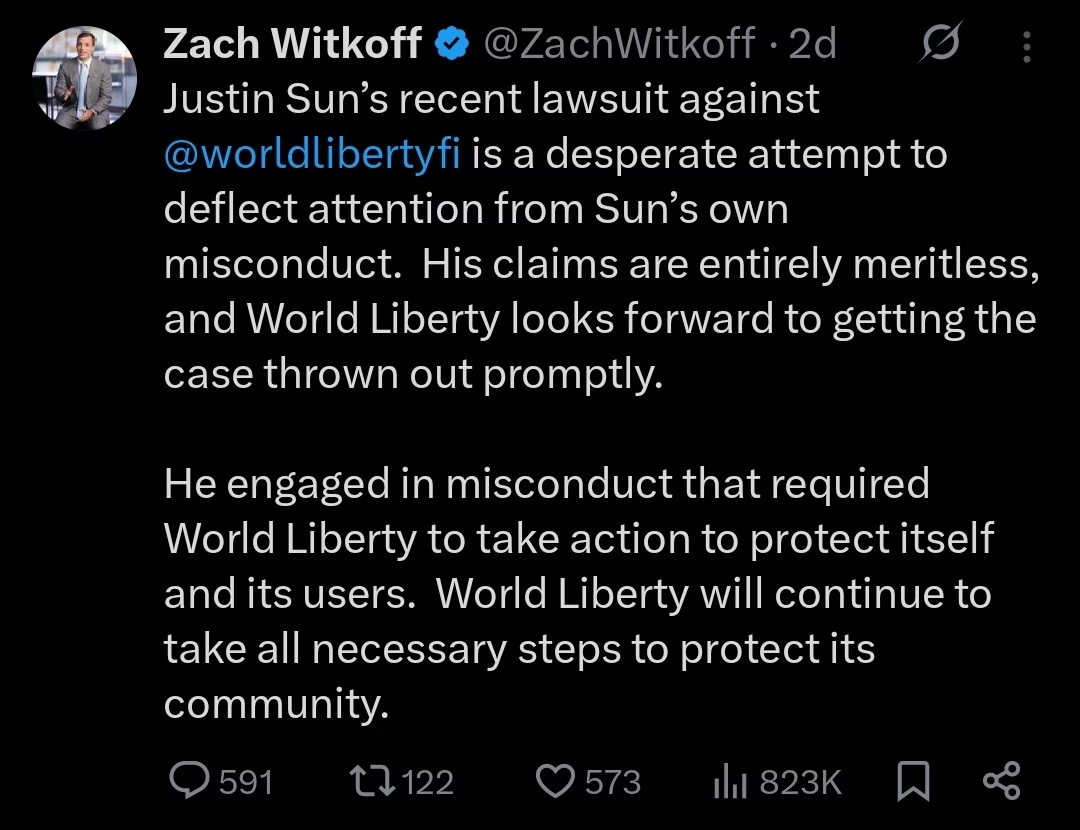
WLFI’s CEO, Zach Witkoff, called the lawsuit “meritless” and claimed the freeze was a legitimate security response to Sun’s “misconduct.”
Eric Trump, meanwhile, dismissed the entire affair by mocking Sun’s famous purchase of a $6.4 million duct taped banana artwork which he ate.
That last bit, the banana, has become the story’s strangest symbol. But do not let the comedy fool you. This is deadly serious.
Here is what keeps me up at night as a crypto writer.
World Liberty Financial markets itself as a decentralized finance project. The “DeFi” in its name implies transparency, immutability, and user control.
But if a project’s smart contract contains a secret blacklist function, one that allows insiders to freeze any wallet without warning, then it is not DeFi. It is a digital fiefdom with a glossy website.
Let that sink in: WLFI’s code allegedly had a trap door. And that trap door was not disclosed to early investors like Sun until it was used against him.
This is not a bug. It is a feature, just not one anyone advertised.
In my view, the crypto community has been too forgiving of “trust us” decentralization. We cheer when a famous name backs a project, but we forget that fame and code are not the same thing. A multisig wallet controlled by a handful of insiders is not a DAO. A blacklist function is not a governance mechanism. It is a leash.
And leashes can be pulled.
We cannot ignore the elephant, or rather, the ex president, in the room.
Donald Trump is not a passive logo on WLFI’s website. According to project documents, Trump and his affiliates receive 75 percent of net revenue from token sales. While he may not code or manage daily operations, his family’s name is the project’s primary marketing engine.
Eric Trump’s decision to respond to a $107 million lawsuit with a banana joke suggests a deliberate strategy: make Sun look ridiculous so no one looks at the code.
But that strategy cuts both ways.
If WLFI is truly a victim of Sun’s “misconduct,” why not release the evidence? Why mock rather than explain? And if the blacklist function exists for legitimate security reasons, why was it kept secret?
As one anonymous crypto analyst on X put it this week:
“A trap door marketed as an open door is not a security feature. It is a con.”
I am not saying Justin Sun is blameless. He has his own history of pump and dump accusations, questionable promotions, and regulatory run ins. But in this specific case, the burden of proof now rests on WLFI. They froze the money. They control the blacklist. They need to show their work.
Let us talk about the numbers, because the market has already voted.
Since the lawsuit was filed, the WLFI token has fallen to an all time low of approximately $0.076, down over 80 percent from its peak.
Trading volume has collapsed. And on chain analysts have confirmed that the lending pool where WLFI allegedly borrowed $75 million using its own tokens as collateral, on a platform co founded by a WLFI advisor, remains under scrutiny.
But the real loss is not measured in dollars. It is measured in trust.
Retail investors who bought WLFI tokens thinking they were buying into a transparent, Trump backed DeFi project are now learning that their assets could be frozen by an insider committee. That is not a bug. That is the point. And once that realization spreads, no amount of presidential branding can fix it.
So where do I land?
I do not trust Justin Sun entirely. His history of hype driven promotions and his willingness to play the victim while sitting on a multi billion dollar crypto empire make him a complicated plaintiff.
But I trust secret blacklists even less.
If WLFI believed Sun was engaging in misconduct, the proper response was transparent governance, an on chain vote, a public explanation, or a time locked freeze with community oversight. Instead, they pushed a button. And that button revealed the truth: WLFI was never truly decentralized. It was always a centralized project wearing a DeFi costume.
For crypto to grow up, we need to stop celebrating celebrity endorsements and start auditing code. We need to stop calling every token sale a “revolution” and start asking hard questions: Who controls the multisig? What happens if a founder disagrees? Is there a blacklist?
If this lawsuit forces those questions into the open, then maybe, just maybe, the banana was worth it.
The case is now in a California federal court. Both sides have filed initial motions, and legal experts expect months of discovery. That discovery will likely include WLFI’s smart contract code, internal communications, and the exact terms of Sun’s advisory agreement.
If the blacklist function was truly disclosed somewhere in the fine print, Sun’s case weakens. If it was hidden, WLFI faces not just a lawsuit but a potential regulatory crackdown.
Either way, the crypto world will be watching.



Copyright © 2025 - The Bit Gazette.

