

- Trending
- Comments
- Latest

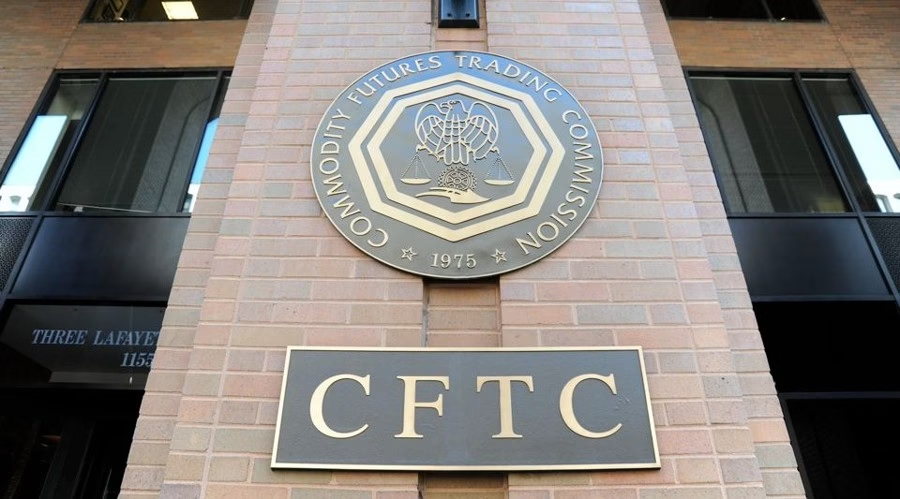
The Commodity Futures Trading Commission has proposed rules that would significantly restrict which real-world events can be traded on prediction market platforms, a move that crypto firms warn could force blockchain-based operators offshore and hand regulatory advantage to overseas competitors.
The Commodity Futures Trading Commission (CFTC) has triggered a fresh wave of debate across the crypto industry with its proposed rules targeting prediction markets, platforms that allow users to bet on real-world outcomes using digital assets.
The regulatory move, announced in 2026, seeks to clarify how such markets fit within U.S. derivatives law, but critics warn it could stifle innovation and push activity offshore.
At the center of the debate is a fundamental question: should event-based contracts, ranging from election outcomes to economic indicators be treated as legitimate financial instruments or prohibited as speculative gambling?
The CFTC argues the rules are necessary to protect market integrity and prevent manipulation.
Industry participants, however, see the proposal as overly restrictive, particularly for blockchain-based platforms that operate globally and often outside traditional financial systems.
According to reports, the proposed framework could significantly limit the types of events that can be legally traded, especially those tied to political outcomes or sensitive public interests.
Crypto firms and market operators have been quick to respond, warning that the rules could undermine a rapidly growing sector of decentralized finance (DeFi).
Prediction markets have gained traction in recent years as tools for hedging risk, gathering crowd-sourced insights, and even forecasting major global events more accurately than traditional polling.
“Overly broad restrictions risk driving innovation out of the United States,” spokesperson, Blockchain Association.
Platforms like Polymarket and Kalshi have become focal points in the discussion.
While Kalshi operates under U.S. regulatory approval, decentralized platforms often exist in a legal gray area, raising questions about jurisdiction and enforcement.
Supporters of the CFTC’s approach argue that without clear rules, prediction markets could be used for illicit activities or to influence real-world outcomes unfairly.
The controversy also highlights a broader issue within crypto regulation: the lack of consistent legal definitions for emerging financial products.
Unlike traditional derivatives, prediction market contracts often blur the line between financial instruments and speculative wagers.
Legal experts say the CFTC’s proposal could set a precedent for how decentralized applications are treated under U.S. law.
Critics argue that the rules fail to account for the decentralized nature of many platforms, where no single entity controls operations.
The outcome of this regulatory push could have far-reaching implications, not just for prediction markets but for the broader crypto ecosystem.
If implemented in its current form, the rules may force platforms to either adapt their offerings, restrict U.S. users, or relocate operations entirely.
For investors and traders, the uncertainty adds another layer of risk to an already volatile market. It also raises questions about whether the U.S. can remain competitive in the global race to define the future of financial technology.
As the consultation process continues, stakeholders across the industry are expected to submit feedback and lobby for adjustments.
The final decision by the CFTC could ultimately determine whether prediction markets evolve into a mainstream financial tool or remain a contested frontier in crypto innovation.



Copyright © 2025 - The Bit Gazette.