

- Trending
- Comments
- Latest

Bitcoin mining firms are redirecting large-scale data centre infrastructure toward artificial intelligence workloads, driven by revenue estimates suggesting AI compute generates up to 20 to 25 times more income per kilowatt-hour than Bitcoin mining, a differential that analysts say is triggering a structural reallocation of compute resources across the sector.
For years, Bitcoin mining operated on a relatively predictable model: deploy ASIC machines, secure cheap electricity, and compete for block rewards. But the economics underpinning that model have weakened, forcing a rethink across the sector.
Rising mining difficulty, increasing energy costs, and periodic halving events have compressed margins significantly. In many cases, operators are skating close to breakeven—or worse. This pressure is a key catalyst behind the Bitcoin mining AI pivot.
Meanwhile, AI has emerged as a far more attractive consumer of compute. Unlike mining, which relies on single-function ASICs, AI workloads depend on GPUs—flexible, high-performance hardware capable of handling diverse computational tasks.
As venture capitalist Marc Andreessen once noted, “Software is eating the world.” Today, compute is the substrate enabling that process—and AI is consuming it at unprecedented scale.
The implication is straightforward: while compute itself can be repurposed, the revenue attached to it varies dramatically. That disparity is driving the Bitcoin mining AI pivot at speed.
At the heart of the Bitcoin mining AI pivot is a simple but powerful reality: AI infrastructure generates significantly more revenue per unit of energy than traditional mining.
Some industry estimates suggest AI data centers can earn up to 20–25 times more revenue per kilowatt-hour compared to Bitcoin mining. That single metric has become the decisive factor.
Bitcoin miners already control three critical assets:
These are precisely the inputs AI companies are scrambling to secure.
According to Jensen Huang, “The next industrial revolution will be driven by AI factories.” Those “factories” require power and infrastructure—both of which miners already possess.
The Bitcoin mining AI pivot is, therefore, less about abandoning crypto and more about reallocating resources to the highest-margin opportunity.
The Bitcoin mining AI pivot is not hypothetical—it’s already visible across the industry.
Mining firms are actively:
In some cases, companies that began as crypto miners have evolved into full-scale AI infrastructure providers with multi-billion-dollar valuations.
Even more striking, analysts forecast that up to 20% of global Bitcoin mining capacity could shift toward AI workloads within the next few years. That scale underscores that the Bitcoin mining AI pivot is not a niche adjustment—it’s a systemic reallocation of compute resources.
A major friction point in the Bitcoin mining AI pivot lies in hardware compatibility.
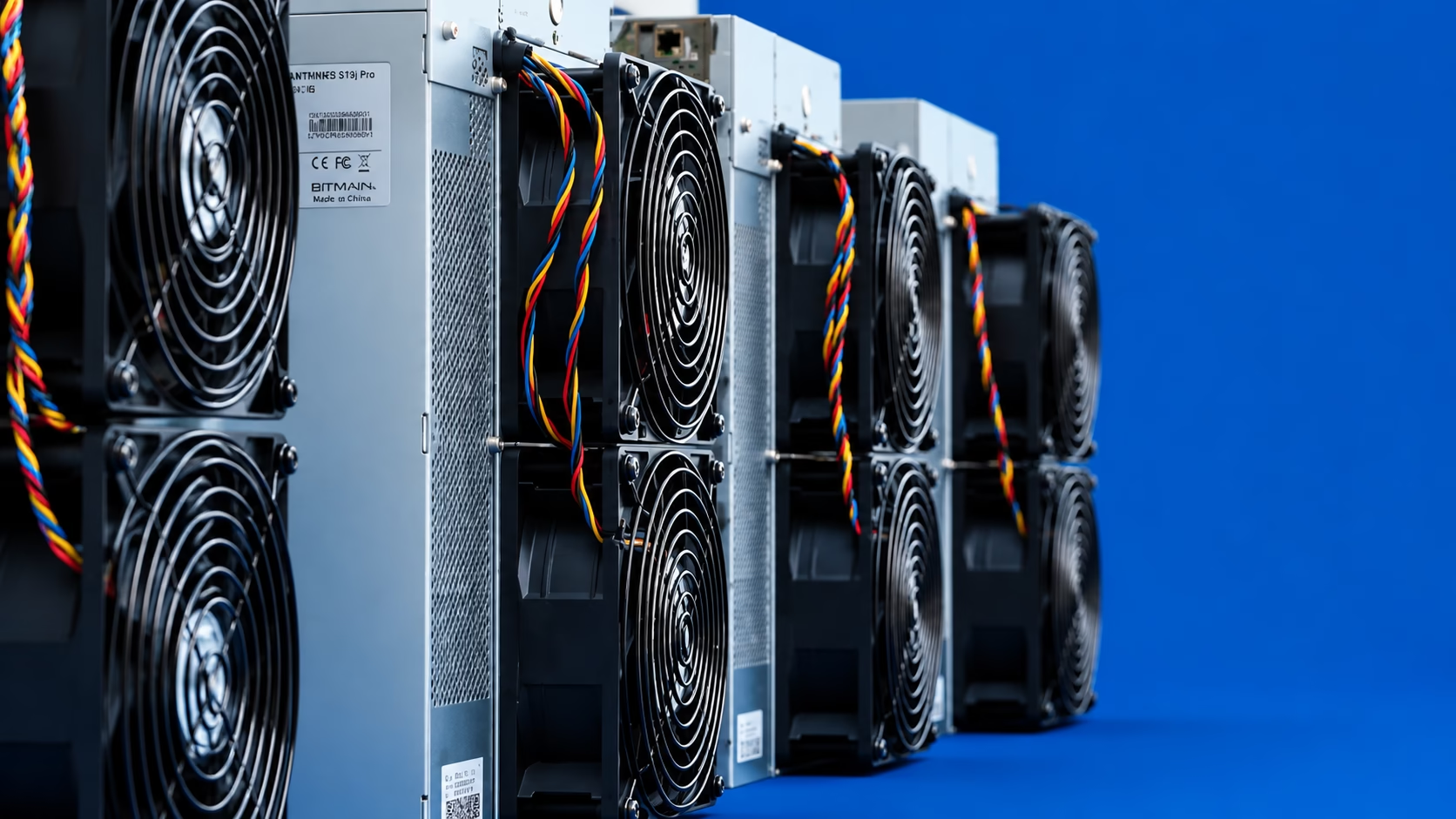
Bitcoin mining relies on ASICs—machines optimized exclusively for SHA-256 hashing. They are extremely efficient but completely inflexible. Outside of mining, they hold little value.
AI workloads, by contrast, depend on GPUs, which are programmable and adaptable across a wide range of tasks, from training large language models to running inference systems.
This mismatch creates a transitional challenge. Miners must:
Some operators are already phasing out older ASICs, replacing them with AI-optimized hardware racks. The Bitcoin mining AI pivot, therefore, isn’t just strategic—it’s architectural, requiring a full-stack overhaul.
Three structural forces are accelerating the Bitcoin mining AI pivot:
1. Predictable Revenue Streams: Bitcoin mining income fluctuates with price volatility and network difficulty. AI infrastructure, on the other hand, is often backed by long-term contracts, offering stable and predictable cash flow.
2. Superior Capital Efficiency: AI clients—including enterprises, startups, and hyperscalers—are willing to pay premium rates for compute. Mining margins, in contrast, continue to tighten.
3. Explosive Demand for AI Compute: The rise of generative AI has triggered a global shortage of compute infrastructure. As Sam Altman stated, “Compute is going to be the currency of the future.” Demand is outpacing supply, pushing prices—and incentives—higher.
Taken together, these factors explain why the Bitcoin mining AI pivot is accelerating. Bitcoin mining is cyclical. AI demand is structural.
The Bitcoin mining AI pivot introduces a new variable into Bitcoin’s long-term outlook: competition for compute.
Bitcoin’s security depends on a robust and decentralized hash rate. If significant mining capacity migrates to AI, potential consequences include:
However, there’s a counterbalance. Reduced competition could improve profitability for miners who remain, potentially stabilizing the network over time.
Still, the Bitcoin mining AI pivot complicates the traditional security model. For the first time, Bitcoin is competing not just with itself—but with an entirely different industry for the same underlying resource.
Perhaps the most profound outcome of the Bitcoin mining AI pivot is the emergence of a new industry category: energy-backed compute providers.
These entities are not ideologically tied to crypto or AI. Their core business is monetizing electricity through computation. Whether that computation secures a blockchain or trains a neural network is secondary.
They allocate resources based on returns.
And right now, AI is outbidding Bitcoin—consistently and significantly.
The Bitcoin mining AI pivot is subtle, but its implications are far-reaching.
Bitcoin mining isn’t disappearing—it’s being repriced against a more lucrative alternative use of compute. What used to be a straightforward industry tied to Bitcoin’s price cycles is evolving into a broader compute marketplace driven by economics.
In past cycles, miners chased Bitcoin’s price.
In this cycle, they are chasing compute yield.
That distinction may ultimately define the next phase of both industries—and determine where the world’s most valuable digital infrastructure is deployed.



Copyright © 2025 - The Bit Gazette.