


- Trending
- Comments
- Latest

Tokenized gold trading hit $90.7 billion in the first quarter of 2026, already surpassing the $84.64 billion recorded across all of 2025, according to CoinGecko’s latest real-world asset report.
According to CoinGecko’s latest Real World Asset report, Tokenized Gold volume reached $90.7 billion during the first quarter of 2026 alone, already surpassing the entire 2025 total of $84.64 billion.
The sharp rise in Tokenized Gold volume reflects how digital representations of physical gold are becoming a preferred hedge for crypto traders navigating volatility across bitcoin, altcoins, and traditional markets.
The report also highlighted how centralized exchanges continue to dominate trading activity in the tokenized commodity sector, reinforcing the growing institutionalization of blockchain-based real-world assets.
Much of the recent Tokenized Gold volume growth came from two leading products: Paxos Gold (PAXG) and Tether Gold (XAUT).
CoinGecko data showed PAXG accounted for between 34.2% and 82.5% of monthly Tokenized Gold volume over the past 15 months, while XAUT represented between 14.8% and 64.6% during the same period.
Together, the two products remain the backbone of the tokenized gold ecosystem. Their dominance also extends beyond trading activity. Tokenized commodity market capitalization expanded from $1.43 billion to $5.55 billion over the last year, with XAUT and PAXG contributing nearly 90% of that growth.
PAXG added roughly $1.8 billion in value, while XAUT contributed approximately $1.87 billion, according to the report.
The rise in Tokenized Gold volume comes as investors seek assets tied to real-world value while still benefiting from blockchain settlement, transferability, and exchange liquidity.
The surge in Tokenized Gold volume has also accelerated institutional and corporate activity around blockchain-based gold products.
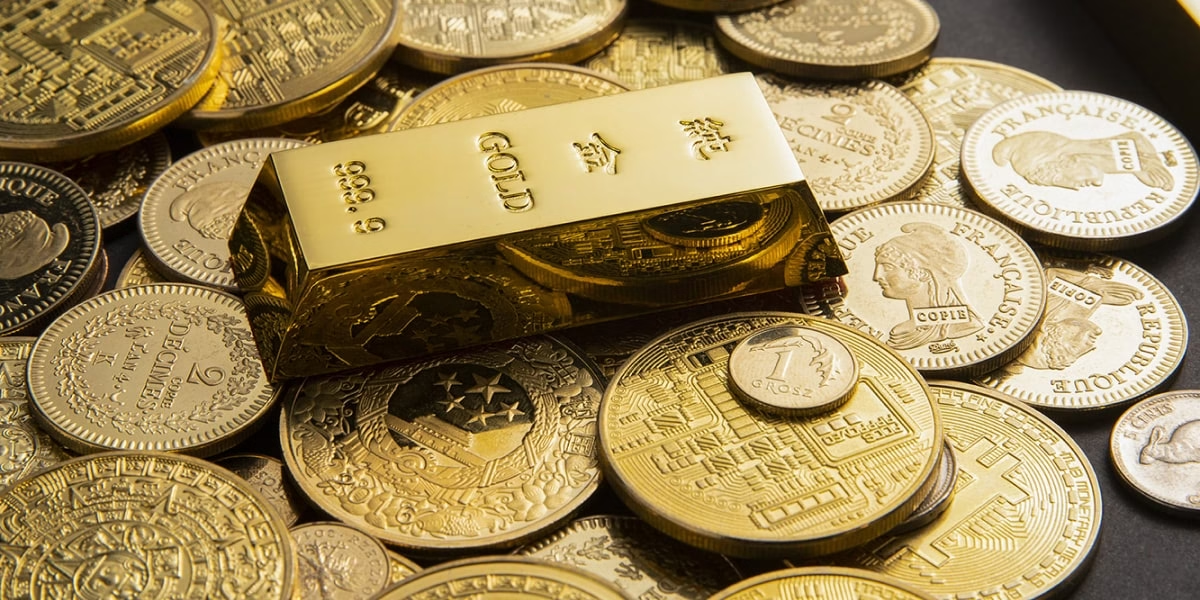
In March, Tether expanded XAUt onto BNB Chain, giving users broader access to gold-backed assets across decentralized finance ecosystems.
Each XAUt token is backed one-to-one by a troy ounce of physical gold stored in Swiss vaults. Tether CEO Paolo Ardoino described the expansion as part of a broader effort to integrate precious metals into digital finance infrastructure.
“Integrating gold into the digital financial system with instant settlement” represents the next stage of commodity tokenization, Ardoino said during the announcement.
The increase in Tokenized Gold volume also coincided with Singapore’s Oversea-Chinese Banking Corporation launching GOLDX on Ethereum and Solana in April.
The token gives institutional investors exposure to the LionGlobal Singapore Physical Gold Fund, which held approximately $525 million in assets as of mid-April.
These launches suggest Tokenized Gold volume is no longer driven solely by crypto-native traders. Traditional financial institutions are increasingly testing blockchain rails for commodity settlement and investment products.
The rise in Tokenized Gold volume is part of a much broader shift toward tokenized real-world assets. CoinGecko reported that the total tokenized RWA market grew from $5.42 billion at the beginning of 2025 to $19.32 billion by March 31, 2026.
Within that market, tokenized commodities represented 28.7% of total sector value by the end of Q1, trailing only tokenized Treasuries.
The World Gold Council has also entered the conversation around Tokenized Gold volume growth. The organization recently proposed a “Gold as a Service” framework aimed at supporting tokenized gold issuance, custody management, compliance operations, reconciliation, and redemption systems.

The proposal reflects growing recognition that tokenized commodities may become a permanent part of modern financial infrastructure rather than a temporary crypto trend.
One major driver behind rising Tokenized Gold volume has been increasing geopolitical and macroeconomic uncertainty.
During periods of market stress earlier this year, gold-backed tokens outperformed many leading cryptocurrencies as investors searched for defensive assets.
The contrast became especially visible during periods of heightened Middle East tensions, when bitcoin and several major altcoins weakened while tokenized gold products gained traction.
That divergence reinforced the narrative that Tokenized Gold volume benefits during risk-off market conditions.
Unlike traditional gold markets, tokenized gold can move instantly across exchanges, wallets, and decentralized finance protocols, offering liquidity and accessibility that physical gold cannot easily match.
For crypto-native investors, the appeal lies in combining the historical stability of gold with blockchain efficiency.
Despite the explosive rise in Tokenized Gold volume, market activity remains highly dependent on broader gold price trends and investor sentiment.
CoinGecko’s monthly data showed tokenized gold trading climbed to $21.38 billion in October 2025 as gold prices reached fresh highs before cooling to around $14.07 billion the following month.

The fluctuations highlight that Tokenized Gold volume still reacts strongly to commodity price cycles and broader financial market conditions.
Analysts say sustained growth will likely depend on continued institutional participation, deeper exchange integration, and broader adoption of tokenized commodities within traditional finance.
Still, the first-quarter figures leave little doubt that tokenized gold has moved from a niche blockchain experiment into one of the fastest-growing sectors within digital assets.
As Tokenized Gold volume continues breaking records, the market is increasingly proving that investors want access not only to crypto volatility, but also to blockchain-based versions of traditional safe-haven assets.



Copyright © 2025 - The Bit Gazette.