
- Trending
- Comments
- Latest

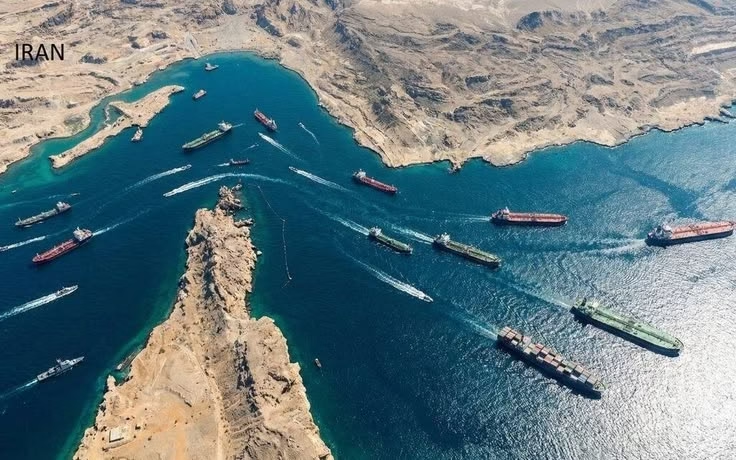
On May 16, 2026, Iran’s Ministry of Economy unveiled “Hormuz Safe,” a state-backed maritime insurance platform for vessels transiting the Strait of Hormuz the narrow waterway through which nearly 20% of global oil supply moves every day.
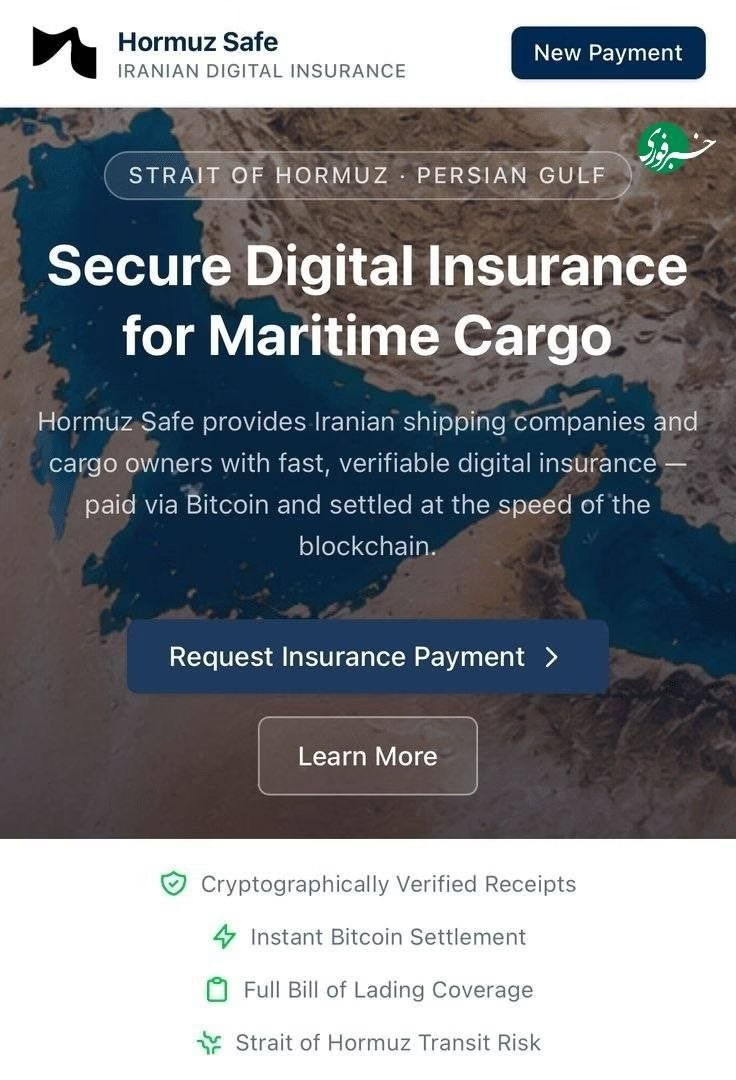
The platform accepts payments in Bitcoin, USDT, and Chinese yuan, allowing shipping participants to settle war-risk coverage outside the SWIFT banking system and beyond traditional Western financial intermediaries.
This is not a crypto experiment or a theoretical blockchain pilot.
Hormuz Safe represents one of the first large-scale sovereign attempts to deploy cryptocurrency as operational trade-finance infrastructure during an active geopolitical conflict. The platform is designed to:
At the center of the strategy is a simple geopolitical reality: the country that controls the Strait of Hormuz controls one of the most important arteries in the global energy economy.
| Key Metric | Value |
|---|---|
| Launch date | May 16, 2026 |
| Platform | Hormuz Safe |
| Accepted payments | Bitcoin, USDT, Chinese yuan |
| Oil supply through Hormuz | ~20% of global flows |
| Pre-conflict insurance premium | ~0.25% of vessel value |
| Current war-risk premiums | Up to 10% |
| Estimated Iranian revenue target | $10–100+ billion |
| Vessel traffic decline | ~95% |
| Estimated IRGC vessel tolls | Up to $2 million |
| Iran crypto ecosystem estimate | ~$78 billion |
| Proposed U.S. response | $40 billion reinsurance facility |
The Strait of Hormuz is widely considered the world’s most strategically important maritime energy corridor.
Under normal conditions, roughly 3,000 vessels transit the strait every month. Nearly one-fifth of global oil shipments pass through the narrow waterway connecting the Persian Gulf to the Gulf of Oman.
That traffic collapsed after renewed military escalation in early 2026.
By April 2026, monthly shipping volume had reportedly fallen to just 191 vessels, a decline of approximately 95% from normal levels. The reduction followed escalating tensions involving Iran, renewed U.S. military operations, and growing security risks throughout the Gulf region.
As shipping risks intensified, insurance markets reacted aggressively.
War-risk premiums reportedly surged from around 0.25% of vessel value before the conflict to as high as 10% for ships attempting to transit the strait. For large oil tankers, that can translate into insurance costs reaching tens of millions of dollars for a single voyage.
Into that vacuum stepped the Islamic Revolutionary Guard Corps (IRGC), which reportedly began charging direct passage-related fees to vessels moving through the region.
Hormuz Safe effectively formalizes that system by transforming geopolitical leverage into a state-backed digital insurance marketplace.
Hormuz Safe offers three categories of maritime coverage:
| Coverage Type | Description |
|---|---|
| War-risk insurance | Military conflict, seizure, detention risks |
| Marine insurance | Hull and cargo protection |
| Digital certificates | Blockchain-verified proof of coverage |
The structure is legally strategic.
Rather than openly charging transit tolls, Iran frames the payments as insurance and maritime security coverage for vessels operating in high-risk waters under Iranian protection.
That distinction matters because it allows Tehran to present Hormuz Safe as a commercial financial service rather than a direct maritime extortion mechanism.
The platform’s most consequential feature is its settlement architecture.
According to reports, the process works as follows:
No SWIFT transfer. No U.S. correspondent bank. No Western intermediary.
The system operates outside the traditional banking rails that have historically formed the backbone of sanctions enforcement against Iran.
Iran’s payment structure appears carefully designed.
Each accepted asset serves a different strategic purpose:
| Asset | Strategic Role |
|---|---|
| Bitcoin | Censorship-resistant settlement |
| USDT | Dollar-equivalent liquidity |
| Chinese yuan | Non-dollar geopolitical alignment |
USDT offers liquidity and familiarity, but it carries a major limitation for sanctioned actors: centralized issuers can freeze funds.
That risk became highly visible after U.S. authorities reportedly seized hundreds of millions of dollars in Iranian-linked USDT earlier in 2026.
Bitcoin is different.
No central authority can freeze a Bitcoin transaction at the protocol level. No issuer controls settlement access. For a sanctioned state attempting to bypass financial restrictions, Bitcoin’s decentralization becomes operational infrastructure rather than ideological symbolism.
That may be the most important implication of Hormuz Safe.
This is not Bitcoin as speculation. It is Bitcoin as sovereign settlement rail.
Iranian projections for Hormuz Safe reportedly range from $10 billion to more than $100 billion annually.
Even the lower estimate would represent a substantial revenue stream for a sanctions-constrained economy.
The business logic is straightforward:
If enough vessels return to the route and Western insurers continue retreating, Iran could potentially capture part of the war-risk insurance market itself.
The key variable is adoption.
The U.S. government moved quickly after the platform’s launch.
On May 17, 2026, the Office of Foreign Assets Control (OFAC) reportedly warned that payments to Iranian state-linked entities related to Hormuz passage could violate U.S. sanctions laws regardless of payment method.
The warning applied to:
The core message was simple: changing the payment rail does not change the legality of the underlying transaction under U.S. sanctions policy.
Washington has also reportedly explored a $40 billion reinsurance facility designed to provide a sanctions-compliant alternative for maritime coverage in the region.
That proposal highlights the seriousness with which U.S. officials appear to view the platform.
Despite its geopolitical significance, Hormuz Safe still faces a major practical challenge.
Global shipping firms are highly regulated and extremely risk-averse.
For major operators, using an Iranian state-backed crypto insurance platform could create severe consequences:
The tipping point will likely come only if a major shipping company publicly uses the platform successfully without facing immediate economic retaliation.
That first adoption event would transform Hormuz Safe from a geopolitical headline into a functioning trade-finance system.
As of May 18, 2026, no major commercial shipping operator had publicly confirmed using the platform.
Hormuz Safe did not emerge in isolation.
Iran has spent years developing a parallel crypto ecosystem shaped by sanctions pressure and energy economics.
Key components include:
Estimates suggest Iran’s broader crypto ecosystem reached approximately $78 billion by 2025, with significant influence attributed to IRGC-linked networks.
What makes Hormuz Safe different is the level of direct sovereign integration.
This is not covert sanctions evasion. It is an openly announced state platform integrating cryptocurrency directly into maritime trade and strategic infrastructure.
Much of crypto’s global narrative has centered around speculation, trading, and retail investment.
Hormuz Safe shifts the conversation toward geopolitics and statecraft.
The platform tests several critical questions simultaneously:
The implications extend far beyond Iran.
Any country controlling a critical trade corridor could theoretically replicate similar models using blockchain settlement systems and state-backed digital certification.
The challenge for regulators is equally profound.
The U.S. government can sanction banks and pressure centralized exchanges. But stopping peer-to-peer blockchain settlement at the protocol level is far more difficult.
That tension sits at the center of Hormuz Safe’s significance.
Several developments will determine whether Hormuz Safe becomes a durable geopolitical model or remains symbolic.
Hormuz Safe may ultimately fail commercially.
Shipping companies could refuse to participate. Sanctions enforcement could deter adoption. Alternative insurance markets could emerge.
But the broader precedent already exists.
Iran has demonstrated a sovereign attempt to use cryptocurrency not for speculation, but as strategic financial infrastructure tied directly to energy transit, sanctions resistance, and geopolitical leverage.
That changes the conversation around digital assets.
For years, debates around Bitcoin focused on whether it could become money.
Hormuz Safe introduces a different possibility: Bitcoin as sovereign infrastructure operating inside geopolitical conflict zones where traditional finance either cannot function or is deliberately excluded.
That is what makes the platform consequential.
Not because it guarantees success, but because it reveals how states may begin using blockchain systems when conventional financial rails become politically inaccessible.



Copyright © 2025 - The Bit Gazette.