

- Trending
- Comments
- Latest

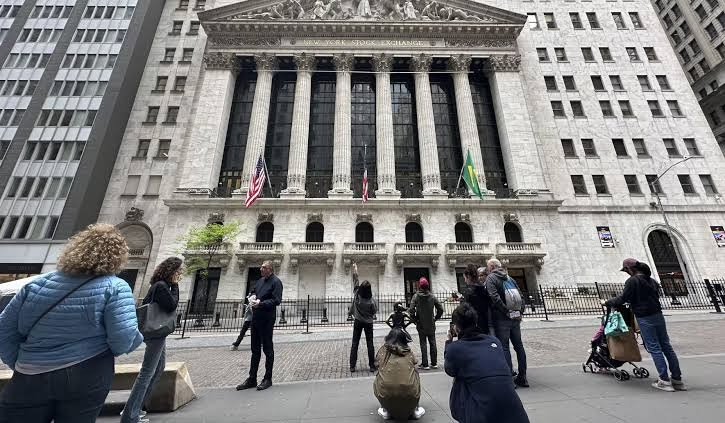
Wall Street built its dominance on one simple advantage: control over liquidity. For decades, the world’s biggest stock exchanges acted as the central hub where capital, investors, brokers, and institutions all converged. Now blockchain infrastructure is threatening to rebuild that system from scratch, faster, cheaper, borderless, and open around the clock.
Tokenized Stocks are beginning to evolve from a niche blockchain experiment into a serious conversation about the future of global equity markets. While traditional finance still dominates volume today, the long-term direction of markets increasingly points toward assets moving on-chain.
The larger issue is no longer whether Tokenized Stocks can exist. The real question is whether they can eventually attract enough liquidity to compete directly with traditional exchanges like Nasdaq and the New York Stock Exchange.
Traditional equity markets still rely on infrastructure built decades ago. Settlement systems remain fragmented, brokerage access varies by country, and trading hours are restricted to specific time zones.
By contrast, Tokenized Stocks offer something modern investors increasingly expect: instant settlement, global accessibility, and 24-hour trading.
On blockchain rails, assets can theoretically move at internet speed. This is one reason major financial institutions are no longer dismissing tokenization. BlackRock CEO Larry Fink recently argued that tokenization could revolutionize capital markets by making investing faster and more efficient.
“Every stock, every bond, every fund — every asset — can be tokenized,” Fink wrote in his annual shareholder letter, describing tokenization as the next evolution of financial markets.
That statement matters because BlackRock is not a crypto-native company chasing hype. It is the world’s largest asset manager. When firms at that level begin openly discussing blockchain infrastructure, the conversation shifts from speculation to long-term market transformation.
One of the strongest arguments supporting Tokenized Stocks is accessibility. Millions of investors around the world still face barriers when attempting to buy U.S. equities. International brokerage limitations, banking restrictions, and regional regulations continue to prevent global participation in traditional markets.
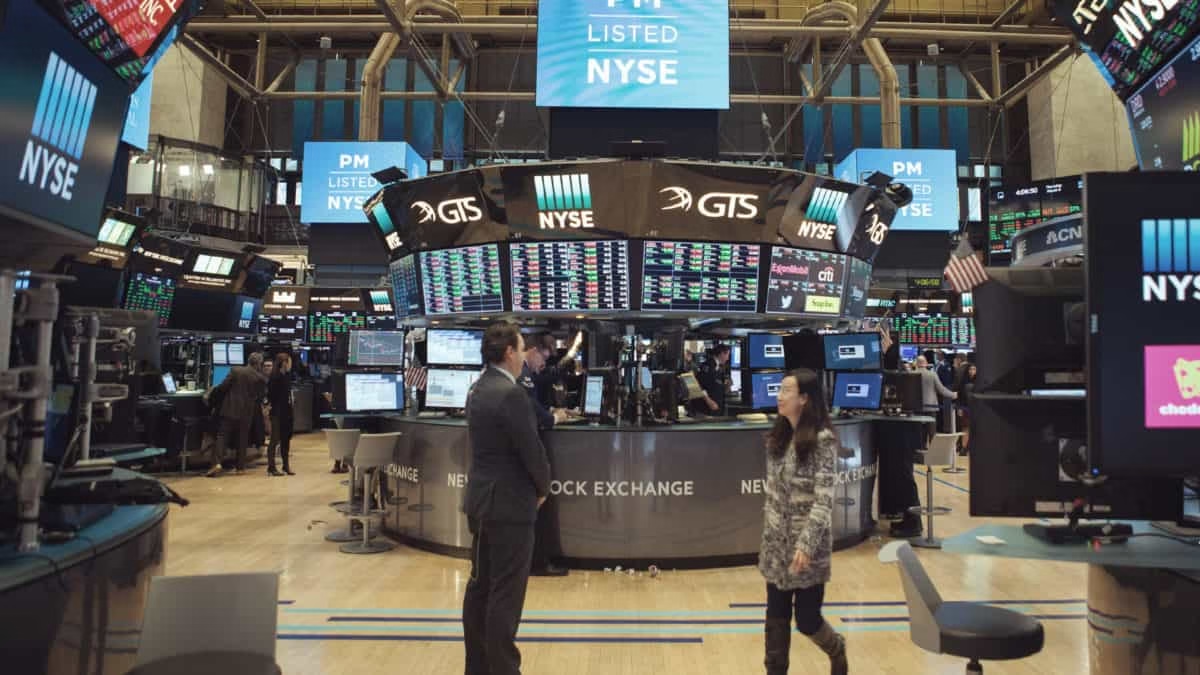
Blockchain-based equity trading changes that equation. With Tokenized Stocks, users theoretically need only a crypto wallet and internet connection to gain exposure to assets that were previously harder to access.
This could become particularly attractive to younger investors already comfortable navigating decentralized applications and digital wallets.
The rise of retail crypto trading over the last decade proved that users are willing to abandon traditional financial platforms if blockchain alternatives offer better speed, lower friction, and easier global participation.
Wall Street’s biggest concern should not be the existence of Tokenized Stocks themselves. The real danger is what happens if meaningful trading volume begins leaving traditional exchanges.
Trading activity generates enormous revenue across the financial system. Exchanges, brokers, clearinghouses, custodians, and payment providers all profit from the movement of capital.
Blockchain markets compress many of those functions into automated smart contract systems.
If Tokenized Stocks mature at scale, the financial industry could experience a slow but significant redistribution of market power.
“Tokenization reduces settlement friction and counterparty complexity,” said Robbie Mitchnick, BlackRock’s head of digital assets, during a recent institutional panel discussion. “That creates operational efficiencies traditional markets cannot ignore.”
If investors can trade tokenized versions of Apple, Nvidia, Tesla, or Amazon shares directly on blockchain networks alongside stablecoins and crypto assets, traditional brokerage ecosystems may gradually lose relevance among certain investor groups.
Several crypto platforms are already preparing for the possibility that Tokenized Stocks become a major category. Exchanges including Kraken, Coinbase, and Binance have all explored or discussed blockchain-based equity products in different forms over the past few years. Meanwhile, tokenization-focused projects continue building infrastructure aimed at real-world assets.
The growth of tokenized Treasury products also provides a preview of where markets may be heading. According to rwa.xyz data, tokenized real-world assets have expanded rapidly over the past year as institutions increasingly move yield-bearing products onto blockchain networks.
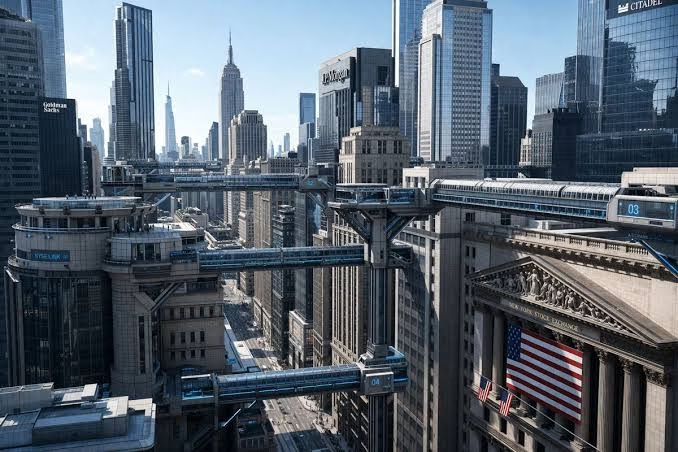
The infrastructure supporting Tokenized Stocks is effectively being built in real time.
This includes custody systems, compliance frameworks, on-chain settlement rails, identity verification tools, and liquidity mechanisms.
Once those systems mature, the transition from tokenized bonds and Treasuries into fully tokenized equities becomes much easier.
Despite the momentum, regulation remains the largest obstacle facing Tokenized Stocks.
Equities fall under strict securities laws in nearly every major economy. Regulators will need to determine how tokenized shares are issued, traded, settled, and supervised before widespread institutional adoption can occur.
That process could take years. Still, governments and regulators are increasingly acknowledging that tokenization is not disappearing.
The European Union’s Markets in Crypto-Assets framework, Singapore’s tokenization initiatives, and ongoing U.S. discussions around digital asset regulation all point toward growing institutional acceptance of blockchain-based financial products.
Even Nasdaq CEO Adena Friedman has previously acknowledged that distributed ledger technology could eventually reshape how securities markets operate globally.
This is ultimately a debate about who controls financial infrastructure in the future.
Traditional exchanges still dominate today, but markets consistently evolve toward systems that are faster, cheaper, and more efficient. Blockchain technology offers all three.
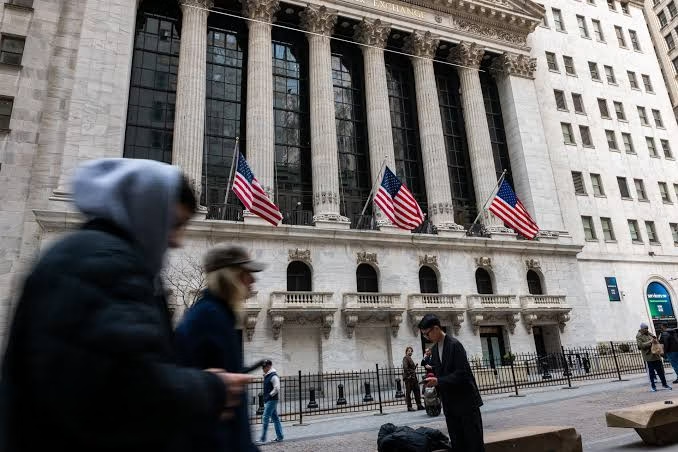
If Tokenized Stocks continue gaining momentum, Wall Street may eventually face the same disruption that streaming platforms brought to television or fintech companies brought to banking.
The migration will likely happen gradually rather than overnight. Institutions move cautiously, regulators move slowly, and legacy financial systems remain deeply entrenched.
The next era of capital markets may not revolve around physical exchanges opening and closing on Wall Street. Instead, it could revolve around globally accessible blockchain networks operating continuously without borders.



Copyright © 2025 - The Bit Gazette.