







- Trending
- Comments
- Latest

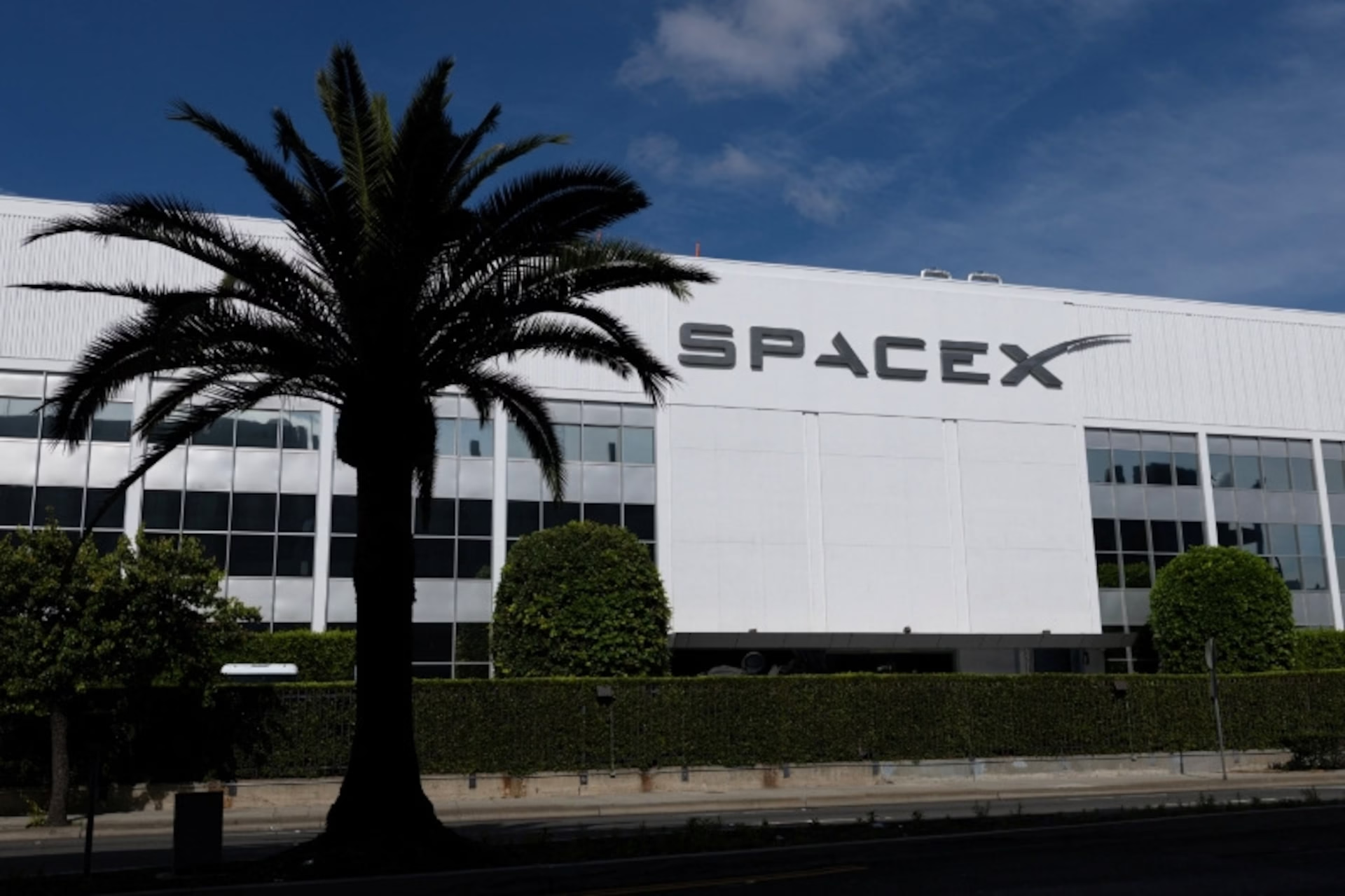
Binance has launched Pre-IPO Perpetual Contracts, a new derivative that lets retail traders speculate on SpaceX’s valuation before the company goes public, marking the first time a major crypto exchange has offered leveraged exposure to private market pricing at scale.
Unlike traditional stocks or even listed crypto assets, these contracts do not represent ownership. Instead, they allow traders to speculate on the expected future valuation of companies that are not yet publicly traded.
This creates a new class of instrument: pre-IPO synthetic derivatives.
Pre-IPO perpetual contracts are crypto derivatives that track the estimated valuation of private companies before they go public.
They function similarly to crypto perpetual futures but with one critical difference: there is no underlying public stock market price to anchor the asset.
Before IPO, pricing is essentially synthetic, based on perceived valuation rather than exchange-traded equity.
This makes the product closer to a prediction market on company valuation than a traditional investment vehicle.
SpaceX was chosen as the flagship asset due to its outsized market narrative and expected IPO scale.
The company is widely speculated to be targeting a multi-trillion-dollar public valuation, driven by:
While exact IPO pricing remains unconfirmed, market expectations have placed SpaceX among the most anticipated listings in financial history.
This makes it ideal for speculative derivatives trading, where future valuation expectations become the tradable asset itself.
Traders do not buy shares. Instead, they take positions on whether the perceived valuation of SpaceX will rise or fall.
Because there is no real-time public stock price, early-stage price formation is heavily influenced by:
This creates a feedback loop where trader activity influences price discovery itself.
No. Pre-IPO perpetual contracts are not shares.
They do NOT provide:
Instead, they represent derivative exposure to a modeled valuation index.
This distinction is critical because it places the product firmly outside traditional equity investing frameworks and into the realm of synthetic derivatives trading.
The introduction of pre-IPO perpetual contracts raises several structural concerns:
Without a real stock market anchor, prices can become detached from actual valuation fundamentals.
Even with capped leverage (5x), price swings can be extreme due to low-liquidity valuation signals.
These instruments sit between:
This creates jurisdictional uncertainty for regulators.
Historically, pre-IPO investing was restricted to venture capital and institutional investors. Now, retail users can access similar exposure with significantly higher risk profiles.
The broader shift is not just financial—it is behavioral.
Crypto markets are increasingly evolving into systems where traders speculate on:
In this environment, valuation becomes the product, not just the underlying company.
Pre-IPO perpetual contracts represent the clearest example of this evolution: a market where traders are no longer buying assets, but trading expectations about assets that do not yet exist in public form.
Binance’s launch of SpaceX Pre-IPO perpetual contracts marks a major expansion of crypto derivatives into private market speculation. While it lowers barriers to entry for retail traders, it also introduces a highly speculative environment built on synthetic valuation rather than tangible equity.
The result is a new financial category where narrative, leverage, and sentiment define price more than fundamentals.
Whether this represents innovation or excess depends on perspective—but structurally, it signals a clear shift: markets are moving toward trading expectations themselves.
They are crypto derivatives that let traders speculate on private company valuations before they go public.
No. They do not provide ownership, voting rights, or dividends. They are purely synthetic trading instruments.
Yes, through Pre-IPO perpetual contracts, but only as a derivative exposure, not actual stock ownership.
They are highly risky due to leverage, synthetic pricing, and lack of a real underlying market before IPO.
Once a company goes public, the contract typically transitions to track the real stock price.



Copyright © 2025 - The Bit Gazette.

