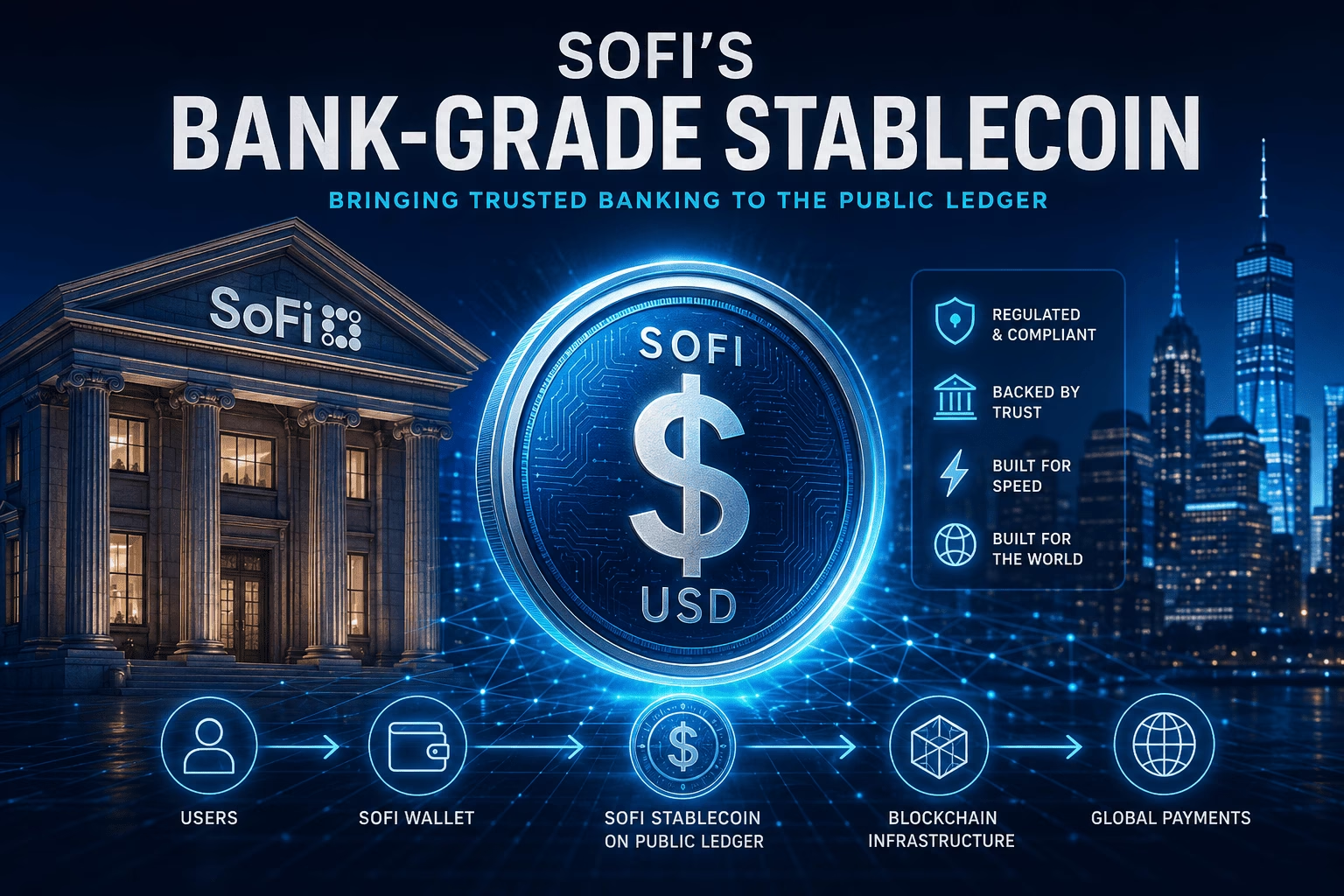
Banks aren’t fighting stablecoins anymore, they’re quietly becoming the ones issuing them
As Wall Street embraces blockchain infrastructure, SoFi may be positioning itself to merge institutional trust with public ledger technology in a way that could permanently alter digital banking.
Somewhere between the whitepaper utopias and the congressional hearings, the banks won. Not by defeating blockchain, but by stepping inside it.
Instead, a different reality is beginning to emerge, one where banks quietly absorb blockchain technology and use it to strengthen their dominance over modern finance. At the center of this transition is the growing concept of the Bank-Grade Stablecoin, a model that blends the efficiency of public blockchain networks with the credibility and oversight of regulated financial institutions.
What initially appeared to be a niche crypto innovation is now evolving into one of the most strategic battlegrounds in global finance. Stablecoins, once dismissed by critics as speculative tools tied to volatile digital assets, are increasingly being viewed by major corporations, regulators, and fintech giants as the foundation for next-generation payment systems.
For fintech powerhouse SoFi Technologies, that shift could represent a defining opportunity.
The race to control blockchain-based banking
Over the past two years, institutional attitudes toward stablecoins have changed dramatically. Companies once skeptical of digital assets are now exploring tokenized payment infrastructure, blockchain settlements, and programmable finance systems capable of moving money faster and cheaper than traditional banking rails.
Executives at Visa and Mastercard have publicly discussed the long-term efficiency advantages of blockchain settlement systems, while PayPal launched its own U.S. dollar-backed stablecoin initiative in 2023.
Industry analysts believe this signals a broader institutional shift toward regulated digital assets.
“Stablecoins are increasingly becoming part of mainstream financial infrastructure,” said Dante Disparte, Chief Strategy Officer at Circle, during multiple industry discussions surrounding digital payments and blockchain settlement. “The technology is moving beyond crypto trading and toward real-world financial utility.”
That evolution is precisely why the Bank-Grade Stablecoin model is attracting growing attention across Wall Street.
Unlike early crypto projects focused on disrupting the banking system, this framework seeks to integrate blockchain technology directly into regulated finance. Public ledgers provide the speed and efficiency, while financial institutions provide compliance, trust, and customer familiarity.
SoFi appears uniquely positioned to capitalize on that transition.
The company’s rise from a student-loan startup into a diversified digital banking platform has been built around technology-first financial services. Its mobile-centric ecosystem and younger customer demographic make it structurally different from legacy banks still burdened by aging infrastructure.
That distinction matters.
If SoFi eventually expands deeper into blockchain-based payments or tokenized financial services, consumers may interact with crypto infrastructure without ever recognizing it as crypto. Transactions would simply become faster, cheaper, and continuously available.
That is the real power behind the Bank-Grade Stablecoin thesis.
Consumers never wanted ideology, they wanted convenience
One of the crypto industry’s biggest miscalculations was assuming consumers cared deeply about decentralization philosophy.
Most users did not.
Consumers consistently prioritized convenience, accessibility, and security over ideological debates about centralized versus decentralized systems. When given the choice between experimental financial tools and trusted institutions, the mainstream market repeatedly leaned toward familiarity.
This explains why regulated stablecoins are now gaining traction globally.
Public blockchain networks solved many of the inefficiencies associated with traditional payment infrastructure. Transactions can settle within minutes rather than days, international transfers become significantly cheaper, and financial systems can operate continuously without depending on banking hours.
However, public confidence still largely rests with regulated institutions.
The Bank-Grade Stablecoin approach effectively combines those two worlds. Blockchain operates invisibly beneath the surface while banks and fintech firms maintain the customer relationship.
To regulators, this structure appears more manageable than decentralized finance platforms. To institutions, it opens entirely new revenue opportunities tied to programmable payments, tokenized assets, and blockchain-native financial products.
According to a 2024 report from International Monetary Fund, regulated digital payment systems and tokenized financial infrastructure could significantly reduce cross-border settlement costs while improving transaction efficiency in emerging and developed markets alike.
For SoFi, this could evolve into a strategic advantage over slower-moving traditional banks.
Public ledgers are becoming financial infrastructure
Crypto enthusiasts once envisioned public blockchains replacing banks altogether.
Instead, blockchains are increasingly becoming the invisible infrastructure underneath institutional finance.
That shift may prove even more transformative.
Stablecoins are no longer functioning solely as trading instruments. They are beginning to resemble programmable financial systems capable of supporting payroll, treasury management, lending, international commerce, and real-time settlement.
A successful Bank-Grade Stablecoin ecosystem could theoretically support:
Instant cross-border payments
Continuous 24/7 settlement infrastructure
Tokenized payroll systems
Embedded lending products
Real-time treasury operations
Yield-generating savings structures
Traditional banks still operate within limited processing windows. Blockchain networks do not.
Over time, that operational gap becomes economically significant.
“You’re seeing blockchain evolve into core financial plumbing,” said Jeremy Allaire, CEO of Circle, during recent discussions about institutional blockchain adoption. “The long-term impact is not just crypto markets — it’s the modernization of global finance itself.”
That modernization could heavily benefit blockchain ecosystems like Ethereum, even if decentralized ideology loses influence.
Institutional stablecoin activity continues to drive network usage across public chains, increasing transaction volume and reinforcing the role of blockchain as foundational infrastructure for future finance.
The Bank-Grade Stablecoin model therefore creates an unusual outcome: traditional finance potentially wins the customer relationship, while blockchain networks still win economically as settlement infrastructure.
Regulators may prefer institutional stablecoins
Ironically, governments and regulators may ultimately support institution-backed stablecoins more aggressively than decentralized alternatives.
The reason is straightforward: regulated issuers are easier to supervise.
Bank-aligned stablecoin systems provide clearer frameworks for reserve audits, anti-money laundering enforcement, transaction monitoring, and compliance oversight. Decentralized systems often present legal and operational uncertainties that regulators struggle to control.
The technology originally designed to bypass traditional financial gatekeepers may instead reinforce institutional dominance under a more technologically advanced framework.
The Bank-Grade Stablecoin narrative reflects that transition perfectly. Rather than replacing banks, blockchain technology may simply upgrade them.
For consumers, the experience improves dramatically through faster settlements, lower fees, and seamless digital payments. Yet the broader financial power structure may remain largely intact.
That is why SoFi’s positioning matters so much.
If the company successfully bridges regulated finance with blockchain-native infrastructure, it could emerge as one of the defining financial institutions of the next decade — not by destroying the banking system, but by quietly bringing the banking system onto the public ledger itself.
And most consumers may never notice the transition happening beneath the surface.