







- Trending
- Comments
- Latest


Four arrested in Poland over SIM-swapping scheme that drained millions from crypto exchange accounts
Polish law enforcement has arrested four alleged members of a SIM-swapping gang accused of stealing millions of dollars from cryptocurrency exchange accounts, following a joint investigation with the FBI and Homeland Security Investigations announced on June 25.
Authorities allege the SIM-swapping gang infiltrated telecommunications partners, hijacked victims’ phone numbers, and gained access to cryptocurrency exchange accounts before laundering the proceeds through a distributed financial network.
The coordinated operation highlights the growing international effort to combat cybercriminal organizations targeting digital assets through SIM-swapping techniques. According to investigators, the suspects have been placed in pre-trial detention and face multiple criminal charges that carry a maximum prison sentence of 25 years.
Investigators say the SIM-swapping gang relied on a combination of specialized software and social engineering to compromise telecommunications infrastructure and employee email accounts associated with telecom operators.
Once access had been obtained, the suspects allegedly collected sensitive customer information that enabled them to perform SIM-swapping attacks. By illegally taking control of victims’ mobile phone numbers, they intercepted SMS authentication codes and email communications, allowing them to bypass two-factor authentication and seize control of cryptocurrency exchange accounts.
In its official announcement, Poland’s Cybercrime Bureau described how the operation unfolded.
“Using specialized software and social engineering, the perpetrators gained unauthorized access to the infrastructure of entities cooperating with telecommunications operators and employee email accounts.” — Poland’s Cybercrime Bureau (CBZC)
The agency further explained the role of the stolen information in facilitating the attacks.
“The data obtained in this way enabled so-called SIM swap attacks, which involve the illegal cloning and takeover of victims’ phone numbers.” — Poland’s Cybercrime Bureau (CBZC)
Authorities believe the SIM-swapping gang systematically exploited these techniques to gain unauthorized access to digital assets belonging to victims, primarily targeting cryptocurrency accounts protected by SMS-based authentication.
Investigators estimate that the SIM-swapping gang stole millions of U.S. dollars before moving the proceeds through numerous financial channels designed to conceal the origin of the funds.
According to CBZC, the suspects allegedly treated the cybercrime operation as a long-term business model rather than isolated criminal incidents. Authorities say they used multiple bank accounts located across different countries as well as various digital wallets to transfer and disguise stolen cryptocurrency.
The bureau estimates that the total value of the funds laundered exceeded several tens of millions of Polish złoty, equivalent to at least $5 million based on current exchange rates.
CBZC stated:
“It is estimated that the total value of the funds laundered in this manner exceeds several tens of millions of Polish złoty.” — Poland’s Cybercrime Bureau (CBZC)
Investigators say the laundering process relied on what authorities described as a distributed financial network, making it more difficult to trace stolen assets across multiple jurisdictions.
The alleged activities of the SIM-swapping gang underscore how organized cybercriminal groups continue to combine technical expertise with financial laundering methods to target cryptocurrency investors worldwide.
The investigation into the SIM-swapping gang involved close cooperation between Polish authorities and U.S. law enforcement agencies, reflecting the cross-border nature of modern cybercrime.
The operation was led by Poland’s Cybercrime Bureau with investigative assistance from the FBI and Homeland Security Investigations. Authorities arrested four suspects, all of whom remain in pre-trial detention while prosecutors pursue charges.
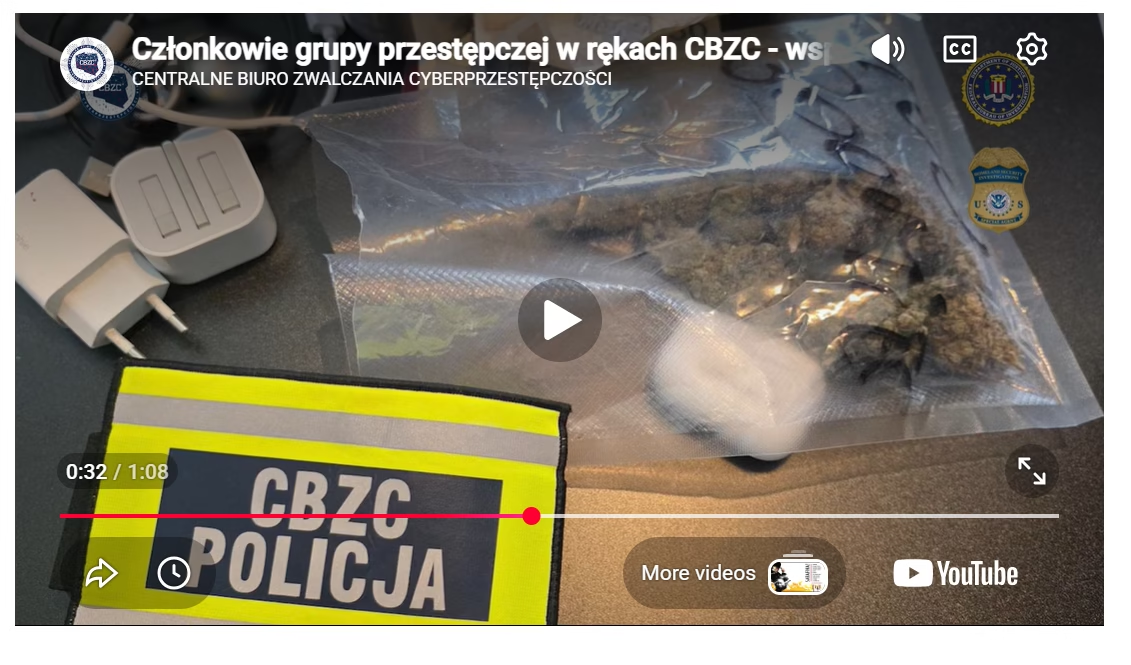
The defendants face allegations of participating in an organized criminal group, unlawfully accessing information technology systems to facilitate theft, and laundering criminal proceeds. If convicted on the charges outlined by investigators, they could face prison sentences of up to 25 years under Polish law.
Although CBZC did not publicly identify the individuals arrested, blockchain investigator ZachXBT later stated that one of the suspects shown in photographs released after the police operation appeared to be Wojtek Kulisz, also known online as “Merry.” Polish authorities have not officially confirmed that identification.
The dismantling of the SIM-swapping gang represents another significant enforcement action against cybercriminal networks targeting digital assets. As cryptocurrency adoption continues to grow globally, investigators increasingly face sophisticated organizations capable of exploiting telecommunications infrastructure, identity verification systems, and online financial platforms.
Security experts have long warned that SIM-swapping remains one of the most effective methods for bypassing SMS-based two-factor authentication. The latest arrests serve as a reminder of the risks associated with relying solely on mobile phone numbers for account security.
For cryptocurrency users, the case also reinforces the importance of adopting stronger authentication methods where available, while regulators and law enforcement agencies continue working across borders to disrupt cybercrime networks.
The investigation remains ongoing, and authorities have not indicated whether additional arrests or charges are expected as inquiries into the alleged SIM-swapping gang continue.
Meanwhile, Poland-founded cryptocurrency platform Kanga has secured a major regulatory milestone after obtaining a Kanga Exchange MiCA license in Latvia, paving the way for the company to offer crypto services throughout the European Union.
Primary Source; CBZC Announcement



Copyright © 2025 - The Bit Gazette.

