- Trending
- Comments
- Latest

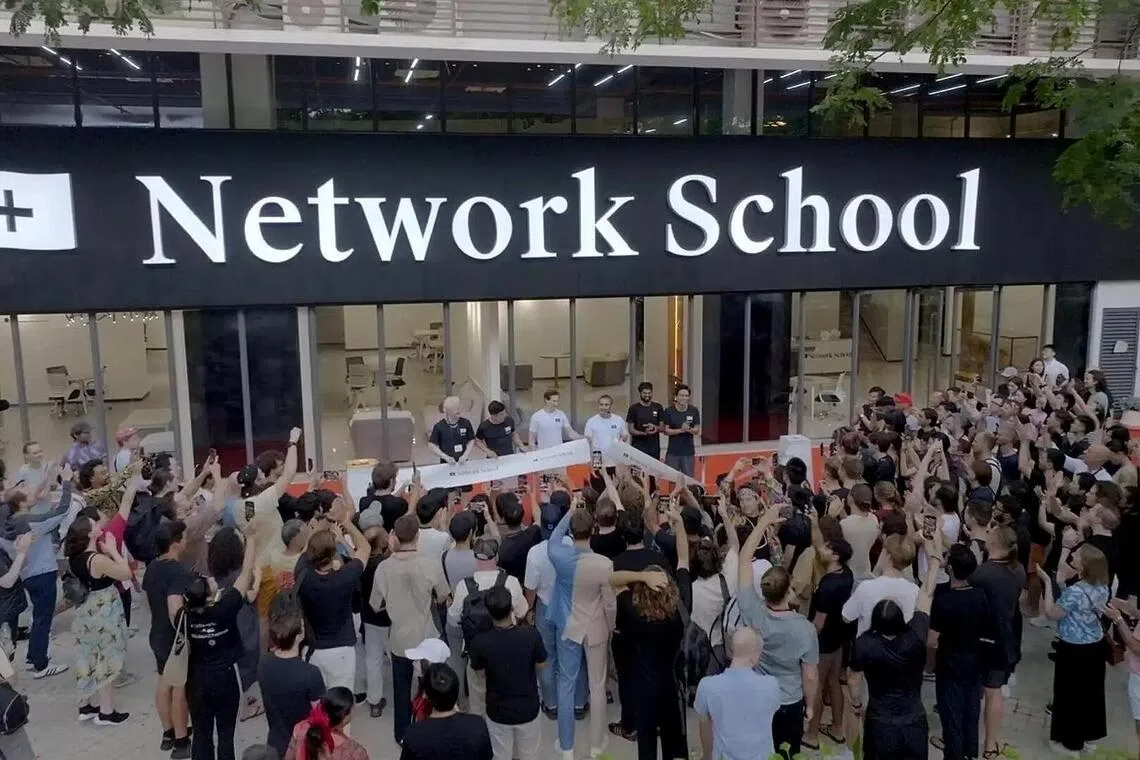
Balaji Srinivasan, the former Coinbase chief technology officer, has frozen further investment in his Network School community in Malaysia after authorities opened an immigration investigation into allegations that Israeli nationals bypassed the country’s entry restrictions to join the program.
Srinivasan says roughly $35 million has already gone into the project’s Forest City campus, but he is now demanding a formal legal agreement with Malaysia’s government before committing more capital.
The controversy began after Malaysian authorities launched an investigation into allegations circulating on social media that Israeli nationals were participating in Network School while bypassing the country’s immigration restrictions.
Malaysia, which does not maintain diplomatic relations with Israel, treats Israeli entry into the country under strict regulations.
Following the allegations, Prime Minister Anwar Ibrahim instructed relevant agencies to investigate whether any immigration or national security laws had been violated.
Subsequent inspections by Malaysia’s Immigration Department found that all 266 foreign residents examined possessed valid travel documents.
Officials stated that compliance checks would continue, but no immediate immigration violations were identified during the initial inspection.
Despite the findings, Srinivasan argued that the investigation itself has damaged confidence among international technology entrepreneurs considering Malaysia as a destination for innovation.
“Should the global tech community continue investing in Malaysia?” — Balaji Srinivasan, Founder, Network School, in a statement posted on X.
Rather than immediately withdrawing from Malaysia, Srinivasan is pushing for a Memorandum of Understanding (MoU) with the Malaysian government that would establish clearer legal protections for Network School and similar international technology initiatives.
According to Srinivasan, Network School has already invested approximately US$35 million in Forest City and had planned substantially larger investments, scholarships, and startup initiatives before placing those plans on hold.
“At this point, all further investment we were planning to make in Malaysia is on hold until we get sufficient assurance that such issues won’t recur.” Balaji Srinivasan, Founder, Network School.
Srinivasan also requested a meeting with Prime Minister Anwar Ibrahim’s office, arguing that a formal agreement would demonstrate Malaysia’s commitment to attracting global technology capital while providing investors with greater regulatory certainty.
Although Network School is not a cryptocurrency exchange or blockchain protocol, the story carries significant implications for the digital asset industry.
Srinivasan remains one of the cryptocurrency sector’s most influential figures, having served as Coinbase’s Chief Technology Officer before becoming a leading advocate for decentralized governance and the concept of “network states” digitally native communities that may eventually evolve into legally recognized jurisdictions.
Many blockchain founders view jurisdictions such as Malaysia, Singapore, Dubai, and parts of Central Asia as potential homes for Web3 innovation due to relatively supportive technology policies.
Malaysia has spent recent years promoting itself as a regional technology hub through startup incentives, digital economy initiatives, and visa programs aimed at attracting foreign entrepreneurs.
The Network School dispute now raises broader questions about how governments balance national sovereignty, immigration enforcement, and the desire to attract high-value technology investment.
For crypto investors, the episode illustrates a recurring challenge facing decentralized projects: regulatory clarity often matters just as much as access to capital.
As blockchain companies increasingly establish physical campuses, research hubs, and startup accelerators around the world, political and legal certainty has become an important factor in determining where innovation occurs.
At the time of writing, Network School has not announced plans to leave Malaysia immediately.
Instead, the project’s future appears to depend on negotiations between Srinivasan and Malaysian officials regarding a potential legal framework that would provide long-term certainty for its operations.
Meanwhile, Malaysian authorities have reiterated that any violations of immigration or national laws will continue to be investigated while emphasizing that the country’s legal framework applies equally to all foreign residents.
For the broader crypto industry, the outcome could become an important case study in how governments engage with emerging digital communities whose ambitions increasingly extend beyond software development into education, investment, and new models of global collaboration.



Copyright © 2025 - The Bit Gazette.