





- Trending
- Comments
- Latest

Animoca Brands co-founder Yat Siu has declared 2026 the year crypto transitions from speculative asset class to invisible automated infrastructure, arguing in a recent interview that AI agents transacting autonomously on-chain will make blockchain useful to billions of users who never need to understand it.
In his view, 2026 will mark the moment crypto finally sheds its speculative skin and becomes invisible, automated infrastructure powering everyday economic activity.
Speaking in a recent interview with Korea Times, Siu described the coming shift as a “singularity moment” where AI agents quietly transact on-chain while humans focus on outcomes, not interfaces. The agentic economy, he argues, will redefine how value moves, how digital property is managed, and how finance operates at machine speed.
“The speculative era is clearly slowing,” Siu said in the interview. “What’s replacing it is an automated on-chain economy where software agents do the work for us.” That transition, he added, is essential if blockchain technology is ever to scale beyond niche users.
For much of the past decade, crypto markets have been dominated by boom-and-bust cycles. But Siu believes that attention on price action has obscured deeper progress. Builders, he said, have been laying the groundwork for the agentic economy, integrating AI into blockchain systems to remove friction that once made crypto unusable for the mainstream.
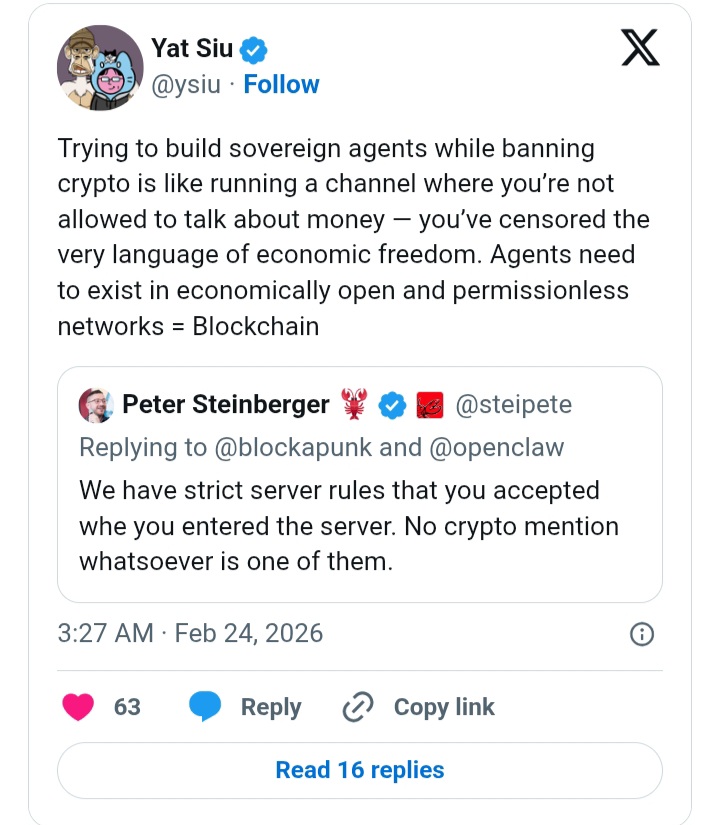
Gas fees, private key management, wallet approvals, and cross-chain bridges are all barriers humans struggle with. AI agents do not. In the agentic economy, these complexities disappear behind autonomous software layers that negotiate, transact, and settle value without constant human input.
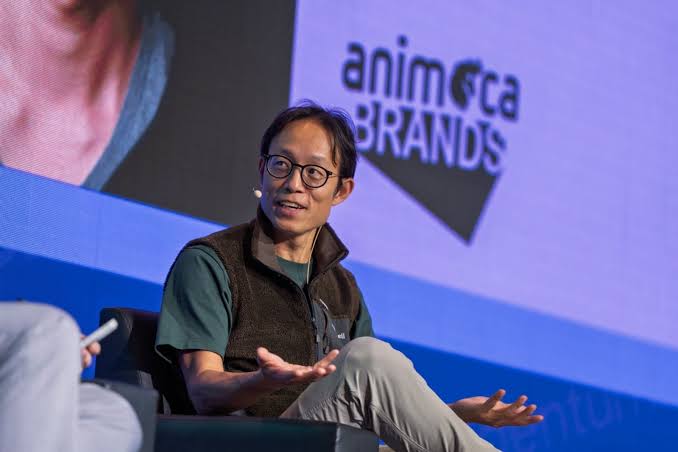
Siu’s thesis is blunt: legacy banking rails are fundamentally incompatible with machine-driven commerce. “AI agents need a borderless, permissionless medium of exchange,” he has argued. “Blockchain is the only system fast and open enough for that.”
At the heart of the agentic economy is the idea that software entities will increasingly act on behalf of users, companies, and even other machines. These agents need to hold assets, pay for services, and enforce rules autonomously. Traditional financial systems, with account approvals, business hours, and jurisdictional limits, cannot support that vision.
Blockchain, Siu says, provides the native settlement layer for machine-to-machine transactions. Smart contracts give AI agents enforceable logic, while tokens provide programmable money. This combination turns blockchains into economic operating systems rather than speculative casinos.
Animoca Brands has long championed the mantra “tokenize or die,” warning that companies failing to adopt digital property standards risk the same fate as retailers that ignored the internet. The agentic economy extends that warning beyond businesses to entire financial systems.
One of the strongest arguments for the agentic economy is usability. For years, crypto adoption has stalled on user experience. Expecting everyday users to manage seed phrases, sign transactions, and interpret gas fees has proven unrealistic.
Siu envisions AI agents as universal intermediaries. Instead of clicking through wallets and protocols, users simply express intent. An agent interprets that request and executes the necessary on-chain actions. In this model, humans never touch the plumbing.
“People shouldn’t have to understand blockchains to benefit from them,” Siu said. “That’s the role of agents.”
However, autonomy introduces risk. Earlier this year, an AI-powered crypto agent made a costly six-figure trading error—an incident that highlighted both the power and danger of machine decision-making. The market’s reaction was telling: rather than panic, many participants treated it as proof that autonomous agents are already economically relevant.

Despite these risks, Siu maintains that automation is unavoidable. If billions of users are to hold and manage digital property, the agentic economy must handle ownership, permissions, and transactions at scale.
Animoca Brands is positioning itself aggressively for this shift. The company has backed more than 600 Web3 projects spanning gaming, infrastructure, and digital property. Its flagship metaverse project, The Sandbox, is often cited as an early example of programmable digital ownership.
Within the agentic economy, these assets are not static collectibles. They become active components of financial systems, leased, traded, and monetized by AI agents in real time. Siu sees this as the logical endpoint of Web3: assets that work continuously, not passively.
Siu’s focus on 2026 is not arbitrary. He points to a convergence of technical maturity and regulatory momentum. On the technical side, blockchains are becoming faster and more secure. Developers on Ethereum are advancing upgrades designed to improve throughput and consensus resilience—critical requirements for millions of AI agents transacting simultaneously.
On the regulatory front, Siu has highlighted the importance of clearer rules. In the United States, proposals such as the CLARITY Act could provide the legal certainty institutional capital demands. In Asia, Japan’s crypto reform agenda and Hong Kong’s renewed Web3 push signal growing acceptance of tokenized finance.
“The agentic economy can’t thrive in a regulatory vacuum,” Siu has said previously. “Institutions need clarity, and agents need finality.”
Animoca’s reported interest in a future public listing in Hong Kong or the Middle East further reflects confidence that global markets will be ready for this shift within the next two years.
An economy humans won’t see—but will use
Perhaps the most radical aspect of the agentic economy is its invisibility. Siu predicts that most people will use AI-driven blockchain systems without realizing it. Payments will clear, assets will move, and contracts will execute in the background.
The open question is timing. The technology exists today. What remains uncertain is whether regulation, liquidity, and infrastructure can align quickly enough. If they do, 2026 may indeed be remembered as the year crypto stopped being speculative and started being useful.
In Siu’s view, the debate is no longer about whether AI agents belong on-chain. It is about whether the world is ready to let the agentic economy quietly take over the machinery of finance.



