







- Trending
- Comments
- Latest

The American Bankers Association has formally urged the Office of the Comptroller of the Currency to suspend further crypto trust charter approvals, warning that the OCC is granting licences faster than the GENIUS Act’s stablecoin rules can catch up, a direct challenge to the agency’s December conditional approval of five digital asset firms including Ripple, Fidelity, and BitGo.
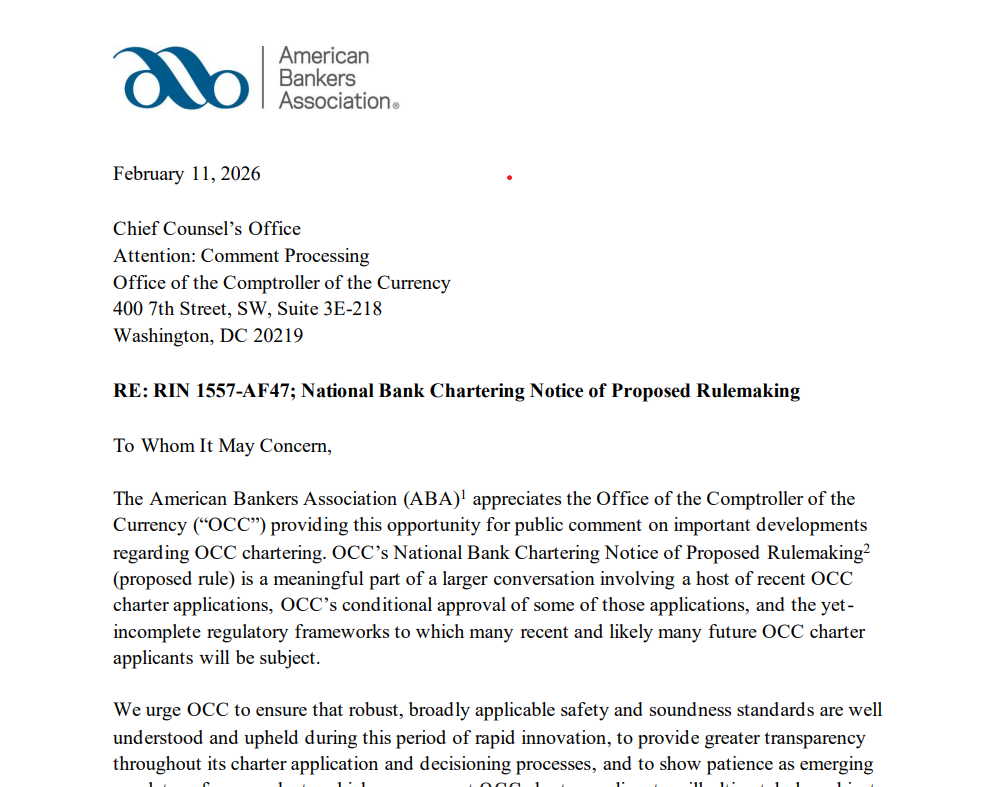
In a formal comment letter submitted Wednesday, the American Bankers Association (ABA) urged the Office of the Comptroller of the Currency (OCC) to delay further approvals of national trust bank charters for crypto and stablecoin companies until the rulemaking process under the Guiding and Establishing National Innovation for US Stablecoins (GENIUS) Act is fully defined.
The intervention underscores a growing fault line between traditional banks and digital asset firms over how — and how fast — crypto trust charters should be granted at the federal level.
Responding to the OCC’s proposed updates to national bank chartering rules, the ABA argued that applicants engaged in digital asset custody, stablecoin issuance, and blockchain-based settlement face overlapping and unresolved supervision from multiple regulators, including federal banking agencies, state authorities, the Securities and Exchange Commission (SEC), and the Commodity Futures Trading Commission (CFTC).
“Advancing charter applications where the full scope of regulatory obligations is not yet known creates unnecessary risk,” the ABA wrote, cautioning that crypto trust charters approved ahead of finalized GENIUS Act rules could lock regulators into frameworks that later prove inconsistent or incomplete.

The GENIUS Act, which aims to establish a unified federal regime for stablecoins, has yet to complete its implementing regulations — leaving open questions around capital treatment, reserve requirements, governance standards, and supervisory authority.
A central theme of the bankers’ critique is that uninsured, digital asset-focused trust banks present unresolved safety and soundness risks.
According to the ABA, crypto trust charters raise complex operational issues related to the segregation of customer assets, cybersecurity controls, conflicts of interest, and the ability to wind down an institution without disrupting markets or harming customers.
“These institutions often operate critical infrastructure for the digital asset ecosystem,” the group warned, adding that failures could have outsized systemic effects despite the absence of traditional deposit-taking.
The letter emphasized that the OCC should resist applying standard charter review timelines and instead adopt a more deliberate approach that ensures each applicant’s supervisory obligations “come fully into view.”
Beyond prudential risk, the ABA cautioned that crypto trust charters could be used as a vehicle for regulatory arbitrage.
Specifically, the association argued that firms might structure activities under a national trust charter to avoid registration or oversight by the SEC or CFTC — even when those activities resemble securities issuance, brokerage, or derivatives trading.
“If an activity would otherwise trigger securities or commodities regulation, a charter should not be used to bypass those regimes,” the ABA said, urging the OCC to coordinate closely with market regulators before granting approvals.
This concern reflects a broader policy debate over whether digital asset custody and settlement should be treated as banking services or as capital markets functions subject to investor protection rules.
The banking lobby also pressed the OCC to provide clearer public guidance on how it calibrates capital, liquidity, operational resilience, and risk management requirements for crypto trust charters, particularly when approvals are issued on a conditional basis.
Without transparency, the ABA warned, market participants and consumers may be left uncertain about the safety of obligations held at federally chartered but uninsured entities.
The group further called on the OCC to tighten naming conventions, arguing that limited-purpose trust banks that do not engage in deposit-taking or lending should not be allowed to use the word “bank” in their names.
Such labeling, the ABA said, risks misleading consumers into assuming protections — such as federal deposit insurance — that do not apply to many crypto trust charters.
The pushback comes less than two months after the OCC granted conditional approval to five digital asset firms seeking national trust status: BitGo Bank & Trust, Fidelity Digital Assets, Ripple National Trust Bank, First National Digital Currency Bank, and Paxos Trust Company.
On December 12, 2025, the OCC outlined a path for these firms to operate under federal oversight while focusing on custody and asset management rather than traditional banking activities. The move marked a significant expansion of crypto trust charters within the US financial system.
Acting Comptroller Michael Hsu has previously said that federal charters can provide stronger and more consistent supervision than state-by-state licensing, a view shared by many crypto firms seeking national scale.
The ABA’s regulatory campaign extends beyond the OCC. The group is also lobbying lawmakers as Congress debates broader crypto market structure legislation, including the Digital Asset Market Clarity (CLARITY) Act.

Bankers argue that yield-bearing stablecoins and affiliate rewards programs resemble bank products and should therefore face equivalent regulation. Allowing such products under crypto trust charters, they contend, would undermine the traditional banking framework.
“The goal is not to stop innovation,” the ABA wrote, “but to ensure it occurs within a regulatory perimeter that protects consumers and the financial system.”
As regulators finalize GENIUS Act rules and Congress continues negotiations over market structure, crypto trust charters are emerging as a focal point in the battle over who controls the future of digital finance in the US.
For now, the OCC faces a delicate balancing act: fostering innovation while avoiding a chartering process that critics say could move faster than the law itself.
Whether the agency heeds the bankers’ call for patience may shape the trajectory of crypto trust charters — and the broader integration of digital assets into the US banking system — for years to come.



Copyright © 2025 - The Bit Gazette.