

- Trending
- Comments
- Latest

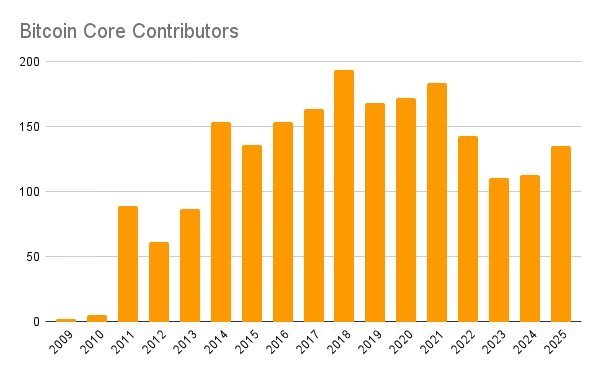
After several years of slowing contributor activity, Bitcoin Core development staged a decisive comeback in 2025, marking one of the most active periods in the protocol’s history.
Data compiled by long-time contributor Jameson Lopp shows development activity rose roughly 60% year over year, signaling renewed engagement around Bitcoin’s base layer even as price volatility remained historically muted.
In total, 135 developers contributed approximately 285,000 lines of code to Bitcoin Core in 2025. The rebound came as the network processed an estimated $4.5 trillion in value transfers across the year, averaging about $144,000 per second, according to CoinMetrics. For many observers, the figures highlight a shift toward infrastructure hardening and long-term scalability rather than speculative experimentation.
“Bitcoin is maturing,” Lopp wrote in his annual review. “Development is becoming more deliberate, but not less active.”
The resurgence in Bitcoin Core development arrived during a year that was otherwise remarkable for its lack of price drama. Bitcoin recorded its flattest trading year on record in 2025, with an average daily price change of just -0.02%, according to market data cited by Lopp.
Under the hood, however, the network continued to evolve. The blockchain expanded from 626.5 gigabytes to 710.1 gigabytes, an annual growth rate of 13.3%. At the same time, efficiency gains led to a contraction in the UTXO set, which fell from 186.3 million to 165.8 million entries—effectively removing one net UTXO every 1.5 seconds.
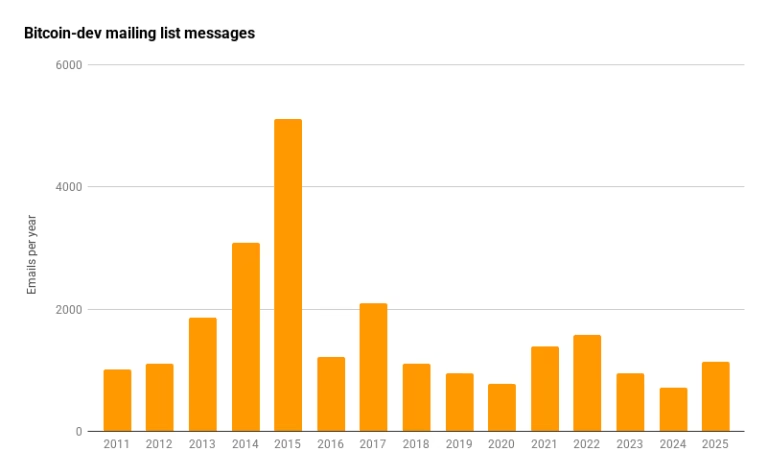
Hashrate growth remained robust, climbing 32% from roughly 802 exahash per second to more than 1,060 EH/s. Reachable node counts also increased 18% to 24,298, according to Bitnodes. Together, these metrics suggest that Bitcoin Core development is increasingly focused on resilience and efficiency rather than headline-grabbing features.
While overall code commits increased only 1% year over year to 2,541, Lopp noted that individual commits tended to be larger and more substantive. Median upstream bandwidth for reachable nodes dropped 39% to 6.6 megabits per second, reflecting optimization efforts that reduce resource requirements for participants.
Security remained a dominant theme throughout the year. Lopp warned that physical attacks on Bitcoin holders reached unprecedented levels in 2025.
“At the beginning of the year I predicted we’d see an all-time high for wrench attacks, averaging one per week,” he wrote. “Unfortunately, that prediction came true.”
The trend reinforced the importance of secure self-custody and informed ongoing Bitcoin Core development discussions around privacy, node operation, and user safety.
Beyond the protocol itself, adoption indicators strengthened. Merchant acceptance rose 53% in 2025, according to BTCmap, a surge widely attributed to Square enabling Bitcoin payments across its point-of-sale terminals.
Corporate adoption also accelerated. Public and private companies now collectively hold close to 7% of Bitcoin’s circulating supply, underscoring growing institutional confidence in the asset even as regulatory scrutiny increased globally.
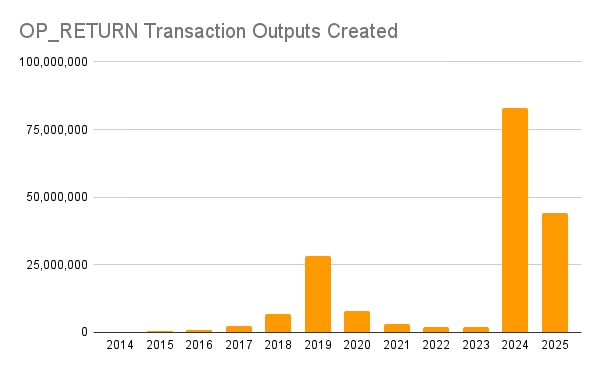
Meanwhile, data usage on the blockchain shifted. OP_RETURN outputs declined 47% year over year as interest in the Runes protocol cooled. Still, inscriptions continued to grow, with 33 million recorded in 2025—a 58% increase from the prior year—though they generated just $12 million in total fees.
These trends fueled heated debates within Bitcoin Core development circles over data storage, fees, and long-term incentives.
One of the most consequential milestones of the year came in November, when Bitcoin Core completed its first public third-party security audit after 16 years of operation. The audit, conducted by Quarkslab and commissioned by the Open Source Technology Improvement Fund with support from Brink, involved 100 person-days of review.
The auditors found no critical vulnerabilities, identifying only two low-severity issues across the peer-to-peer layer, mempool, and consensus logic. Supporters hailed the results as a validation of the protocol’s cautious development philosophy.
A month earlier, Bitcoin Core released version 30.0, a controversial update that removed the long-standing 80-byte OP_RETURN limit, raised the default data carrier size to 100,000 bytes, and allowed multiple OP_RETURN outputs per transaction.
Blockstream CEO Adam Back defended the release, saying it bundled vital security patches from “200 of the most skilled people on the planet.” Critics countered that the changes could invite spam and regulatory risk, exposing deep philosophical rifts within Bitcoin Core development.
The disagreements triggered a migration toward alternative implementations. Bitcoin Knots, a long-standing fork, grew to represent roughly 28% of reachable nodes following the v30.0 release.
Further controversy followed in December, when developer Claire Ostrom proposed “The Cat,” a change that would render certain Ordinals and NFT-related outputs unspendable. Greg Maxwell, a veteran Bitcoin developer, denounced the idea as “outright theft” of user funds, illustrating how governance disputes remain a defining feature of Bitcoin Core development.
Elsewhere, the BSV fork continued its decline, losing another 64% relative to Bitcoin in 2025 and falling to just 0.02% of Bitcoin’s value.
Despite technical debates, market sentiment improved toward year-end. Lightning Network capacity quietly climbed to a record 5,805 BTC after spending much of the year in decline, hinting at renewed interest in Layer-2 payments.
Akshat Siddhant, lead quant analyst at Mudrex, said institutional interest strengthened following geopolitical developments and renewed ETF inflows.
“If Bitcoin closes above $93,700, momentum could carry it toward $100,000, with support near $88,500,” Siddhant told reporters.
At the time of writing, Bitcoin trades around $92,861, up 1.64% over 24 hours. As price action stabilizes, the resurgence in Bitcoin Core development suggests that the protocol’s builders are preparing the network for its next phase—one defined less by speculation and more by durability, security, and long-term relevance.



Copyright © 2025 - The Bit Gazette.