


- Trending
- Comments
- Latest

For years, Bitcoin’s pitch to investors rested on a single compelling idea: it moves to its own beat. When stocks fall, Bitcoin holds. When central banks print money, Bitcoin rises. That story didn’t survive contact with the Federal Reserve’s rate hiking cycle, and the data has been making the case ever since.
In simple terms, Crypto Macroeconomic Correlation measures how closely crypto assets especially Bitcoin move in response to broader economic conditions.
For example, when central banks tighten monetary policy, risk assets often decline. In recent years, crypto has followed a similar pattern, highlighting a growing alignment with traditional markets.
According to International Monetary Fund, “correlations between crypto assets and equity markets have increased significantly since 2020,” signaling deeper integration into the global financial system.
Historically, Bitcoin was promoted as a hedge against inflation. However, during aggressive rate hikes by the Federal Reserve, crypto markets experienced sharp declines alongside tech stocks.

This suggests that liquidity not just narrative plays a dominant role. When money is cheap and abundant, crypto tends to rise. When liquidity tightens, prices often fall.
As Jerome Powell noted, “financial conditions influence risk appetite across markets,” a statement increasingly reflected in crypto behavior.
Several macro factors shape Crypto Macroeconomic Correlation:
Interest Rates: Higher rates reduce risk appetite, pressuring crypto prices.
Inflation: While once seen as a bullish catalyst, inflation now impacts crypto indirectly through policy responses.
Liquidity: Global money supply remains one of the strongest drivers of crypto cycles.
Risk Sentiment: Crypto often trades like a high-beta tech asset during uncertain periods.
These elements combine to strengthen Crypto Macroeconomic Correlation, particularly during periods of economic stress.
A clear example of Crypto Macroeconomic Correlation is Bitcoin’s relationship with tech equities.
Data from firms like CoinMetrics shows that Bitcoin has, at times, moved closely with the Nasdaq, especially during market downturns. This challenges the idea of crypto as an uncorrelated asset.
“Bitcoin is increasingly behaving like a risk asset,” analysts at CoinMetrics have observed, pointing to institutional participation as a key factor.
The rise of Crypto Macroeconomic Correlation has sparked debate.
Some argue that growing correlation undermines crypto’s original value proposition. Others see it as a natural phase of maturation as institutional capital flows into the space.
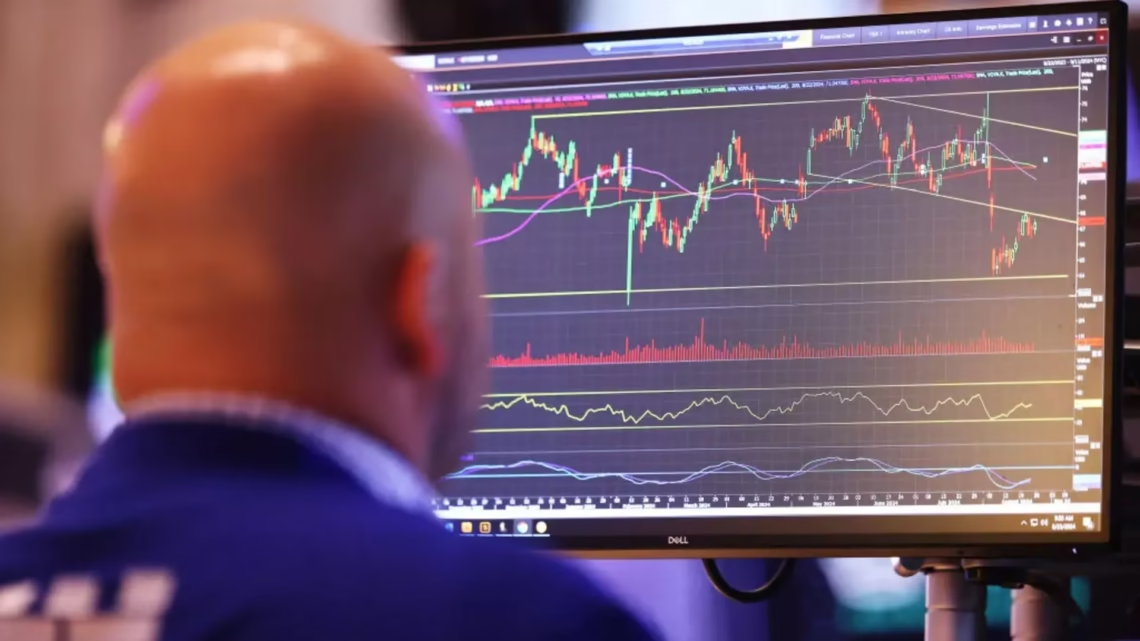
Lyn Alden has noted that liquidity cycles “drive most asset classes, including Bitcoin,” reinforcing the idea that macro forces are unavoidable.
A critical question is whether Crypto Macroeconomic Correlation is permanent.
There are scenarios where decoupling could occur—such as renewed retail-driven cycles, regulatory shifts, or breakthroughs in blockchain utility. However, as long as institutional investors dominate flows, macro alignment is likely to persist.
Crypto Macroeconomic Correlation is now a defining feature of the digital asset landscape. It reflects crypto’s transition from a niche experiment to a globally integrated financial asset class.
For investors and analysts, ignoring macro trends is no longer an option. Understanding how inflation, interest rates, and liquidity interact with crypto markets provides a clearer, more disciplined approach to navigating volatility.



Copyright © 2025 - The Bit Gazette.