





- Trending
- Comments
- Latest

The launch of Citrea’s mainnet has pushed a long-running Bitcoin debate back into the spotlight: how much activity should the world’s largest cryptocurrency actually anchor on its base layer.
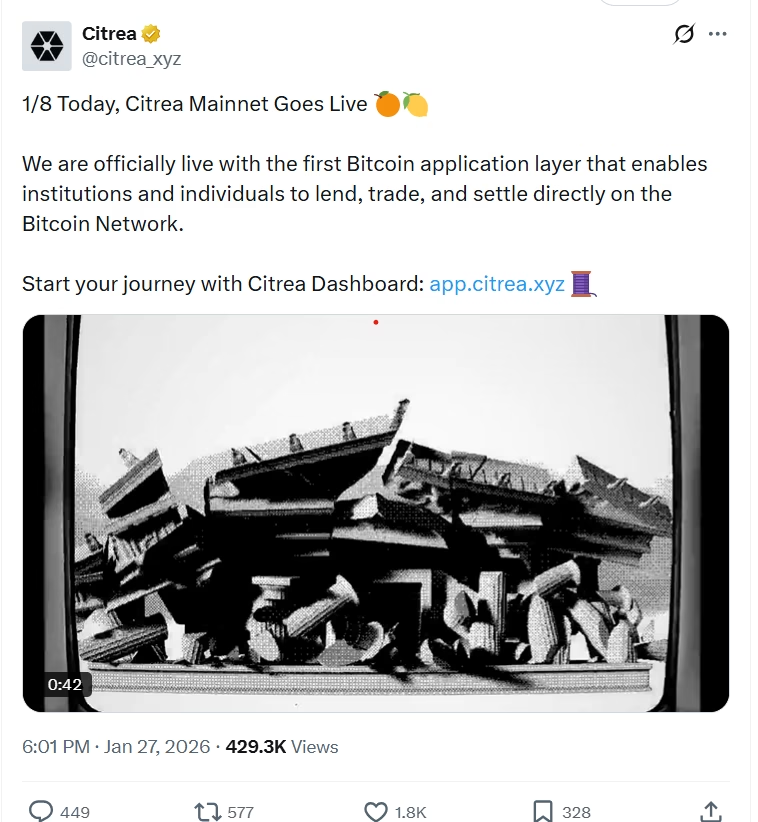
Backed by Founders Fund and Galaxy Ventures, Citrea has rolled out what it describes as a full-stack Bitcoin zero-knowledge rollup, complete with BTC-backed lending, structured products, decentralized trading, and a natively issued US dollar stablecoin.
At its core, Citrea is testing whether Bitcoin can support a broader decentralized finance ecosystem without abandoning its conservative design philosophy. For supporters, the Bitcoin zero-knowledge rollup model offers a way to unlock idle BTC capital while preserving Bitcoin’s security guarantees. For critics, it risks overloading scarce block space with financial complexity that belongs elsewhere.
Citrea’s team says the protocol is designed to turn “economically idle” Bitcoin into productive collateral for DeFi and payments. At launch, the network went live with BTC lending markets, structured yield products, and ctUSD, a new stablecoin meant to address persistent liquidity gaps across Bitcoin-adjacent ecosystems. The company expects active liquidity on the platform to exceed $50 million within the first few weeks.
That ambition alone was enough to reignite an old argument: should Bitcoin be used strictly for simple, censorship-resistant payments, or can it serve as a settlement layer for more advanced financial systems?
The timing of Citrea’s debut is significant. As Bitcoin’s block subsidy continues to decline, developers and miners are increasingly focused on transaction fees as a long-term incentive mechanism. Advocates argue that non-payment use cases, including a Bitcoin zero-knowledge rollup, can help sustain miner revenue by driving consistent demand for block space.

“Bitcoin needs fee pressure that’s not purely speculative,” said Casa chief security officer and Bitcoin Core contributor Jameson Lopp, who described Citrea’s rollout as “the next grand experiment in generating sustainable demand for block space.”
Citrea anchors cryptographic proofs to Bitcoin while executing application logic offchain using an Ethereum Virtual Machine-compatible environment. In practice, this means users are not trading or lending directly on Bitcoin itself. Instead, Bitcoin functions as a settlement and verification layer for the Bitcoin zero-knowledge rollup, storing proofs that attest to offchain activity.
That distinction has drawn sharp criticism from Bitcoin purists, who argue that such designs stretch the definition of “building on Bitcoin.” One critic summarized the concern bluntly: Bitcoin risks becoming little more than a “filing cabinet” for rollup receipts.
A central piece of Citrea’s strategy is ctUSD, a natively issued stablecoin built specifically for its Bitcoin zero-knowledge rollup. Unlike wrapped versions of USDT or USDC that circulate across Bitcoin-adjacent layers, ctUSD is issued directly on Citrea’s network.
CtUSD is issued by MoonPay, a regulated crypto payments and infrastructure provider known for its fiat on- and off-ramps. According to Citrea, the stablecoin is backed one-to-one by cash and short-term US Treasurys and integrated into MoonPay’s Iron banking infrastructure.
Orkun Mahir Kılıç, co-founder and CEO of Chainway Labs, the company behind Citrea, told Cointelegraph that ctUSD’s native design was intentional. “Bridged assets inherit the security risks of their weakest link,” Kılıç said. “By natively issuing ctUSD on the Bitcoin zero-knowledge rollup, we avoid external bridge dependencies and reduce systemic risk.”
The integration includes banking-grade rails such as virtual IBANs, allowing users to send fiat that is automatically converted into ctUSD and settled onchain. Kılıç said this setup is meant to make ctUSD a “compliance-forward” alternative to wrapped stablecoins while providing deeper, more unified liquidity.
Liquidity fragmentation has long plagued Bitcoin-based DeFi experiments. Multiple wrapped versions of the same asset often compete across layers, driving up slippage and reducing capital efficiency. Citrea’s team argues that positioning ctUSD as the primary stablecoin for its Bitcoin zero-knowledge rollup solves this problem.
“In most ecosystems, liquidity is split across several bridged representations,” Kılıç said. “Here, ctUSD is the single preferred stablecoin, which helps lenders, traders, and protocols operate more efficiently.”
Citrea plans to scale ctUSD from a launch asset into what it calls a standard liquidity layer for the Bitcoin economy over the next six to 12 months. Whether that vision succeeds may depend less on technical execution and more on whether users accept the trade-offs inherent in a rollup-based design.
Even before mainnet, Citrea’s testnet activity hinted at the potential impact of rollups on Bitcoin. According to the team, data availability usage from testnet operations at one point accounted for nearly 10% of Bitcoin’s monthly data bandwidth. That figure has become a talking point for critics who worry that widespread adoption of a Bitcoin zero-knowledge rollup could crowd out simpler transactions.

Supporters counter that market forces will ultimately decide. If users are willing to pay fees for rollup proofs, miners will include them. If not, the model fails.
Despite the excitement, Citrea is not without trust assumptions. Critics have pointed to its single sequencer model, offchain treasury management, and a limited federation structure as areas where risk is shifted rather than eliminated.
“You know the difference,” one critic remarked in response to Lopp’s comments. “You’re pretending you don’t.”
Citrea’s launch underscores a broader reality: Bitcoin’s future is no longer just about payments versus store of value. As Bitcoin zero-knowledge rollup designs mature, they are forcing the community to confront uncomfortable questions about what Bitcoin should be, and what it should never become.
Whether Citrea becomes a cornerstone of Bitcoin-based DeFi or another chapter in the block space wars, its debut has already achieved one thing: it has made the debate impossible to ignore.