




- Trending
- Comments
- Latest

BitMine, the publicly traded crypto firm chaired by Fundstrat’s Tom Lee, plans to launch its Made in America Validator Network in early 2026 to stake its $12 billion ether treasury—the largest publicly disclosed Ethereum position in the market.
The network could generate $374 million in annual staking revenue at full deployment, representing a strategic pivot from passive accumulation to active yield generation.
According to a company update released Monday, BitMine currently holds 4,110,525 Ether, valued at roughly $12 billion. The firm says the scale of that holding positions it not only as a major Ethereum stakeholder but also as a potential force in validator operations once the BitMine eth validator network is fully deployed.
The move is unfolding in the United States, with management citing improving regulatory signals and growing investor interest in compliant staking infrastructure.
For years, BitMine’s strategy centered on accumulating Ether as a long-term treasury asset. The BitMine eth validator network represents what management describes as the next phase: converting dormant holdings into recurring yield through validator rewards.
Chairman Thomas Tom Lee framed the project as a core pillar of the company’s future revenue model.
“We continue to make progress on our staking solution known as The Made in America Validator Network (MAVAN). This will be the ‘best-in-class’ solution offering secure staking infrastructure and will be deployed in early calendar 2026,” — Thomas Tom Lee, Chairman, BitMine.
The BitMine eth validator network is designed to operate at scale, allowing the company to stake a significant portion of its Ether while maintaining custody standards aimed at institutional partners.
BitMine has said the network will emphasize uptime, security and compliance, positioning MAVAN as a domestic alternative in a market historically dominated by offshore or centralized staking providers.
The financial logic of the BitMine eth validator network rests on Ethereum’s proof-of-stake mechanics. Validator rewards are paid in Ether and depend on several variables, including total network participation, validator performance, uptime and additional revenue streams such as maximal extractable value (MEV).
Lee has publicly outlined the potential upside if the BitMine eth validator network reaches full deployment.
“At scale (when BitMine’s ETH is fully staked by MAVAN and its staking partners), the ETH staking fee is $374 million annual (using 2.81% CESR), or greater than $1 million per day,” — Thomas Tom Lee, Chairman, BitMine.
Those projections assume that a large share of the firm’s Ether is staked, that validator penalties remain minimal and that yield conditions and Ether prices remain broadly supportive. While the company has attracted attention for the “$1 million per day” narrative, it has also acknowledged that the figures are sensitive to market conditions and network dynamics.
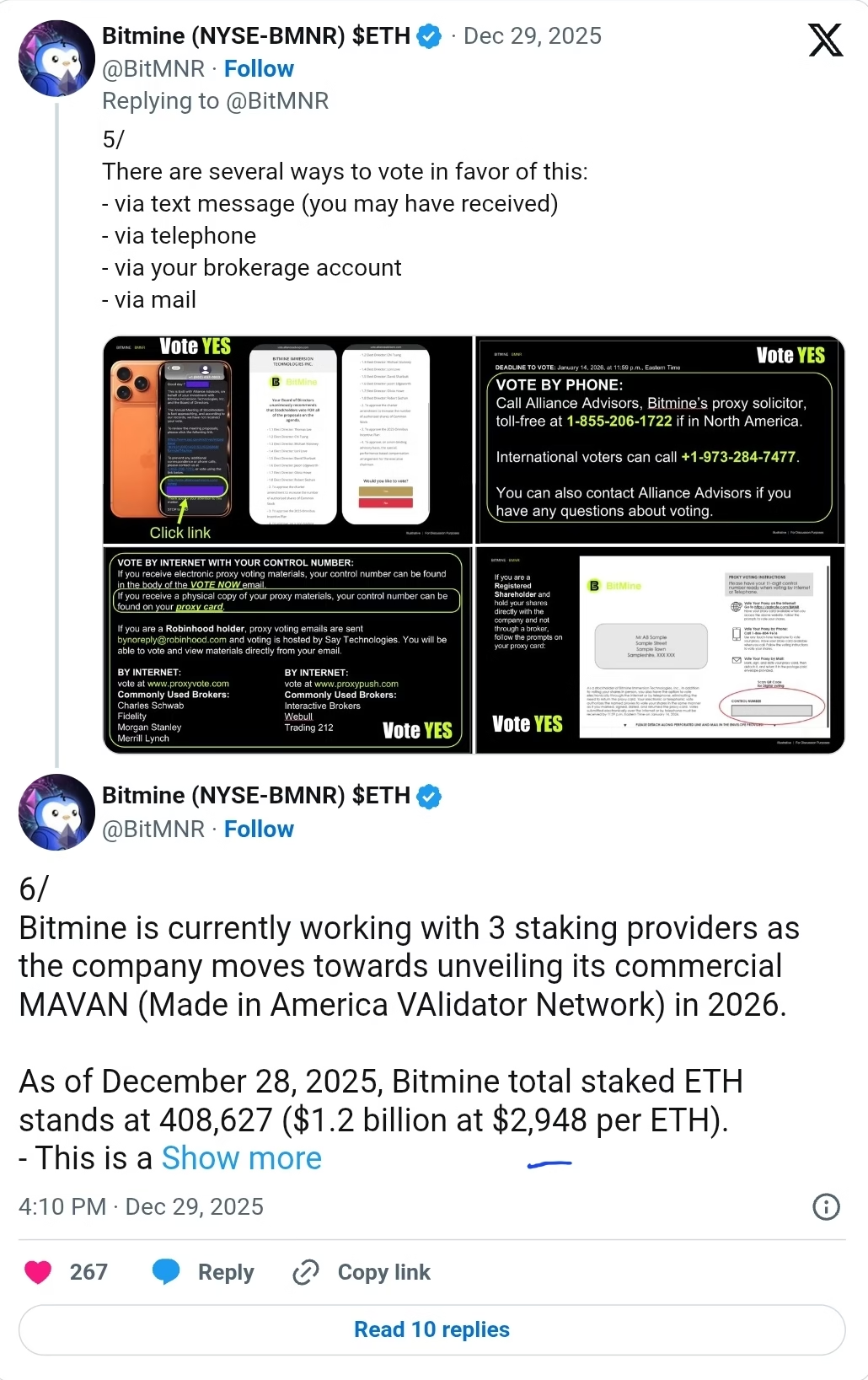
BitMine has already begun laying the groundwork for the BitMine eth validator network. The company disclosed that 408,627 Ether is currently staked with third-party providers as part of its testing and transition phase ahead of the planned early 2026 launch.
At the same time, BitMine continues to add to its Ether position. The firm said it purchased an additional 44,463 Ether in the past week, describing itself as the largest “fresh money” buyer of Ether during that period. Including crypto assets, cash and what it labels “moonshots,” BitMine put the total value of its holdings at $13.2 billion, with $1.0 billion held in cash.
The company’s equity has also become a focal point for investors tracking the BitMine eth validator network.
BitMine reported that its stock, trading under the ticker BMNR, averaged about $980 million in daily trading volume over a five-day period, ranking 47th among U.S.-listed stocks as of Dec. 26, 2025. Management has emphasized that liquidity matters as the firm’s balance sheet increasingly mirrors Ether market movements.
The launch of the BitMine eth validator network is unfolding against a changing regulatory environment in Washington.
Earlier enforcement actions, including the U.S. Securities and Exchange Commission’s 2023 case against Kraken that led to the shutdown of its U.S. staking-as-a-service program and a $30 million settlement, cast a long shadow over domestic staking operations.
More recently, however, the SEC under President Donald Trump has moved to dismiss its civil enforcement action against Coinbase, signaling a broader reassessment of crypto oversight. BitMine has positioned its Made in America approach as aligned with this evolving policy climate, emphasizing transparency and regulatory engagement.
Company disclosures list notable backers, including Cathie Wood’s ARK, Founders Fund, Pantera, Kraken, Digital Currency Group and Galaxy Digital. BitMine has tied that support to its longer-term ambition of controlling 5% of the total Ether supply, a goal it refers to internally as the “Alchemy of 5%.”
Investors will get another update soon. BitMine has scheduled its annual stockholder meeting for Jan. 15, 2026, at the Wynn Las Vegas.
According to its proxy filing, shareholders will vote on director appointments as well as proposals related to capital structure and incentive plans—decisions that could shape how aggressively the BitMine eth validator network is scaled after launch.



Copyright © 2025 - The Bit Gazette.