





- Trending
- Comments
- Latest

Bybit has partnered with layer-2 network Mantle and lending protocol Aave to bridge its 70 million users with decentralized finance services, the companies announced Tuesday.
The collaboration integrates Aave’s lending protocol directly onto Mantle’s Ethereum layer-2 network, while Bybit serves as a liquidity gateway between centralized exchange markets and on-chain lending pools. Users can now access Aave’s lending services through Bybit’s platform with lower gas fees and faster settlement times via Mantle’s infrastructure.
The partnership includes MNT token incentives for early liquidity providers and aims to reduce technical barriers that have historically limited institutional participation in DeFi. Bybit says the integration allows both retail and institutional clients to transition between centralized trading and decentralized lending without managing multiple wallets or navigating complex on-chain interfaces.
“This creates a bridge between the liquidity depth of centralized exchanges and the transparency of decentralized protocols,” TokenLogic, which coordinated the partnership, said in a statement.
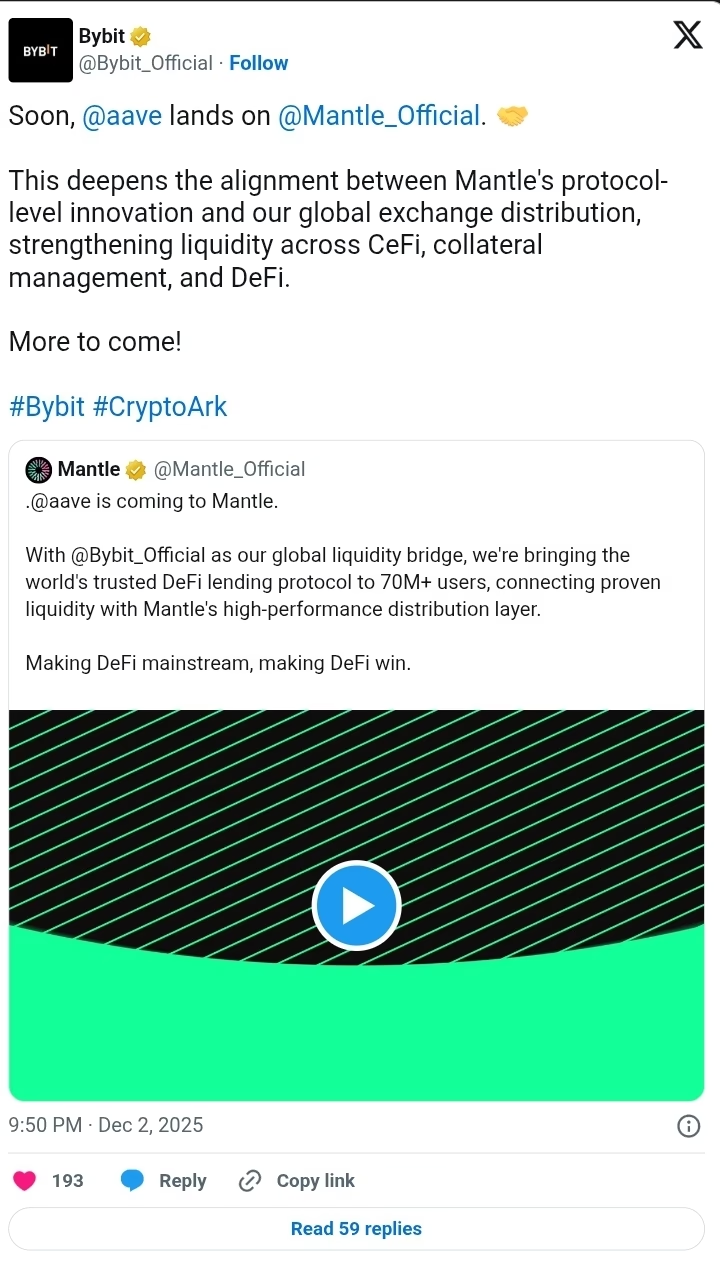
A central milestone in the partnership is the deployment of Aave on Mantle’s EVM-compatible Layer-2 chain. The launch enables users worldwide to engage with tokenized assets, supply liquidity, borrow funds and execute a range of on-chain strategies with enhanced throughput and lower costs.
Mantle’s design—engineered for real-world assets, stablecoin flows and restaking environments—creates a foundation suited for strategies requiring institutional-grade DeFi liquidity.
Through this integration, Aave can deliver lending services with the speed and cost-efficiency required for high-volume or institutional activity. Participants are now able to engage with lending pools in ways that reflect traditional market efficiency, while still benefiting from the transparency inherent to decentralized protocols.
The presence of institutional-grade DeFi liquidity on Mantle also positions the network as a viable environment for tokenized portfolios and yield-bearing instruments that demand composability and low-latency execution.
MNT-based incentives across Aave pools introduce additional participation levers, encouraging early adoption and increasing the depth of liquidity—another prerequisite for maintaining institutional-grade DeFi liquidity at scale.
Bybit’s role in the collaboration is to connect its centralized liquidity with the expanding on-chain activity emerging from the Aave–Mantle environment. With more than 70 million users worldwide, Bybit’s involvement enables real-time access to lending pools, yield programs and diversified liquidity pathways that previously required technical onboarding barriers typical in DeFi.
By serving as the bridge between centralized exchange markets and decentralized protocols, Bybit contributes the market depth necessary to reinforce institutional-grade DeFi liquidity.
The exchange’s infrastructure allows users—both retail and institutional—to transition between on-chain lending and traditional trading environments with reduced friction. This alignment supports the broader goal of merging execution speed, market transparency and asset composability into a unified framework.
The initiative’s architects describe it as a key step toward increasing global DeFi participation, as the availability of institutional-grade DeFi liquidity gives market participants confidence in the stability and scalability of integrated financial systems.
The combined effort from Bybit, Mantle and Aave is being positioned as a blueprint for next-generation on-chain finance. By merging protocol-level security, Layer-2 efficiency and exchange-level liquidity, the partnership provides a structure capable of sustaining institutional-grade DeFi liquidity across various market conditions.
Industry observers note that the collaboration may accelerate the adoption of tokenized assets and integrated DeFi strategies, particularly in environments where liquidity depth and settlement reliability are essential. The presence of institutional-grade DeFi liquidity creates an operational environment closer to traditional financial systems, while still preserving the openness of decentralized architecture.
Alongside the integration, Bybit also revealed a strategic partnership with Taxbit to streamline global tax reporting and compliance across its international and EU platforms. The announcement underscores Bybit’s broader push to strengthen the infrastructure necessary for regulated digital finance—a requirement closely linked to sustaining global demand for institutional-grade DeFi liquidity.



Copyright © 2025 - The Bit Gazette.