

- Trending
- Comments
- Latest

“I kind of hate ads just as an aesthetic choice.”
That was OpenAI CEO Sam Altman in 2024. Speaking on the Lex Fridman podcast, he didn’t just dismiss them as annoying; he framed them as a breach of trust. He preferred a simple business model where, in his words, “I know that I’m not the product.”
Yesterday, that era officially died.
With the announcement that ads are coming to ChatGPT’s free and “Go” tiers, OpenAI has admitted a hard truth: Intelligence is expensive, and you are no longer the customer, you are the product.
OpenAI promises the ads will be “bottom-banner only” and “clearly labeled.” They insist advertisers won’t influence the actual answers.
Don’t believe it.
The moment you introduce an advertising incentive into an AI model, you break the fundamental contract of trust. An AI is supposed to be a neutral arbiter of truth, an Oracle. But an Oracle that needs to sell you running shoes to pay its server bills is no longer neutral; it is conflicted.
Consider the “Pizza Problem”:
If you ask ChatGPT, “What is the best pizza in Chicago?”
Technically, the answer is still “pure.” But for how long? When Domino’s becomes a $100 million partner, does the AI start subtly prioritizing “fast delivery” over “deep dish quality” in its ranking algorithms? We saw this happen with Google Search. We are naive if we think it won’t happen with LLMs.
The most dystopian aspect of this announcement isn’t the ads themselves, it’s who has to see them.
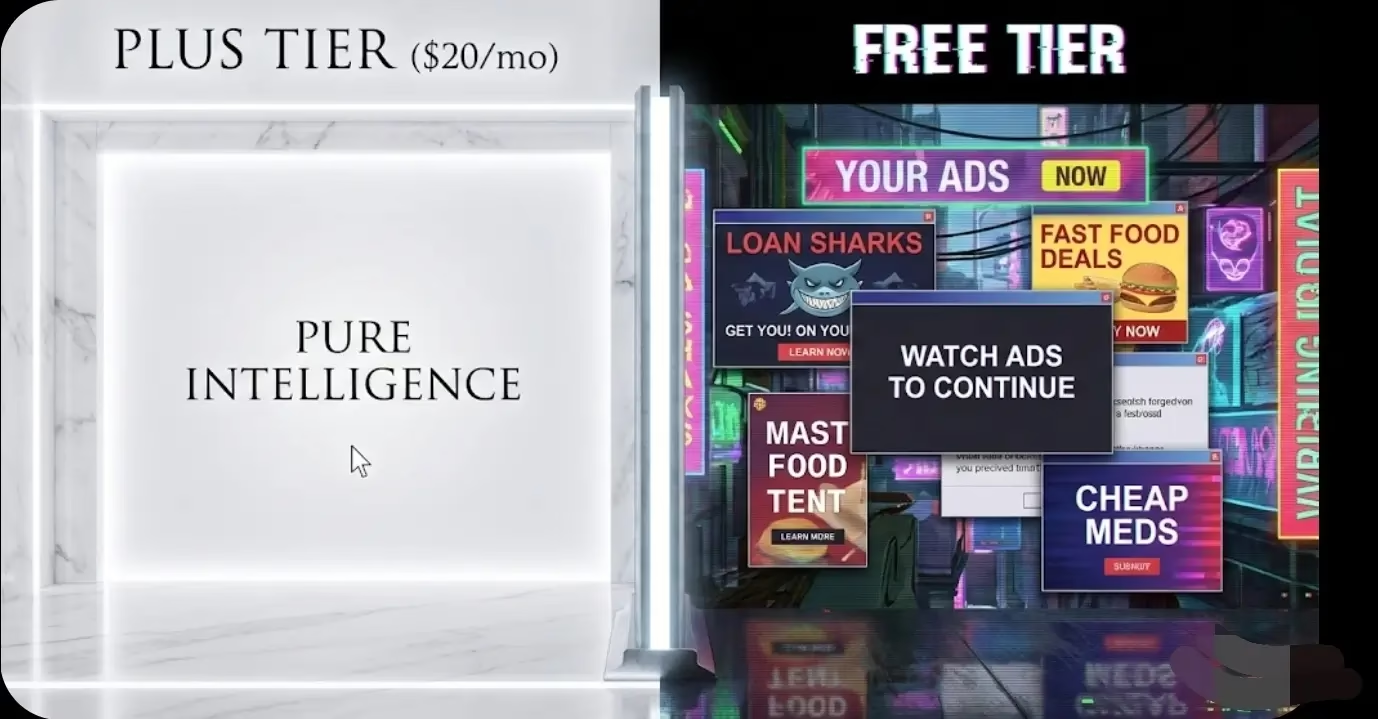
By keeping the Plus, Pro, and Team tiers ad-free, OpenAI is creating a Class-Based Internet:
We are entering an era where “focus” is a luxury good. If you can’t afford the subscription, your cognitive interface, the very tool you use to think, write, and code comes with a tax on your attention.
OpenAI claims your “conversations” won’t be shared with advertisers. But they will use context to target ads.
Think about that for a second.
If you are using ChatGPT to help you navigate a divorce, or diagnose a weird rash, or draft a debt consolidation email, the AI knows. Even if it doesn’t sell the chat log to a lawyer or a bank, it acts as the broker. It uses your most vulnerable, private moments to decide which banner to flash at the bottom of the screen.
That is a level of intimacy Google never had. Google knew what you searched for; ChatGPT knows how you think.
OpenAI supporters will argue that ads enable free access, that without ad revenue, ChatGPT would become a luxury product only the wealthy could afford. Some will point to the billions required to train and run frontier AI models and insist there’s simply no alternative.
But that argument is a false choice dressed up as pragmatism.
Wikipedia proves that quality, neutral information can be sustained through donations, grants, and community support.
Mozilla has funded Firefox development for decades without turning your browser into a shopping mall. Signal maintains encrypted messaging for millions without selling user attention to the highest bidder.
OpenAI didn’t choose the advertising model because it was necessary. They chose it because it was the most profitable path, and because venture capital investors demanded a clearer route to returns. Let’s not pretend this decision was made for the users’ benefit. It was made despite them.
The “free tier” defense also ignores a more fundamental question: If serving ads to free users was always the plan, why did Sam Altman spend years positioning OpenAI as morally superior to ad-driven platforms? The hypocrisy isn’t just in adopting ads, it’s in the years spent pretending they never would.
We all knew this day was coming. Running GPT-5 scale models costs billions. The “Compute Bill” eventually comes due.
But let’s call this what it is: The Google-ification of OpenAI.
For three years, ChatGPT felt like magic because it felt clean. It was just a blinking cursor and the sum of human knowledge. Now, it’s just another website trying to sell you a mattress.
The Oracle hasn’t just sold out. It has become a salesman.



Copyright © 2025 - The Bit Gazette.