


- Trending
- Comments
- Latest

Cryptocurrency tokens are increasingly difficult to classify as projects adopt features traditionally associated with corporate equity—including profit-sharing mechanisms and shareholder-like governance rights—while simultaneously issuing separate tokens designed purely to subsidize user acquisition.
The converging trends have complicated how investors value crypto assets and how regulators should classify them, according to Delphi Digital’s 2026 outlook released this week.
Projects like Uniswap now route trading fees to token holders similar to dividend payments, while others like Worldcoin have distributed hundreds of millions of tokens as marketing incentives, creating what Delphi calls a “token identity crisis” that challenges traditional valuation frameworks.
Delphi’s 2026 outlook highlights how token structures are converging with traditional equity models. Companies such as California-based Securitize are pursuing initial public offerings while simultaneously developing tokenized securities infrastructure, operating in both public markets and blockchain-based finance.

Several crypto-native projects have already adopted equity-like mechanics. MetaDAO has issued ownership tokens that resemble corporate shares, while decentralized exchange Uniswap introduced fee switches that route protocol revenue to token holders—functionally similar to profit participation.
Delphi analysts noted that these design choices are deliberate, reflecting growing demand for yield and ownership clarity. However, they also blur distinctions between equity and tokens, accelerating the Crypto token identity crisis by making it harder for investors to determine what rights a token actually represents.
Beyond equity-style designs, Delphi identified the rise of Customer Acquisition Cost (CAC) tokens as another complicating factor. These tokens are not designed to confer ownership or governance rights. Instead, they are issued to subsidize growth by rewarding early users, with incentives declining as adoption increases.
PayPal provides a point of comparison. The payments company reportedly spent more than $60 million in venture capital funding on incentives while expanding into digital assets. Delphi argues CAC tokens could achieve similar onboarding results through emissions, shifting user acquisition costs directly onto token supply.
Worldcoin is cited as a leading example. The project distributed more than 500 million WLD tokens to onboard users to its World App. According to Dune Analytics, Worldcoin’s market capitalization reached roughly $3.8 billion during the mid-2025 rally, despite the token trading below $2.50 throughout most of last year.
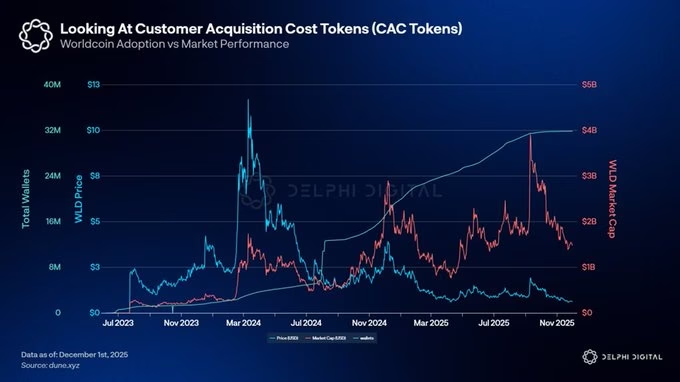
The model challenges traditional valuation assumptions and adds another layer to the Crypto token identity crisis, particularly for investors attempting to distinguish between assets and marketing mechanisms.
Regulatory developments in the U.S. and Europe have brought greater clarity to crypto markets, but they have not resolved the classification debate. In the United States, the president signed an executive order supporting responsible crypto innovation and the use of dollar-backed stablecoins, while explicitly rejecting the creation of a central bank digital currency.
The Securities and Exchange Commission followed with limited regulatory relief, issuing no-action letters related to the Depository Trust Company’s tokenization pilot and the Fuse Crypto Token. These moves signaled tolerance for experimentation but stopped short of redefining how tokens should be treated.
Congress has also shown growing support for crypto-friendly candidates ahead of the 2026 midterm elections, alongside ongoing debate around the CLARITY Act, which would place primary oversight of crypto markets under the Commodity Futures Trading Commission.
In Europe, the Markets in Crypto-Assets (MiCA) framework has provided a clearer compliance pathway, making the region more attractive to institutional participants, even as cross-border inconsistencies persist.
Despite ongoing uncertainty, industry observers argue the crypto sector is structurally stronger than in previous cycles. Bitcoin continues to trade just under $90,000, and derivatives positioning suggests traders are preparing for potential upside.

“It’s more of an industry now,” Kaiko senior researcher Adam Morgan McCarthy told NPR. “So if there is a winter or a downturn, it’s not going to be a complete lights-out moment.”
According to Coinglass data, roughly $2.2 billion in Bitcoin and Ethereum options are nearing expiration, with Bitcoin accounting for $1.87 billion in notional value. Open interest shows 14,194 call contracts versus 6,806 puts, indicating traders are leaning toward a move above $90,000.
At the time of reporting, Bitcoin was trading near $88,970, slightly above the $88,000 “max pain” level. Regardless of short-term price movement, analysts say the Crypto token identity crisis will remain a defining issue in 2026.
As tokens continue to take on attributes of equity, governance rights, and growth incentives, investors face a market that no longer fits clean definitions. Until clearer standards emerge, the Crypto token identity crisis is set to shape capital allocation and product design across the digital asset industry.



Copyright © 2025 - The Bit Gazette.