

- Trending
- Comments
- Latest

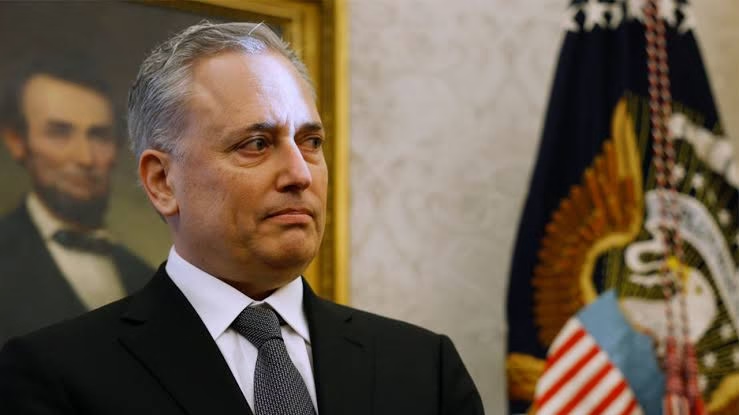
The White House has appointed David Sacks as co-chair of the President’s Council of Advisors on Science and Technology (PCAST), positioning him to continue shaping U.S. crypto and AI policy beyond his 130-day tenure as special government employee.
The appointment, announced this week, comes after federal rules limiting special advisers to 130 days of service within a 12-month period ended his formal czar role.
Now serving on the President’s Council of Advisors on Science and Technology, the David Sacks PCAST co-chair role places him at the center of high-level discussions shaping the future of artificial intelligence, crypto regulation, and national tech strategy.
Despite the title change, the David Sacks PCAST co-chair position ensures continuity in his influence over both crypto and AI. According to administration insiders, his new role will closely mirror his previous responsibilities, with broader reach across emerging technologies.
A senior White House adviser told Fox Business that “David will always be his crypto and AI czar,” reinforcing the idea that the David Sacks PCAST co-chair role is more of an evolution than a departure.
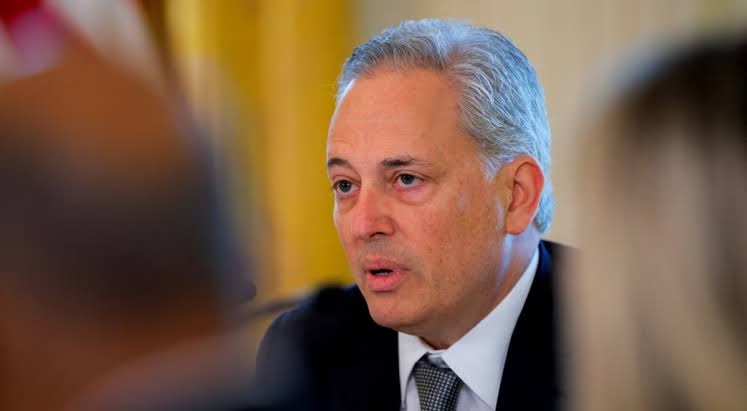
Sacks himself confirmed that the council will collaborate on major policy issues before issuing recommendations to regulators, meaning the David Sacks PCAST co-chair position remains deeply intertwined with federal decision-making processes.
The David Sacks PCAST co-chair appointment comes after his active involvement in shaping U.S. crypto policy. During his time as czar, Sacks played a key role in the President’s Working Group on Digital Asset Markets, which released a comprehensive report in July 2025 outlining regulatory pathways for the industry.
That groundwork is expected to carry forward under the David Sacks PCAST co-chair leadership, particularly as policymakers grapple with how to balance innovation with oversight in digital assets.
Industry analysts say the David Sacks PCAST co-chair role could influence how the U.S. positions itself in the global crypto race, especially as other regions move faster in establishing clear regulatory frameworks.
Beyond crypto, the David Sacks PCAST co-chair position also reinforces his influence over artificial intelligence policy. Sacks has been a vocal advocate for a unified national approach to AI regulation, warning against fragmented, state-level rules.
The administration’s AI policy framework released on March 20, 2026, reflects many of these priorities, emphasizing coordination at the federal level. The David Sacks PCAST co-chair role will likely play a central part in advancing this agenda.
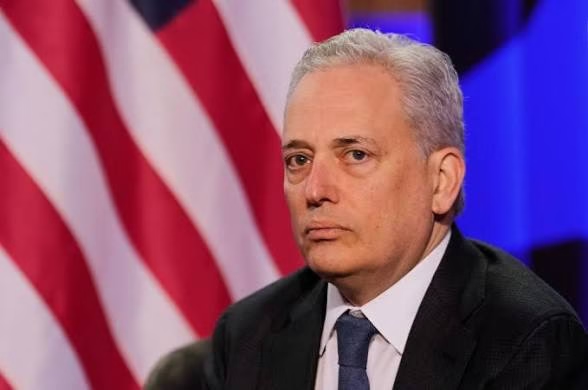
Sacks has previously argued that a “patchwork of regulation” could slow innovation and create unnecessary complexity for companies operating across multiple states. Under the David Sacks PCAST co-chair structure, efforts to establish a single national framework are expected to intensify.
The influence of the David Sacks PCAST co-chair role is amplified by the caliber of figures on the advisory council. The White House confirmed that the group includes industry heavyweights such as Jensen Huang, Mark Zuckerberg, Larry Ellison, and Lisa Su.
This lineup signals that the David Sacks PCAST co-chair position will operate within a broader ecosystem of technology leadership, spanning AI, semiconductors, cloud computing, and digital platforms.
The council’s composition suggests that discussions will extend beyond crypto into areas such as computing infrastructure, AI safety, and global technological competitiveness.
What makes the David Sacks PCAST co-chair role particularly significant is its advisory nature. While it does not carry direct regulatory authority, it shapes the recommendations that influence federal agencies and legislative priorities.
In practice, this means the David Sacks PCAST co-chair position could have a lasting impact on how the U.S. approaches both crypto and AI governance in the years ahead.
Observers note that advisory councils often serve as incubators for policy ideas, many of which later become formal regulations or executive actions.
For the crypto sector, the David Sacks PCAST co-chair transition offers a degree of stability. His continued involvement signals that digital assets remain a priority within the broader U.S. technology agenda.
At the same time, the expanded scope of the David Sacks PCAST co-chair role indicates that crypto will increasingly be considered alongside other critical technologies, rather than in isolation.
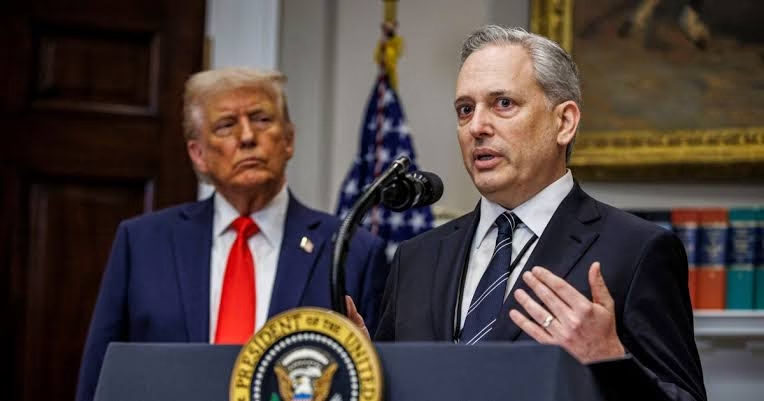
This integrated approach could lead to more cohesive policymaking, but it also raises the stakes for how crypto fits into national security, economic strategy, and innovation policy.
Ultimately, the move into the David Sacks PCAST co-chair role reflects a strategic repositioning rather than an exit from influence. By stepping into a broader advisory , Sacks gains a wider platform to shape the intersection of crypto, AI, and national technology priorities.
As the U.S. navigates an increasingly competitive global tech landscape, the David Sacks PCAST co-chair role is likely to remain a key lever in defining how policy evolves—and how innovation is guided at the highest levels of government.



Copyright © 2025 - The Bit Gazette.