






- Trending
- Comments
- Latest

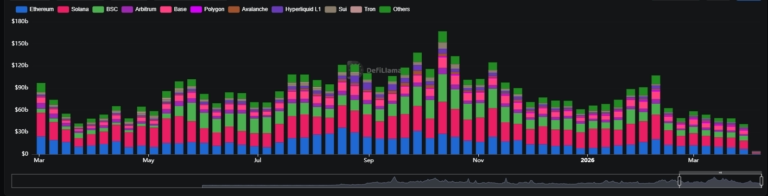
Decentralized exchange trading volume has fallen to its lowest level in a year, signaling a sharp retreat from the retail-driven speculation that dominated 2025. Data shows weekly Dex volumes have dropped to $41 billion, erasing much of 2025’s gains, as Q1 2026 sentiment cooled and traders abandoned high-risk token trades.
“Dex trading activity is often a direct reflection of retail participation and risk appetite,” said Ryan Watkins. “When markets slow down, speculative trading is usually the first thing to fade.”
A major driver behind the drop in Dex trading activity has been a noticeable outflow of trading volumes from Ethereum, historically the dominant chain for decentralized finance. As liquidity thinned and token volatility decreased, traders moved capital away from decentralized exchanges, contributing to the broader decline in Dex trading activity.
While newer initiatives like HIP-3 and the introduction of commodity-based markets provided some support, they have not been enough to offset the contraction in traditional token trading. As a result, Dex trading activity remains under pressure despite pockets of innovation.

At the same time, the altcoin market has undergone a structural shift. The absence of so-called “star tokens”—assets capable of capturing widespread attention—has reduced speculative flows that typically drive Dex trading activity during bullish cycles.
The decline in Dex trading activity is not isolated to a single network. Instead, it has affected all major blockchains, underscoring a broader market-wide slowdown. Weekly Dex trading activity recently hovered around $41 billion, closely matching levels last seen in early 2025 and effectively erasing much of last year’s growth.
Despite the downturn, Solana continues to dominate Dex trading activity with a weekly volume share of $11.42 billion. Its sustained leadership is largely driven by platforms like PumpSwap and the ongoing token generation engine of Pump.fun, which continues to attract speculative traders.
“Even in a quieter market, Solana’s ecosystem is still generating enough activity to lead Dex trading activity globally,” noted Anatoly Yakovenko in earlier commentary on network engagement trends.
However, Dex trading activity as a percentage of total crypto trading has declined. Decentralized platforms now account for roughly 14.1% of overall volume, down from over 21% during the peak trading months of mid-2025. This drop highlights a partial shift back toward centralized exchanges or reduced trading altogether.
Even as Dex trading activity slows, leading platforms continue to consolidate user traffic. PancakeSwap remains the most active decentralized exchange, capturing nearly 10% of all Dex trading activity.
Multi-chain platforms have proven particularly resilient, as users increasingly seek flexibility across ecosystems. Meanwhile, token valuations tied to decentralized exchanges have held relatively steady, with the sector maintaining a combined market cap of around $18 billion.
Key tokens such as UNI, JUP, and CAKE continue to anchor the market, though only a handful have managed to sustain valuations above the $1 billion mark. The cooling of yield farming incentives and liquidity mining programs has also contributed to reduced participation, further dampening Dex trading activity.
Interestingly, some Dex trading activity remains underreported due to the rise of alternative trading environments. Platforms like the HumidiFi dark pool on Solana account for a growing share of volume that does not always appear in standard metrics.
HumidiFi alone represents approximately 7.8% of market share, suggesting that Dex trading activity may be more fragmented than headline figures indicate. This shift toward less visible trading venues reflects evolving user preferences, particularly among larger traders seeking privacy and reduced market impact.
Another notable trend tied to declining Dex trading activity is the drop in sandwich attacks, especially on Solana. With fewer high-volume meme token trades, bots have less incentive to exploit transactions. Data shows that most remaining sandwich attacks now target trades under $1, highlighting how even micro-transactions were previously subject to automated strategies.
The slowdown in Dex trading activity is more than just a temporary dip—it reflects a deeper transformation in how users interact with crypto markets. With fewer speculative opportunities and a maturing ecosystem, traders appear to be prioritizing stability and utility over hype-driven gains.

“Dex trading activity is evolving,” said Hayden Adams. “We’re seeing a transition from pure speculation to more sustainable on-chain use cases.”
While the current downturn may concern short-term traders, some analysts view it as a necessary reset. Lower Dex trading activity could pave the way for healthier market dynamics, driven by real demand rather than speculative excess.
For now, Dex trading activity remains subdued, but its role as a key indicator of crypto-native engagement ensures it will stay closely watched as markets attempt to regain momentum later in 2026.



Copyright © 2025 - The Bit Gazette.