




- Trending
- Comments
- Latest

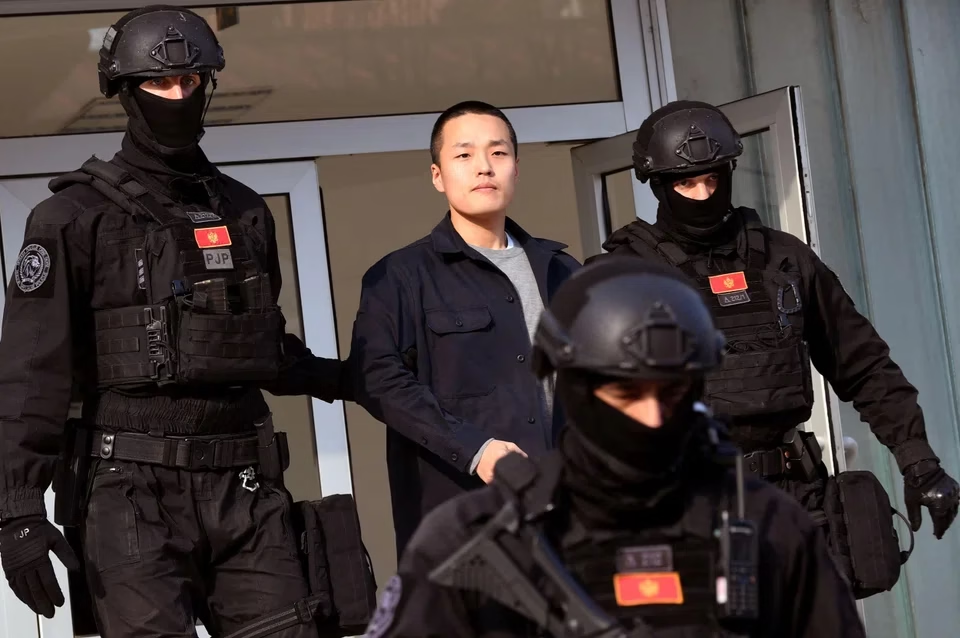
Terraform Labs co-founder Do Kwon will be sentenced Thursday in Manhattan federal court for his role in the $40 billion collapse of the TerraUSD stablecoin, with prosecutors seeking at least 12 years in prison for fraud that triggered cascading failures across the cryptocurrency industry.
Kwon, 34, pleaded guilty in August to defrauding investors by misrepresenting the stability of TerraUSD, an algorithmic stablecoin that was marketed as capable of maintaining its $1 peg during extreme market volatility but collapsed in May 2022, wiping out an estimated $40 billion in investor funds.
Kwon became one of several high-profile crypto moguls facing U.S. charges in the aftermath of the 2022 market downturn, a period defined by steep token price declines and corporate failures. According to the indictment, prosecutors filed nine criminal counts in January, including securities fraud, wire fraud, commodities fraud, and money-laundering conspiracy.
Central to the government’s case—and now central to the Do Kwon sentence deliberations—is the allegation that Kwon misrepresented the stability of TerraUSD. The so-called algorithmic stablecoin was designed to hold a value of $1 through automated trading mechanisms.
Prosecutors said that when TerraUSD slipped below the peg in May 2021, Kwon falsely told investors that an algorithm known as the “Terra Protocol” had restored its value. In reality, charging documents claim, Kwon secretly coordinated with a high-frequency trading firm to artificially support the token’s price.
The entrepreneur acknowledged these misrepresentations in court when he entered his guilty plea in August.
“I made false and misleading statements about why it regained its peg by failing to disclose a trading firm’s role in restoring that peg,” he said. “What I did was wrong.”
This admission is expected to weigh heavily on the Do Kwon sentence, particularly given the scale of investor losses and the broader market instability that followed Terra’s collapse.
While prosecutors have emphasized the systemic ripple effects of Terra’s failure, Kwon’s legal team has argued for a more limited term. They have asked the judge to consider a sentence of no more than five years.
According to court filings, they say this would allow Kwon to return to South Korea to face additional charges there. The plea arrangement allows Kwon to apply for transfer abroad after serving half of his U.S. sentence, and prosecutors have agreed not to oppose such a request.
Still, the Do Kwon sentence will reflect more than just the specifics of his plea. The ruling will help define how aggressively U.S. courts respond to deception in the crypto markets, especially when algorithmic systems fail in ways that can mislead even seasoned investors.
Beyond criminal sentencing, Kwon also agreed in 2024 to pay an $80 million civil fine and to accept a ban on all crypto-related activities as part of a $4.55 billion settlement with the U.S. Securities and Exchange Commission.
This civil outcome adds another layer of accountability, reinforcing the broader consequences tied to the Do Kwon sentence.
With regulators worldwide reassessing stablecoin risks and the reliability of algorithm-driven financial instruments, the Do Kwon sentence is emerging as a defining moment in the intersection of digital innovation and legal responsibility.



Copyright © 2025 - The Bit Gazette.